
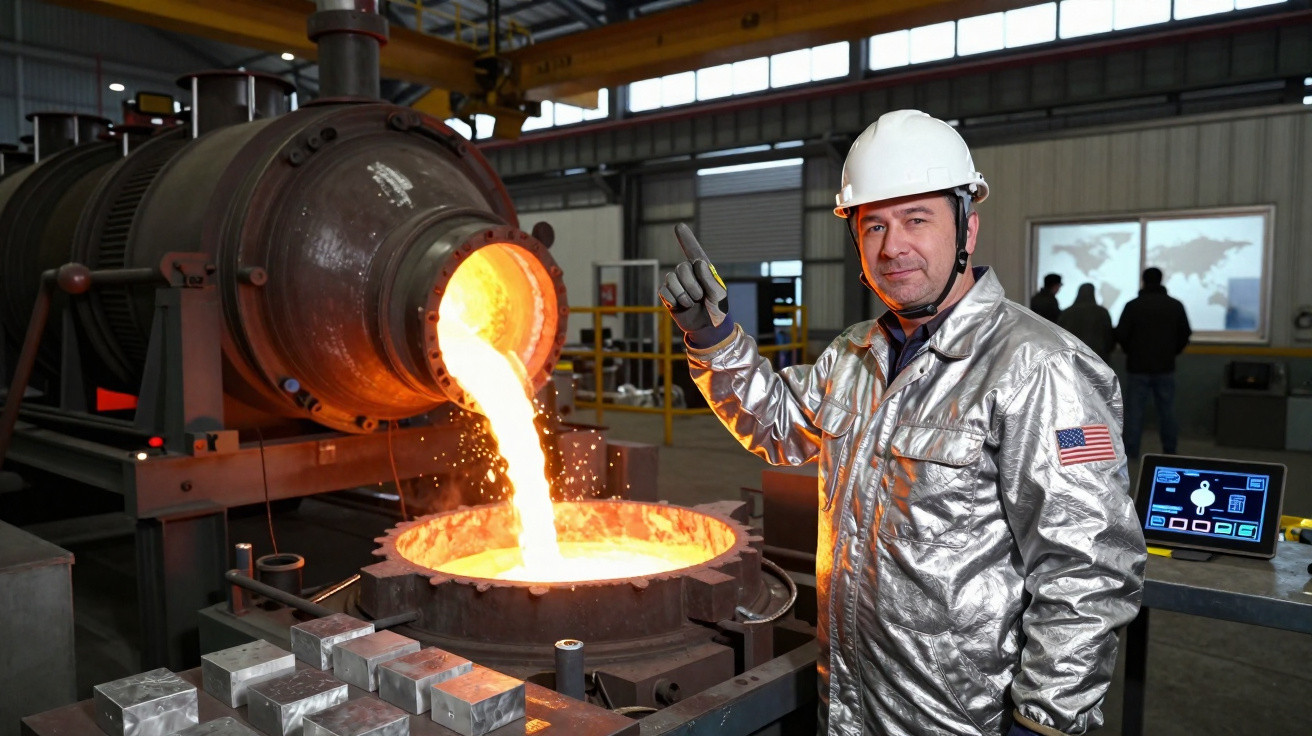
As geopolitical competition for resources intensifies, Washington is discreetly supporting the return of an industrial force that had been dormant for decades.
The United States is giving an aluminium smelter a fresh purpose in the contest for strategic metals, aiming to reduce China’s hold over materials essential to defence, electric vehicles and clean-energy technology.
America’s industrial revival meets the metals squeeze
Behind the prominent stories of electric cars and renewable electricity lies a less visible question: who controls the metals required to deliver this transition? For decades, the US shifted heavy industry overseas as China invested heavily in refineries, smelters and processing facilities.
As a result, Washington depends on overseas sources for numerous critical materials, including rare earths and particular aluminium alloys required for aircraft and advanced electronics. This reliance is now widely regarded as a strategic vulnerability.
The relaunch of a US aluminium smelter into strategic-metal production marks the first shift of this kind in more than four decades.
The development involves far more than reopening a plant. It represents a broader effort to redirect supply chains through North America rather than leave them dependent on routes across the Pacific.
A landmark shift for a US aluminium smelter
For more than 40 years, American aluminium plants have largely produced conventional materials for drinks cans, buildings and vehicle body panels. Higher-value processing for defence-related metals gradually moved abroad. One smelter is now being adapted to make strategic alloys and potentially process critical by-products that were previously shipped overseas for refining.
This differs from earlier reshoring efforts for several reasons:
- New federal grants, subsidies and tax credits for critical minerals and green industry
- Rapidly rising demand from electric vehicle, battery and aerospace producers
- Increasing concern about China’s concentrated refining capacity
- Pressure from military planners for reliable domestic supply chains
Managers and engineers at the plant must transform a conventional, power-intensive operation into a more adaptable centre able to manage complex feedstocks, tighter environmental requirements and more demanding customers.
Why aluminium is important in the strategic metals race
Aluminium is not scarce, yet it is fundamental to modern manufacturing. It is used in aircraft fuselages, missiles, satellites, electric-vehicle frames and high-voltage cables. Combined with small quantities of metals including scandium or rare earth elements, aluminium alloys can be made lighter, stronger and more resistant to heat.
The strategic importance becomes greater with these high-performance alloys. They can enable military aircraft to carry additional equipment, make rockets lighter and give EVs a few more miles of range without enlarging the battery. Dependable and consistent access to these materials is particularly important to the US military and aerospace industries.
Control over advanced aluminium alloys is as much about military readiness as it is about economic competitiveness.
The China factor: refining capacity and geopolitical influence
China is dominant not merely in mining several important metals, but more importantly in refining and processing them. This intermediate stage converts raw ore into usable materials, and it is where both value and geopolitical influence are concentrated.
For aluminium, China has developed vast smelting capacity supported by low-cost coal-generated electricity and state backing. It has also funded facilities capable of separating, purifying and blending lower-volume strategic elements. By comparison, Western nations have generally closed down such energy-hungry and pollution-intensive plants.
| Stage | Typical Chinese share of global capacity | US position |
|---|---|---|
| Raw bauxite mining | Significant, but not dominant | Limited domestic production |
| Aluminium smelting | Leading share worldwide | Shrinking capacity, plant closures |
| Processing of strategic alloying metals | High concentration | Strong import dependence |
For Washington, this degree of concentration creates clear risks. Trade conflict, sanctions or a Taiwan Strait crisis could interrupt supplies of specialised metals. Even limited export controls can sharply increase prices and hold up major projects.
Subsidies, legislation and industry pressure
Reviving the strategic purpose of an aluminium smelter is not an isolated decision. It follows legislation including the Inflation Reduction Act and the Infrastructure Investment and Jobs Act, both of which direct billions towards domestic production and critical materials.
Through these schemes, businesses may receive tax credits for low-carbon output, grants to upgrade older facilities and assistance for pilot projects involving battery materials, rare earth magnets and advanced alloys. Defence contracts provide a further incentive by securing long-term demand for certified and traceable products.
Policy shifts have turned what used to be a marginal, risky bet into a plausible business case for US metal producers.
Meanwhile, car manufacturers, aerospace groups and clean-technology companies are increasing demands on suppliers. They are seeking domestic content, shorter supply routes and smaller carbon footprints. This demand encourages aluminium producers to develop additional capabilities and cleaner technologies.
Technical and environmental obstacles ahead
Bringing a smelter back into operation, or modernising one, after decades of limited investment is challenging. Machinery needs replacing or substantial refurbishment, while skilled employees require training in new methods, digital systems and more rigorous safety requirements.
Environmental conditions matter just as much. Smelters require enormous quantities of electricity and may release greenhouse gases and hazardous particulates. For the upgraded facility to remain viable, it must secure clean, or at least cleaner, energy as well as enhanced filtration and waste-management systems.
- Moving away from coal-dependent grids towards hydropower, nuclear energy or renewables can reduce emissions substantially.
- Recovering and reusing waste heat reduces total energy requirements.
- Recycling aluminium scrap cuts the demand for newly mined bauxite and can be considerably less carbon-intensive.
Meeting these demands increases expense and operational complexity, but it could also make the site a flagship for a lower-carbon metals industry focused on strategic needs.
What “strategic metals” really means
“Strategic metals” is a widely used, and sometimes imprecise, term, so it is worth clarifying. In US policy debates, it generally describes materials that fulfil three criteria: they are essential to high-tech or defence uses, difficult to replace, and supplied through chains exposed to disruption.
Frequently mentioned examples are lithium, cobalt, nickel, rare earths, titanium, and certain specialised types of aluminium and magnesium. Not every one of these is geologically rare. The constraint often lies in refining, processing and the expertise needed to manage the materials safely and reliably.
Strategic status comes less from rarity in the ground than from fragility in the supply chain.
For businesses, this requires contracts, procurement choices and investment plans to account for geopolitical exposure alongside cost. A metal that is marginally more expensive from a dependable supplier could prove cheaper than relying on one distant refinery vulnerable to sanctions or shipping disruption.
Potential scenarios over the next decade
Should the US trial involving this modernised aluminium smelter prove successful, several options could follow. Additional facilities might be converted to process strategic alloys, in some cases alongside Canadian or Mexican sites. Regional industrial clusters could emerge near ports, hydroelectric dams or established manufacturing centres.
Under a more ambitious outcome, recycling and urban mining could expand, with end-of-life vehicles, aircraft and electronics supplying an increasing proportion of metal feedstock. This would reduce pressure for new mining and lessen reliance on foreign suppliers. The redesigned smelter might become a hub combining recycled material, imported ore and domestic concentrates.
A less favourable outcome would bring high costs, local opposition and regulatory hold-ups. US purchasers could then remain reliant on foreign refineries, while only a small number of high-profile projects obtained enough backing to continue. Strategic weakness would persist, though supported by a somewhat larger domestic capacity buffer.
Risks, compromises and what companies need to monitor
Businesses ranging from automotive manufacturers to defence contractors will closely follow this transition. A successful expansion could alter contractual arrangements, placing greater weight on local-sourcing obligations and long-term pricing structures that support major capital investment in the US.
Risks exist for every party. Producers must contend with fluctuating energy costs, policy uncertainty following election cycles, and community concerns about pollution and water consumption. Purchasers need to determine how much “security premium” they will pay for metals that are nearer, cleaner and less vulnerable to geopolitical disruption.
One practical method is diversification rather than straightforward replacement. Rather than ending Chinese supply relationships immediately, companies can create a blended portfolio: long-term agreements with US or allied producers, continued imports from current partners, and an expanding proportion of recycled material.
That layered approach reflects the evolution of the aluminium smelter itself: not a restoration of the previous heavy-industry model, but an effort to combine established assets with modern technology, new policy and stronger geopolitical awareness.





Comments
No comments yet. Be the first to comment!
Leave a Comment