
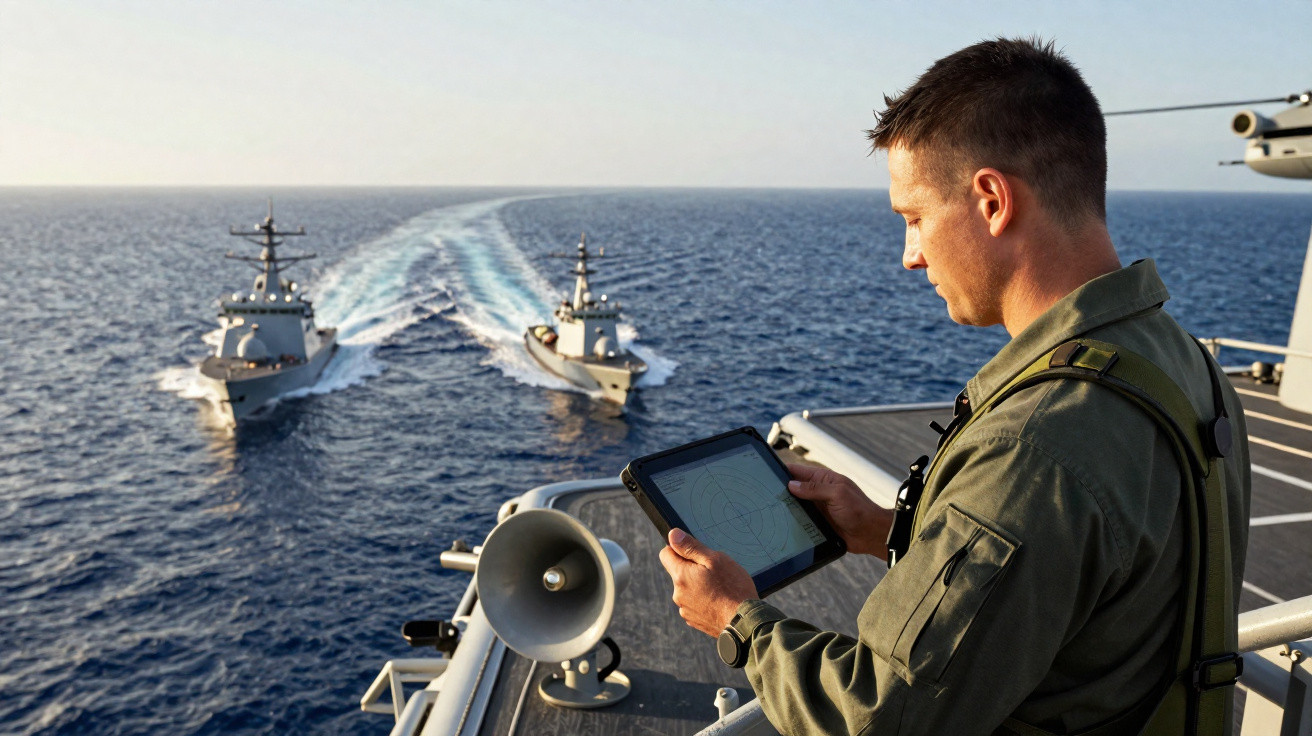
In 2026, the US Navy is set to take an unprecedented step: it will bring fully autonomous, crewless surface vessels into its frontline fleet, including within a carrier strike group. The move represents a decisive departure from more than a century of crewed warships.
A quiet revolution under the carrier’s shadow
For years, the US Sea Hunter and its sister vessel, Seahawk, have been well known in military-technology circles. So far, however, they have been regarded as experimental platforms, operated by research bodies and observed by interested admirals. That period is now coming to an end.
Both ships are due to transfer from the test community to the operational order of battle in 2026. One will operate with a carrier strike group, inside the defensive zone usually reserved exclusively for crewed escorts.
For the first time, a US carrier will accept a crewless surface ship as a close escort, trusted to manoeuvre and share data without a single sailor on board.
For a navy whose prestige is still closely linked to the tonnage of grey steel and the number of personnel aboard, this is as much a psychological jolt as a technological advance. Commanders are doing more than introducing another sensor or missile: they are redefining what they consider a “warship”.
From DARPA experiment to frontline asset
Sea Hunter: the pioneering vessel
Sea Hunter originated in the laboratories of DARPA, the Pentagon’s advanced research agency, and first entered the water in 2016. Its initial role was tightly defined yet challenging: to find and follow submarines for weeks at a time without a human crew.
Measuring roughly 40 metres long, Sea Hunter is far smaller than a frigate, but it has accumulated years of open-ocean trials. Engineers used the vessel to assess how an autonomous hull performs in rough seas, complies with collision-avoidance regulations and makes routine decisions without officers on a bridge.
This practical experience, rather than polished promotional material, ultimately persuaded the US Navy to place trust in the technology near its most valuable assets.
Seahawk: designed for combat roles
Seahawk represents the more developed second phase. Created using lessons learned from Sea Hunter, its architecture was designed from the outset for demanding naval missions.
- Long-duration surveillance in contested waters
- Mine warfare support, including detection and potentially neutralisation
- Forward reconnaissance ahead of crewed escorts
- Data relay linking dispersed forces
Rather than serving as an isolated technological novelty, Seahawk is intended to connect directly to fleet operations, providing live information feeds to crewed ships and shore-based maritime operations centres.
Autonomy is no longer treated as a wild bet for the future, but as a proven capability that can be ordered “off the shelf” for combat use.
From trials to US Navy squadrons
A different fleet structure
The transition involves more than two hulls. US Navy planners are now discussing whole divisions of unmanned surface vessels (USVs) permanently allocated to numbered fleets.
Current targets are as follows:
- 11 autonomous surface ships in service by 2027
- More than 30 units by 2030
- A fleet where around 45% of surface platforms could be crewless by 2045
These vessels are not expected to replace destroyers or frigates directly. Instead, they will extend the reach of each crewed ship while making it more difficult for an adversary to disable the fleet through one concentrated attack.
New command arrangements are also being considered. Officers will probably lead mixed squadrons of crewed and uncrewed ships, while shore-based specialists oversee autonomy software, legal compliance and cyber security.
Why a crewless ship alters the rules
Conventional warships are designed around their people. Cabins, galleys, fresh water, air conditioning, medical facilities and lifeboats all require space, weight and funding.
Eliminate the crew and the design can focus on endurance, sensors and payload. A ship can become smaller and less expensive, remain at sea for longer with fewer resupply requirements, and operate in areas where commanders might otherwise be unwilling to endanger hundreds of sailors.
Autonomous surface vessels turn presence into a numbers game: more hulls on the water, more eyes and ears, fewer lives at stake when things go wrong.
During a crisis, a carrier group could send USVs ahead as expendable scouts, examining hostile waters, charting minefields or provoking enemy radar and missile systems. The loss of one would create a budgetary issue rather than a national tragedy.
The industrial force behind autonomy
US defence contractor Leidos is central to this transition. As the prime contractor for Sea Hunter and Seahawk, it has spent years refining the main autonomy package by combining navigation sensors, collision-avoidance logic and secure communications.
The process is neither glamorous nor varied: sail, test, break equipment, repair it and sail again. Yet this repeated cycle is precisely what armed forces require before allowing software to control multi-million-dollar hardware in crowded waters.
How other navies are reacting
The United States is not the only country developing such vessels, but it is advancing fastest in incorporating crewless surface ships into its routine fleet structure.
| Country / navy | Status of surface drones | Planned units | Operational integration | Main focus |
|---|---|---|---|---|
| United States (US Navy) | Operational (Sea Hunter, Seahawk) | 11 by 2027, 30+ by 2030, up to 45% unmanned by 2045 | Carrier and surface strike groups | Surveillance, anti-submarine warfare, force multiplication |
| France (Marine nationale) | Advanced trials (DANAE project, 2026) | Seven prototypes under test | Limited, focus still on aerial drones | Port protection, convoy escort |
| United Kingdom (Royal Navy) | Targeted trials (Mine Hunting Capability) | Dedicated mine countermeasures units | Partial integration | Mine warfare and coastal surveillance |
| China | Prototype deployments | Extended coastal surveillance assets | Limited but operational | Pacific EEZ patrols and escort of manned ships |
| Russia / Turkey | Coastal prototypes | Specialised units | Experimental | Electronic warfare and hybrid operations |
French and British initiatives are strongly focused on mine warfare and port protection, where operating distances are shorter and the legal challenges of busy shipping routes are easier to address. China has adopted a more assertive approach, operating drones alongside major units in the Pacific for coastal surveillance and presence missions.
What this “technological Rubicon” actually involves
Important terms explained
Two phrases repeatedly appear in discussions of this change: “carrier strike group” and “unmanned surface vessel”.
A carrier strike group is the Navy’s principal combat formation, comprising an aircraft carrier, destroyers and cruisers, at least one submarine, and support ships. Adding a crewless vessel to this close coordination requires it to maintain position, react to signals immediately and prevent collisions within congested formations.
An unmanned surface vessel (USV) is, in essence, a boat or ship that travels with nobody aboard. People still establish objectives and rules, and monitor operations from shore or another ship. However, everyday steering, changes of speed and obstacle avoidance are managed by software and sensors.
Risks, scenarios and hard questions
The risks are evident. Autonomous systems can malfunction, GPS can be jammed, and opponents may attempt to hack command links, deceive sensors or seize a damaged vessel for intelligence purposes. International law is also behind the technology: who bears responsibility when a crewless ship collides with a merchant vessel in a congested strait?
Defence planners are conducting war games based on credible situations. One frequent scenario envisages a regional crisis in the western Pacific, with USVs spreading between islands to listen for submarine activity and passing targeting data to crewed destroyers. Another centres on a drone-led mine-clearance operation in a mined chokepoint, where crewless boats absorb explosions instead of conventional minesweepers.
There are also longer-term questions about people. As the proportion of uncrewed hulls moves towards 45% by 2045, a naval officer’s role will change: less ship-handling and more systems management; less time at sea on steel decks and more time in operations centres filled with screens.
For the moment, however, the Rubicon is straightforward and tangible: when a US carrier sails in 2026 with a crewless escort maintaining position in its wake, the definition of a warship will have changed permanently.

Comments
No comments yet. Be the first to comment!
Leave a Comment