
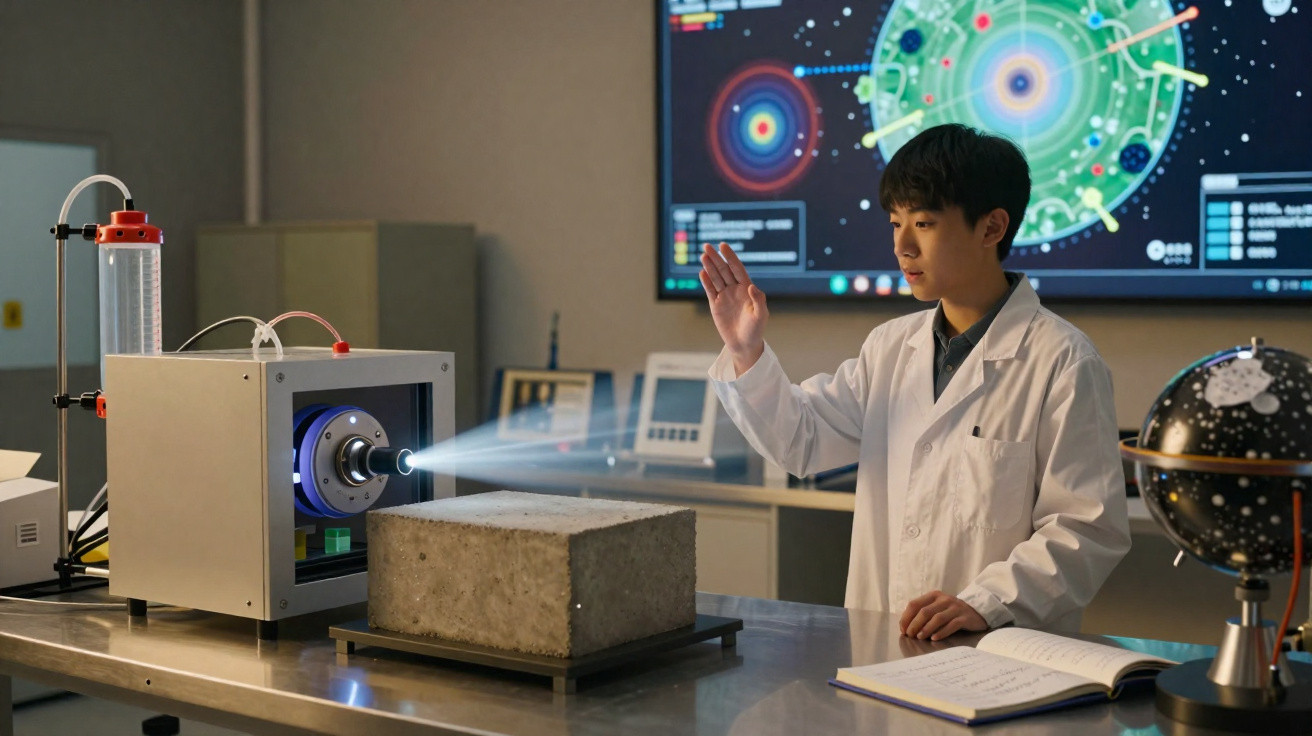
MIT physicists have set out a proposal for a device that sounds straight out of science fiction: a neutrino ‘laser’ that could assist in investigating the Universe’s unanswered questions.
Why neutrinos are so difficult to study
Neutrinos are the most plentiful particles with mass. Yet, ironically, they are extraordinarily hard to detect, which has earned them the label ‘ghost particles’. Trillions pass through your body at any one time, but they interact with matter so infrequently that examining them is exceptionally challenging.
Physicists at MIT and the University of Texas at Arlington have therefore described a possible neutrino laser, designed to gather these errant particles into a focused beam that would be easier to analyse.
Creating a neutrino laser with rubidium-83
In theory, producing such a device would require a cloud of rubidium-83 atoms to be cooled to temperatures below those of interstellar space. This would make the atoms behave as a single quantum object, in a state of matter called a Bose-Einstein condensate (BEC).
Rubidium-83 is radioactive and emits neutrinos as its atoms decay. Under normal conditions, the atoms decay in a partly random fashion, releasing neutrinos at unpredictable moments and in every direction. In a BEC state, however, their behaviour ought to become coordinated, including the process of decay.
The idea has some similarity to an ordinary laser, which generates photons and arranges them into a precise beam. Once the necessary temperature has been reached, the proposed system should produce a strong neutrino beam aimed in one direction within minutes.
Detecting neutrinos and their potential uses
Observing a neutrino is a matter of probability. Today’s most effective experiments monitor huge quantities of water or ice in locations with minimal interference, awaiting the rare occasion when a neutrino collides with a visible nucleus. Being able to predict where neutrinos will be within a far smaller area would tilt those odds in our favour.
More dependable neutrino detection and research could help address major questions in physics, such as the nature of dark matter and why antimatter did not destroy the Universe as we know it.
Their reluctance to interact with matter may also make neutrinos useful for communications that could pass directly through objects, including underground.
Naturally, the initial task is to establish whether a neutrino laser can genuinely be built.
“If it turns out that we can show it in the lab, then people can think about: Can we use this as a neutrino detector? Or a new form of communication?” says Joseph Formaggio, physicist at MIT. “That's when the fun really starts.”
The research was published in the journal Physical Review Letters.






Comments
No comments yet. Be the first to comment!
Leave a Comment