
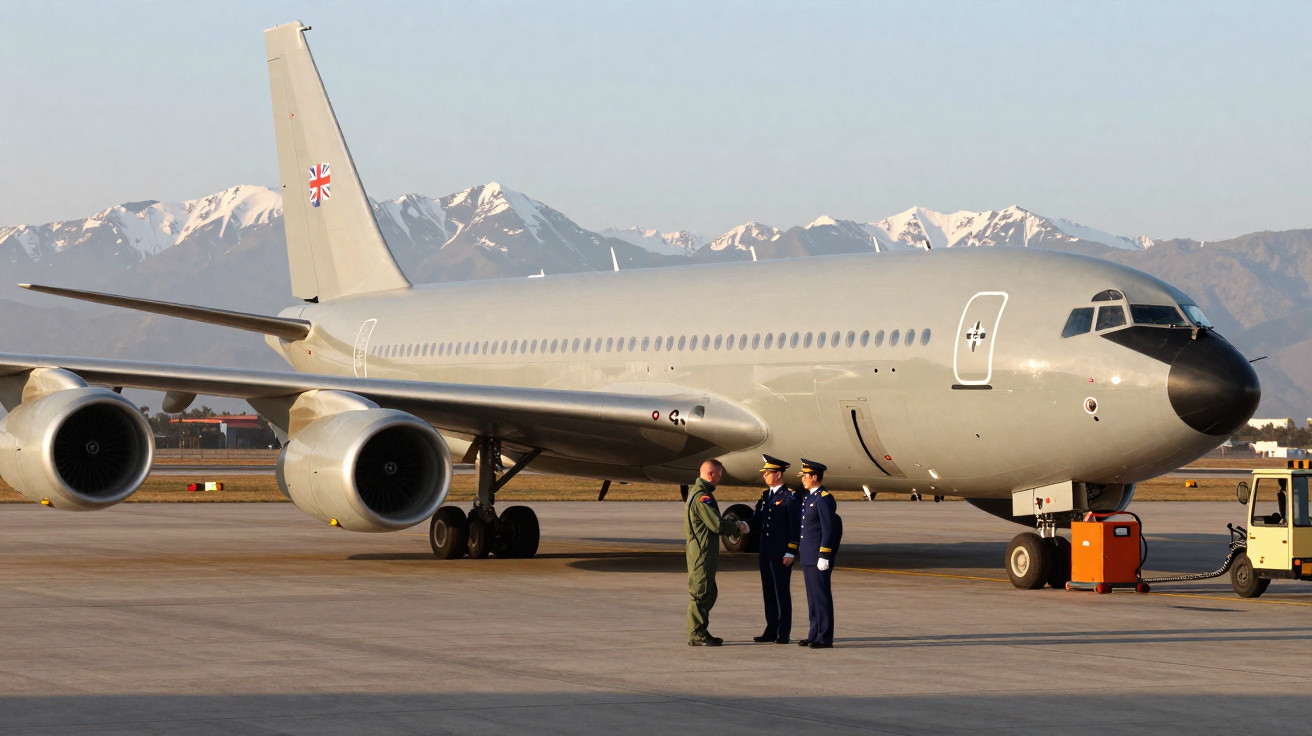
As part of the United Kingdom’s continuing air activity in the South Atlantic, intended to sustain its military presence in the Malvinas Islands, a Royal Air Force (RAF) Airbus KC Mk 2 Voyager tanker, serial ZZ333, stopped at a Chilean Air Force (FACh) base after operating from Mount Pleasant Air Base. The movement, identified through open-source flight-tracking platforms, highlights the UK’s logistical reach between the archipelago and the Antarctic region, representing a further development in Britain’s regional presence.
RAF Voyager KC Mk 2 stopover in Chile
The KC Mk 2 Voyager, operating under callsign RRR9000, left Mount Pleasant Air Base on 26 January 2026 at 12:35 and arrived in Santiago de Chile at 17:15, following a non-stop flight lasting 4 hours and 40 minutes. After reaching Chile, the aircraft was seen at installations used by the Chilean Air Force’s Air Group No. 10. This was not an isolated deployment: a few days previously, an RAF Airbus A400M Atlas transport aircraft flying from Mount Pleasant had also arrived at the same facilities, underlining the use of South American locations within the UK’s logistical support network.
Before its Chilean stopover, the Voyager had undertaken a sequence of missions over the South Atlantic and Antarctica. Between 20 and 22 January, ZZ333 was tracked conducting flights from Mount Pleasant under several operational callsigns, at the same time as A400M Atlas ZM413 was active. The latter was observed over the Antarctic Peninsula and in areas close to Argentina’s Joint Antarctic Base San Martín, near the British Antarctic Survey’s (BAS) Rothera Station. The activity of the two aircraft points to an integrated refuelling and logistics arrangement designed to increase the range and endurance of British missions in the far south.
South Atlantic logistics linking the Malvinas and Antarctica
The Voyager KC Mk 2 is now the RAF’s principal air-to-air refuelling aircraft and supports the Eurofighter Typhoon multirole fighters stationed in the Malvinas. Its operations towards Chile and Antarctica indicate coordinated logistical planning through which the United Kingdom maintains a regional support network incorporating transport aircraft, aerial refuelling and strategic stopovers in continental South America. The pattern observed reinforces an air logistics structure connecting significant elements of Britain’s South Atlantic posture, with the Malvinas Islands acting as a hub for operations extending towards Antarctica.
The latest Voyager stopover forms part of a recurring operational pattern. Only a week earlier, A400M Atlas ZM413 had travelled from Mount Pleasant to Santiago de Chile and used the same Chilean Air Force facilities. Able to carry heavy equipment and personnel over long distances, the aircraft is central to supporting the British detachment in the South Atlantic. For years, the United Kingdom has used A400Ms alongside Voyagers to lessen dependence on sea transport and preserve a continuous air logistics link between the archipelago and mainland South America.
Political and diplomatic implications
Beyond the technical aspects, these flights have notable political and diplomatic implications. British military aircraft operating near Argentine Antarctic bases, combined with stopovers at Chilean military installations, renews discussion surrounding the militarisation of the South Atlantic and the United Kingdom’s use of regional infrastructure. Continued operations connected to the Malvinas military posture-over territory whose sovereignty remains disputed by Argentina and the United Kingdom-demonstrate that strategic competition in the far south remains active, including within the context of logistical and scientific activity.
Images are for illustrative purposes.
You may also be interested in: *RAF Eurofighters deployed in the Malvinas conducted new QRA exercises*




Comments
No comments yet. Be the first to comment!
Leave a Comment