
Operation Windlord: C-17 transport of the Ward250 microreactor
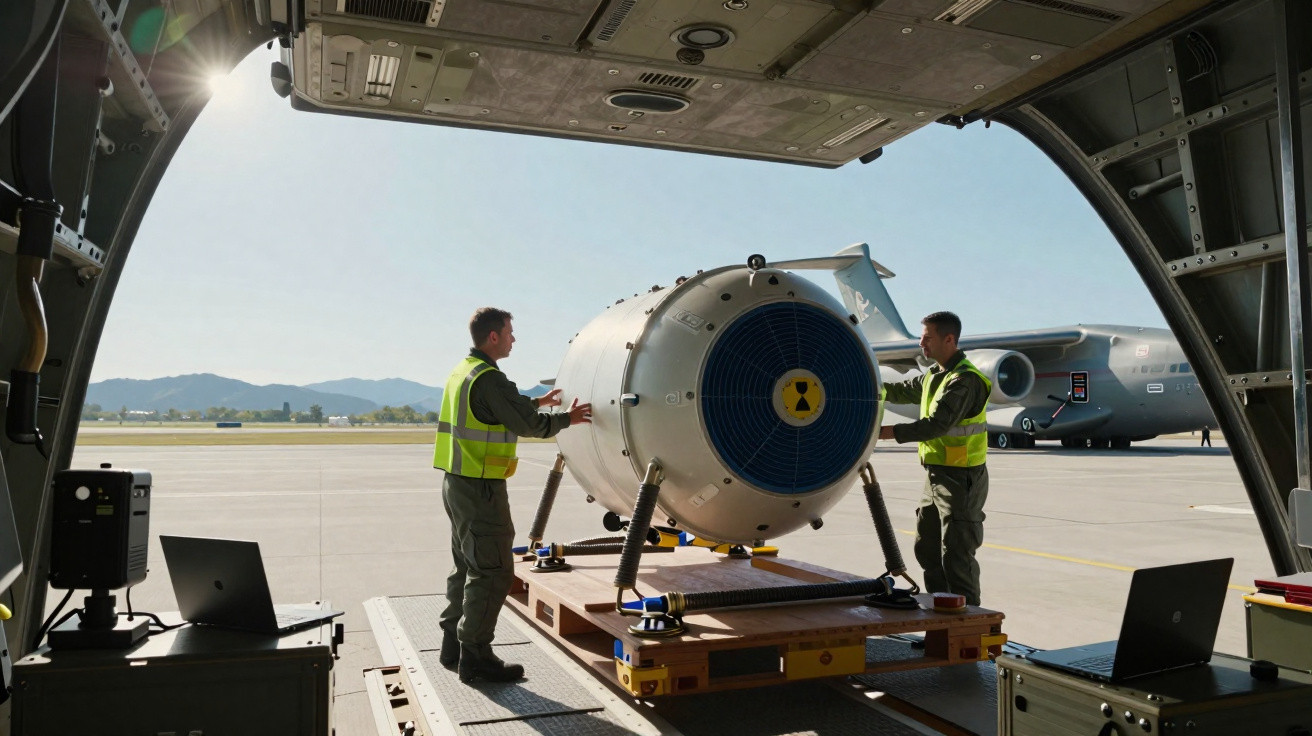
In a development with no recent equivalent, a U.S. Air Force C-17 Globemaster III strategic airlifter has carried a nuclear microreactor. The mission forms part of U.S. efforts to improve energy self-sufficiency for military units and was widely publicised by the U.S. Departments of War and Energy as Operation Windlord.
Operation Windlord involved C-17 aircraft transporting several components and modules of the Ward250 micro microreactor, which is designed and manufactured by Valar Atomics. The aircraft moved the equipment from March Air Reserve Base in southern California to Hill Air Force Base.
Energy self-sufficiency for U.S. military units
As well as marking a milestone in the transport of a nuclear minireactor, Operation Windlord demonstrates the Department of War and Department of Energy's drive to give the United States Armed Forces greater energy independence.
This is far from a minor consideration. Facilities used to generate, transmit, distribute and commercialise electricity-which underpins much of daily life for billions of people-are priority targets in potential conflicts. Both military and irregular forces may target them across numerous domains, from conventional environments to cyberspace.
At present, many military units rely on commercial electricity generation and distribution networks to function. The United States is therefore assessing nuclear microreactors such as the Ward250 to improve the autonomy of bases and units, while also supplying installations located far from urban centres and operating independently from the power grid.
Ward250 nuclear microreactor design and testing
The minireactor recently carried by the C-17s was developed in response to a series of directives issued under Executive Order 14301. It is a next-generation 5-megawatt nuclear reactor that uses established, reliable nuclear technologies: helium coolant, a graphite moderator and TRISO fuel, comprising uranium kernels enclosed in ceramic layers for added safety.
Marking the milestone, the U.S. Air Force and Michael P. Duffey, Under Secretary of War for Acquisition and Sustainment, stressed: “The future of warfare will be energy-intensive - he indicated - and will include artificial intelligence data centers, directed-energy weapons, as well as space and cyber infrastructure. The civilian power grid was not designed to support those demands, so the Department of War must build its own energy infrastructure.”
“Powering next-generation warfare will require us to move faster than our adversaries, to build a system that not only equips our warfighters to fight, but equips them to win at extraordinary speed,” Duffey added. “Today is a monumental step toward building that system. By supporting the industrial base and its capacity for innovation, we accelerate the delivery of resilient energy wherever it is needed.”
Once the transport of the eight modules comprising the reactor's components has been completed, the Ward 250 will be transferred to the Utah San Rafael Energy Laboratory (USREL) for intensive testing. In its 17 February statement, the U.S. Air Force projected that: “… it will imply that by July 4 the administration expects three small reactors to reach criticality, that is, to be operating normally,”
Related reading: Construction of the U.S. Navy's future USS District of Columbia ballistic missile submarine reaches 65% completion




Comments
No comments yet. Be the first to comment!
Leave a Comment