
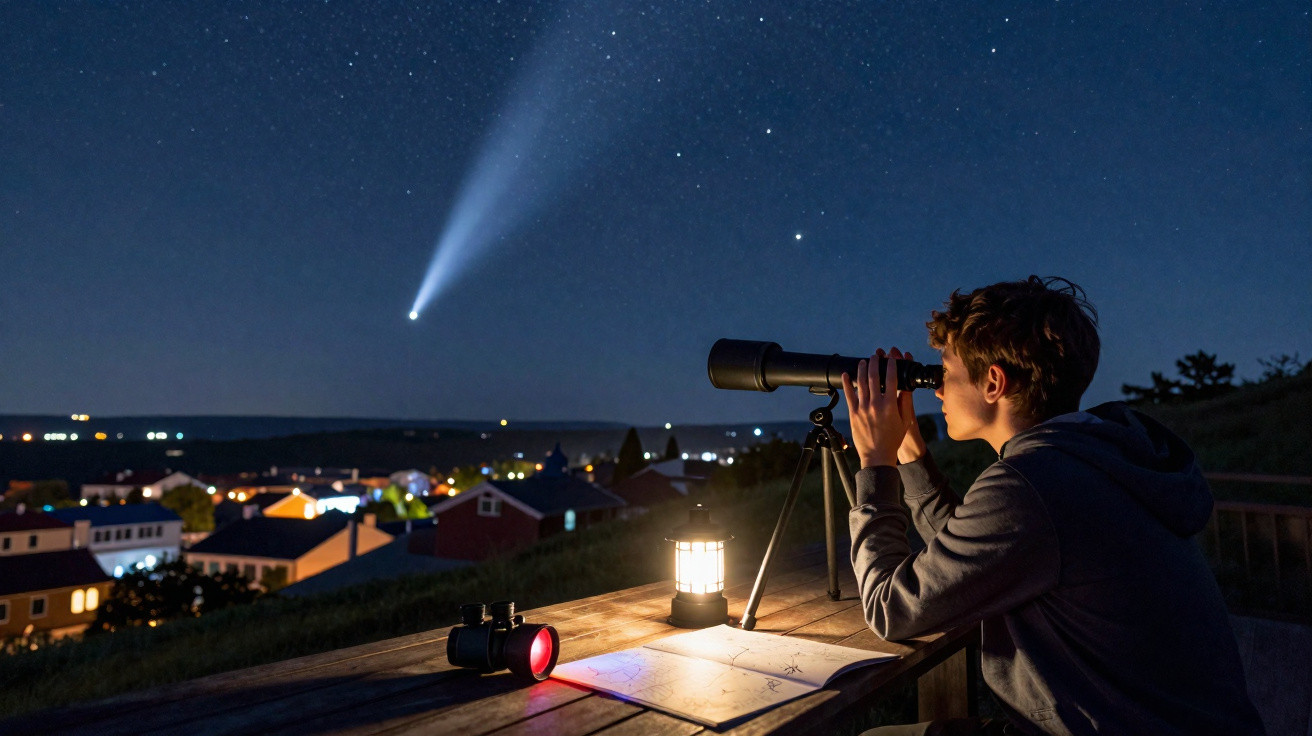
After travelling for millions of years, it will be visible in the sky for only a short time: an icy body from the depths of space is approaching our cosmic neighbourhood.
A faint point of light spotted during a routine observation has become a once-in-a-lifetime event. A newly discovered comet from the farthest reaches of our Solar System is passing Earth in the coming weeks and may even be visible through ordinary binoculars. Anyone hoping to see this celestial visitor will need some preparation, a dark location and clear skies.
A comet from the Solar System’s frozen frontier
In March 2024, Polish astronomer Kacper Wierzchoś noticed a point shifting slightly while examining sky images. It was not a data error, but a previously unknown comet that was later designated C/2024 E1 (Wierzchoś).
Follow-up observations, including work with the James Webb Telescope, confirmed the discovery. Tracking its orbit revealed that this body originated in the so-called Oort Cloud, a vast reservoir of icy and rocky objects far beyond the orbits of the known planets.
The Oort Cloud is thought to lie around 70 times farther from the Sun than Neptune. Extreme cold and perpetual darkness prevail there, leaving objects effectively frozen in the Solar System’s deep freezer. From time to time, gravitational forces - from passing stars, for example - disturb the paths of individual bodies, which then slowly make their way towards the inner planets.
A comet originating in the Oort Cloud and entering the inner Solar System is so rare that many people will consciously observe such a sight only once in their lifetime.
C/2024 E1 is now crossing our cosmic neighbourhood. It will come within roughly 150 million kilometres of Earth - approximately the distance between Earth and the Sun. In astronomical terms, that is remarkably close, but it poses absolutely no danger to us.
How bright the comet may become
The comet is made up of rock, dust, ice and frozen gases. As it approaches the Sun, its surface warms up. Frozen materials start to vaporise, sending gas and dust out into space. This creates the distinctive coma - a glowing envelope - along with the familiar structure of a comet’s tail.
How clearly C/2024 E1 will be seen in the sky depends heavily on this activity. If sunlight breaks open layers at the surface, short-lived outbursts can occur, releasing large amounts of dust and gas. Its brightness then increases, allowing the comet to stand out more clearly against the background stars.
Astronomers expect it to be detectable at least with good binoculars or a small amateur observatory. With some luck and sufficiently strong outbursts, it could even be visible to the naked eye from very dark locations, appearing as a diffuse, slightly blurred patch.
How to find comet C/2024 E1 in the sky
The best viewing period
The nights around 19 March offer particularly favourable conditions. The Moon is new during this period, so there is no disruptive moonlight and the sky appears darker. This improves contrast, making faint objects such as comets easier to see.
- Best period: several nights before and after 19 March
- Time of day: immediately after evening twilight has ended
- Weather: as clear and cloud-free as possible
- Location: well away from city lights, ideally in a rural area
Observing from the middle of a city will be difficult. Street lamps, advertising signs and illuminated windows all brighten the sky and drown out faint celestial objects.
Using the constellation Orion for orientation
The highly distinctive constellation Orion provides a useful starting point, as it is easily visible in the evening sky during winter and early spring. Its most striking feature is Orion’s Belt: three bright stars arranged in an almost straight line.
Follow these steps:
- Once darkness has fallen, look south and locate Orion.
- Identify the three Belt stars, which sit close together in a line.
- Move your gaze, or your binoculars, slightly downwards to find the Orion Nebula as a hazy patch of light.
- From there, move about 25 to 30 degrees to the right, towards west-south-west.
- The comet should be around five degrees below this imaginary line.
A simple way to estimate the distance is to hold out your arm: the width of a clenched fist at arm’s length covers roughly ten degrees of sky. Moving two to three “fist widths” to the right will therefore give approximately the stated distance.
Useful equipment for viewing the comet
No professional observatory is required to see the comet. A steady pair of binoculars with eight- to ten-times magnification is already a good starting point. Small telescopes, including basic beginner models, are even more suitable.
| Equipment | Advantage | Suitable for? |
|---|---|---|
| Naked eye | No equipment required, an immediate view | Very dark location, only if brightness is high |
| Binoculars (8x–10x) | Wide field of view, easy to use | Beginners and occasional skywatchers |
| Small telescope | More detail, better view of the coma | Amateur astronomers and technology enthusiasts |
A sturdy tripod is important. Holding binoculars by hand may work for a first impression, but the image quickly becomes unsteady. A tripod, or simply a way to support your arms, significantly improves the chances of seeing it.
The difference between a comet, asteroid and meteor
Spectacular astronomical events often create confusion over terminology. Three labels appear especially often: asteroid, comet and meteor. They refer to very different phenomena.
The body: asteroid
An asteroid is a compact object made of rock or metal. Some consist of one large boulder, while others are formed from many pieces stuck together. Well-known examples orbit in the asteroid belt between Mars and Jupiter.
The tailed object: comet
A comet consists of a mixture of rock, ice and frozen gases. While travelling far from the Sun, it remains a relatively dark and inconspicuous nucleus. As it gets closer, ice and gases begin to vaporise, a coma forms and the characteristic tail develops.
The shooting star: meteor
A meteor is not an independent celestial body, but a light phenomenon. Tiny fragments of rock or dust race into Earth’s atmosphere, heat up intensely and burn away - producing the brief, bright streak in the sky known as a “shooting star”.
Only comets have this characteristic tail of gas and dust, which glows in sunlight and looks so impressive in the night sky.
Why it is worth looking up at the sky
A comet from the Oort Cloud is more than an attractive photographic subject. It also carries information from the early history of the Solar System. Its composition reveals which building blocks were present when the Sun and planets formed. For research institutes, such objects are flying deep-freezers from the era of formation.
For non-specialists, this event is above all a rare opportunity to step outside everyday life for a moment. Standing outdoors on a clear March night, leaving streetlights behind and quietly looking towards Orion changes the way the sky appears: no longer a flat backdrop of stars, but a space in which real bodies travel at immense speeds.
Anyone wishing to explore the experience further can use simple star-map apps on a smartphone. Using GPS, they show the current positions of Orion, the comet and other objects. This makes orientation easier without constantly having to consult specialist literature.
It is also fascinating to compare this with future events: other comets and meteor showers will pass by in the years ahead, but a body that has come so deeply from the Oort Cloud and becomes this visible remains the exception. Those who look up consciously now will gain a celestial experience that is difficult to replicate.






Comments
No comments yet. Be the first to comment!
Leave a Comment