
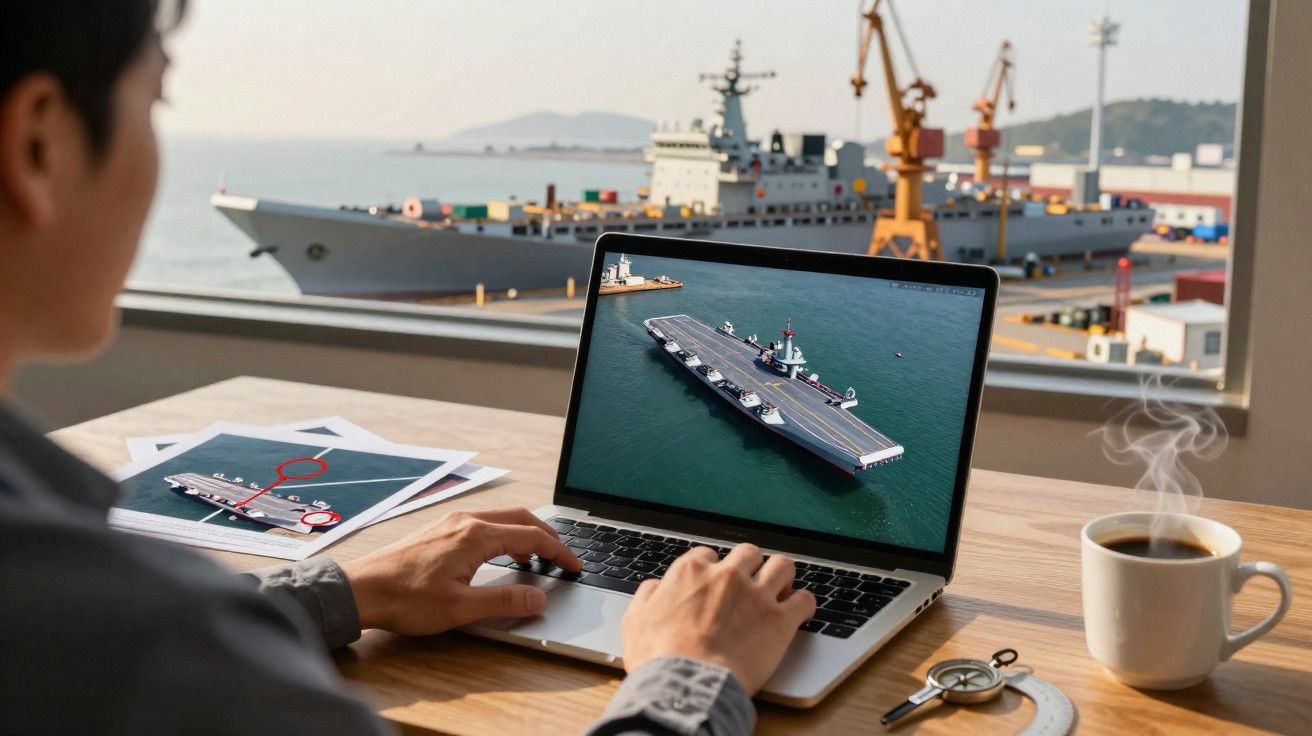
Satellite imagery has confirmed that the Chinese People’s Liberation Army Navy (PLAN) aircraft carrier Shandong (CV-17) has moved into dry dock at Yulin Naval Base on Hainan Island, following weeks of uncertainty over its operational condition. The images resolve questions raised after a series of deployments in the Pacific and other areas of strategic interest to Beijing.
Open-source intelligence (OSINT) imagery places the ship - the PLAN’s second aircraft carrier and the first to be constructed wholly in China - within one of the base’s large dry docks. Specialist analysts assess the move as part of an extensive maintenance programme, probably involving hull cleaning, systems checks and flight-deck work, including resurfacing.
Major maintenance at Yulin Naval Base
Shandong is now at the Yulin naval complex, also called Sanya, which is among the principal bases operated by the Chinese Navy’s Southern Theater Command. The site has a substantial dry dock, roughly 375 metres long and 78 metres wide, constructed between 2017 and 2022. It can accommodate major warships, including aircraft carriers and destroyers.
Shandong’s arrival in dry dock is especially notable as it represents one of the first confirmed occasions on which a Chinese aircraft carrier has used this new facility. It broadens the PLAN’s maintenance and logistical capacity beyond the Dalian shipyards, which have historically been associated with sustaining its carriers. The development also illustrates the considerable expansion of the Navy’s maintenance infrastructure - and, in turn, the size of its fleet - over the past decade.
Operational record of the aircraft carrier Shandong
Commissioned in December 2019, CV-17 was China’s first entirely domestically built aircraft carrier. Its design is derived from that of Liaoning (CV-16), although it includes structural refinements and newer technologies that improve on the original Soviet-derived Admiral Kuznetsov-class design.
In 2023, Shandong conducted its first significant deployment into the Western Pacific, operating beyond the so-called First Island Chain. During 2025, it took part in several South China Sea exercises involving intensive flying operations by its embarked air wing, led by Shenyang J-15 carrier-based fighters.
What Shandong’s maintenance indicates
More than simply routine upkeep, Shandong’s use of the Yulin dry dock points to a wider development: Hainan’s consolidation as an important logistical and operational centre for Chinese naval activity in the South China Sea and for Pacific access.
Meanwhile, the PLAN is continuing the initial deployments of Fujian (CV-18), China’s third aircraft carrier, which was commissioned in November 2025. Fujian has electromagnetic catapults (EMALS) and a more varied air wing comprising J-15, J-35 and KJ-600 airborne early-warning aircraft. Its arrival has allowed the Navy to sustain a continuous, uninterrupted regional presence, with at least one aircraft carrier available for operations while others receive maintenance.
China is also pressing ahead with the development and construction of its fourth aircraft carrier. Analysts believe it may become the country’s first nuclear-powered carrier, comparable to classes currently operated only by the United States and France. The most recent open-source satellite imagery shows the shipbuilder using gantry cranes to fit new sections. This indicates that the Dalian shipyards are already working on bow modules and lateral hangar sections, highlighting the speed with which Beijing is progressing the project.
You may also like: In 2025, the Chinese Navy substantially increased and widened its military activity across the Indo-Pacific




Comments
No comments yet. Be the first to comment!
Leave a Comment