
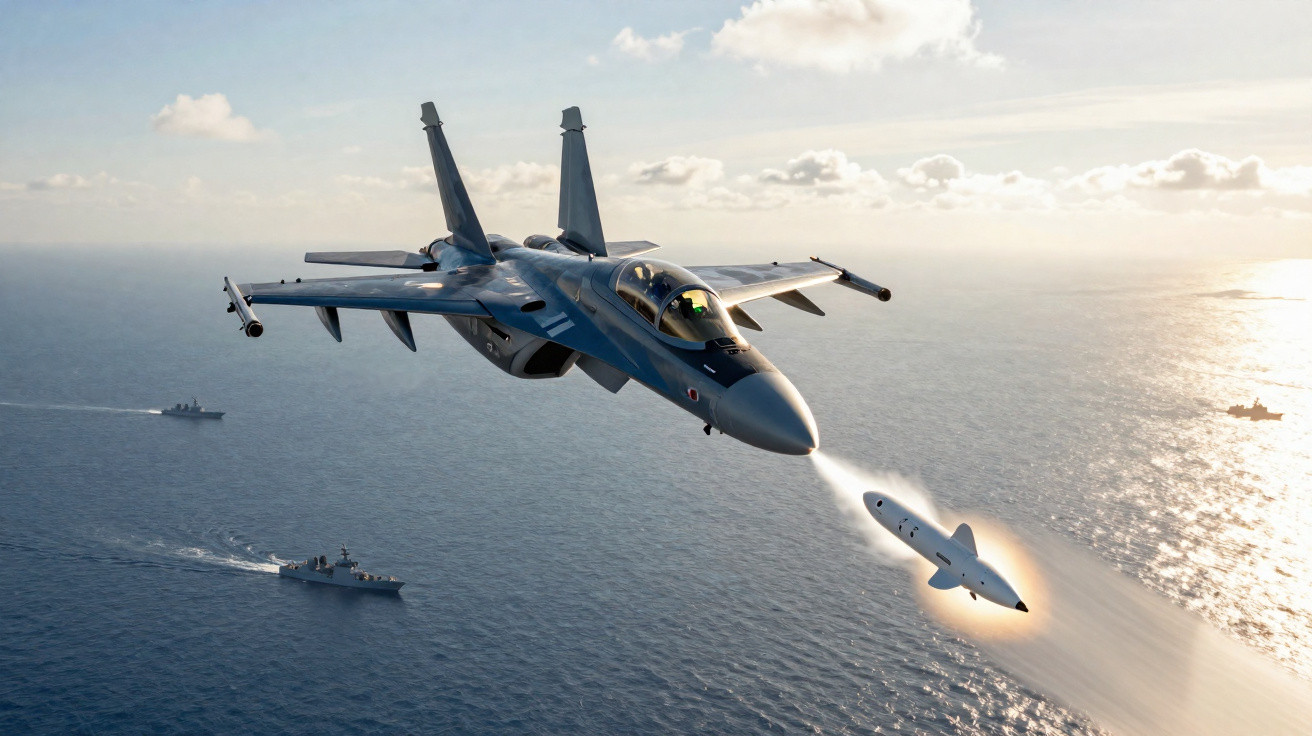
Public attention may still be centred on fighter aircraft and warships, but Japanese engineers have been refining a supersonic anti-ship missile for years: a weapon intended to strike with force and speed while remaining beyond the reach of hostile defences.
ASM-3A: a missile designed to outpace naval defences
Japan’s new ASM-3A anti-ship missile represents the latest stage in the country’s gradual movement from strictly defensive equipment towards long-range precision-strike capability. Built by Mitsubishi Heavy Industries, it develops the earlier ASM-3, although its strategic implications are markedly different.
Designed to exceed Mach 3 and engage targets at ranges of more than 300 km, the missile occupies a space between traditional anti-ship weapons and fully hypersonic systems. Its extended range enables Japanese aircraft to attack vessels while remaining beyond the engagement range of many naval surface-to-air missiles.
Japan’s ASM‑3A is built to be around ten times faster than many subsonic anti‑ship missiles still in service, while striking from more than 300 km away.
The ASM-3A’s key feature is its upgraded ramjet engine. Whereas a conventional rocket motor burns out rapidly, a ramjet compresses incoming air through the missile’s own forward motion, allowing it to maintain thrust for longer.
Why maritime speed is crucial
Many anti-ship missiles deployed during the Cold War, including early versions of Harpoon, travelled at subsonic speeds. Although simpler to guide and less expensive to manufacture, they were also easier to detect, track and intercept.
A weapon travelling at more than Mach 3 drastically reduces the available response time. If such a missile appears at the edge of a ship’s radar coverage, its crew may have less than a minute to identify, track and engage it. This narrow timeframe raises the prospect that at least one missile could penetrate even a heavily layered air-defence system.
- Subsonic anti-ship missiles: approximately Mach 0.8–0.9, offering a long detection and engagement window
- Supersonic missiles such as ASM-3A: Mach 3+ and a sharply reduced reaction timeline
- Their long range also supports “shoot and leave” tactics by the launch aircraft
The Mitsubishi F-2 as ASM-3A’s principal launch platform
The Mitsubishi F-2, a Japanese-built development of the F-16, is intended to be the ASM-3A’s main carrier aircraft. From the beginning, the jet was configured for maritime strike, with a larger wing to carry additional fuel and weapons, plus an advanced AESA radar able to detect ships at considerable distances.
In what planners describe as “stand-off” operations, an F-2 can fire ASM-3A missiles without entering the threat zone of hostile frigates or destroyers. The pilot can remain farther from danger by depending on long-range sensors, external targeting information, or a combination of the two.
By pairing the F‑2 with the ASM‑3A, Japan turns a legacy fighter into a long‑range ship killer suited for contested waters.
The technical advance from ASM-3 to ASM-3A
Rather than being designed from scratch, the ASM-3A is a direct development of the earlier ASM-3 programme. Its enhanced performance is intended to respond to the accelerating naval expansion of China and other regional powers.
| Feature | ASM-3 | ASM-3A |
|---|---|---|
| Estimated range | ~200 km | 300–400 km |
| Speed | ~Mach 3 | Mach 3+ (supersonic throughout flight) |
| Propulsion | Ramjet | Improved ramjet with hybrid profile |
| Main platform | Mitsubishi F-2 | Mitsubishi F-2 (others possible later) |
Its hybrid propulsion profile provides substantial thrust during the terminal attack phase as well. This retained energy complicates last-ditch interception and supplies the warhead with the kinetic force required to damage larger vessels, including helicopter carriers or, during a crisis, aircraft carriers.
ASM-3A within Japan’s layered maritime strategy
Tokyo’s missile ambitions extend beyond the ASM-3A. The weapon is becoming part of an expanding group of long-range strike systems designed to make operational planning in the Western Pacific more difficult for any adversary.
Japan is introducing the Joint Strike Missile (JSM) for its stealthy F-35 fleet; this weapon can reach roughly 500 km while maintaining a low-observable profile. Modernised F-15s are also expected to receive long-range anti-ship missiles resembling the US LRASM, creating another threat layer for surface fleets.
Different missiles, different speeds and different flight profiles create overlapping threat zones that are harder to defend against than a single, uniform system.
This range of weapons broadens Japan’s ability to cover naval targets. Certain missiles travel low and stealthily over longer distances, while others, including the ASM-3A, sacrifice some stealth in favour of sheer speed. Taken together, they create a networked arsenal instead of a single universal solution.
A signal for competing fleets
The ASM-3A’s public presentation at defence exhibitions, including DSEI Japan 2025, sends an unmistakable message to regional naval forces. Attempts to concentrate warships or drone swarms near Japanese territory could now be met by coordinated long-range attacks launched by several aircraft types.
The missile is especially appropriate for engaging high-value targets, including surveillance frigates, amphibious vessels, helicopter carriers and the logistics ships that enable a fleet to operate far from its home ports. Damaging or disabling those assets could impair a naval task force without having to confront every escort vessel directly.
A wholly domestic programme and its implications
Japan has elected to retain the ASM-3A programme entirely within the country. Mitsubishi Heavy Industries and domestic suppliers are responsible for its propulsion, guidance, sensors and advanced materials.
This model fulfils several objectives simultaneously. It reinforces national control over essential components, limits vulnerability to export restrictions and supports a defence-industrial base that Tokyo considers strategically valuable in its own right.
- An independent supply chain for vital missile components
- More freedom to implement upgrades and software modifications
- An industrial foundation capable of supporting future programmes, including hypersonic systems
Domestic development also gives Japan greater latitude in deploying and potentially exporting future variants. This remains a sensitive issue as the country progressively eases some limits on defence collaboration.
From a defensive shield to pre-emptive reach?
Japan officially continues to present these capabilities as deterrence measures within a defensive posture. The government maintains that long-range missiles are necessary to counter expanding missile inventories and increasingly large naval forces operating close to Japanese waters.
However, the range, accuracy and speed available through weapons such as the ASM-3A push doctrine in a more proactive direction. During a crisis, planners might weigh pre-emptive strikes against ships or launch platforms believed to be preparing hostile action, rather than waiting to endure an initial attack.
Missiles that can strike from hundreds of kilometres away give political leaders options that did not exist when Japan relied mostly on short‑range weapons.
Such a change has prompted domestic debate over constitutional constraints on the use of force, alongside international questions over how neighbouring countries could respond to a more assertive Japanese stance.
Key concepts behind the technology
What does “Mach 3” actually mean?
Mach values measure speed against the local speed of sound. At normal cruising altitudes, Mach 1 is about 1,200 km/h, although the figure changes with air temperature and pressure. A missile flying at Mach 3 is therefore travelling at roughly 3,600 km/h or faster.
At this speed, a missile fired from 300 km away could arrive at its target in around five minutes. A ship’s combat system consequently has little allowance for delayed sensor data, operator judgement or mechanical faults affecting interceptor missiles.
How a ramjet transforms performance
A ramjet is a straightforward engine with no rotating compressor blades. It depends on the missile already moving quickly enough for its forward speed to compress the incoming air. Fuel is then introduced and burned within that compressed airflow.
This engine type performs best at high velocity and can continue propelling the missile through much of its flight path. In contrast with a solid rocket motor that exhausts its fuel early, a ramjet supports greater sustained speed and improved manoeuvrability in the later stages of flight.
Potential scenarios and risks
In a crisis involving disputed islands or narrow straits, Japanese F-2s armed with ASM-3A missiles could patrol beyond the principal air-defence zone of an approaching fleet. They could then fire coordinated salvos at leading vessels, support ships or amphibious units moving towards contested territory.
These possibilities would require any navy operating near Japan to adapt its planning. Task groups might have to operate farther from shore, invest in more densely layered air defences, or dedicate additional aircraft solely to patrol and early-warning duties. Each option increases both cost and complexity.
Risks also remain. In a congested maritime region where several actors possess long-range supersonic missiles, the likelihood of miscalculation increases. A radar contact wrongly identified as hostile, or an unsuccessful warning shot, could escalate rapidly when both sides understand that incoming weapons will arrive in minutes rather than tens of minutes.
At the same time, programme supporters contend that credible long-range strike capabilities such as the ASM-3A may deter coercive conduct at sea. If a prospective aggressor cannot be confident that its ships can approach without swift retaliation, the threshold for initiating a confrontation becomes higher.




Comments
No comments yet. Be the first to comment!
Leave a Comment