
The US Navy and American industry have been advancing a concept that combines operational urgency with a degree of technical pragmatism: turning land-based defences into shipborne capabilities that can be deployed swiftly, without waiting for new classes of vessel. In that vein, Lockheed Martin previously demonstrated the integration of an M903 launcher from the Patriot system aboard USS Montgomery (LCS 8), an Independence-class Littoral Combat Ship, to explore an expeditionary air and missile defence arrangement that could be “placed” on a ship at short notice.
PAC-3 MSE interceptors aboard Littoral Combat Ships
Technically, the appeal of this kind of trial lies in pairing PAC-3 MSE interceptors - designed to counter highly complex threats - with a naval platform that was originally fitted with more limited point-defence weaponry. The underlying aim is straightforward: enhance a ship's defence technology without redesigning its hull or making major changes to its organic launch architecture. For the US Navy, the PAC-3 MSE is also a high-performance interceptor that is mature, in production and has an operational track record, qualities of particular value when time is the central challenge.
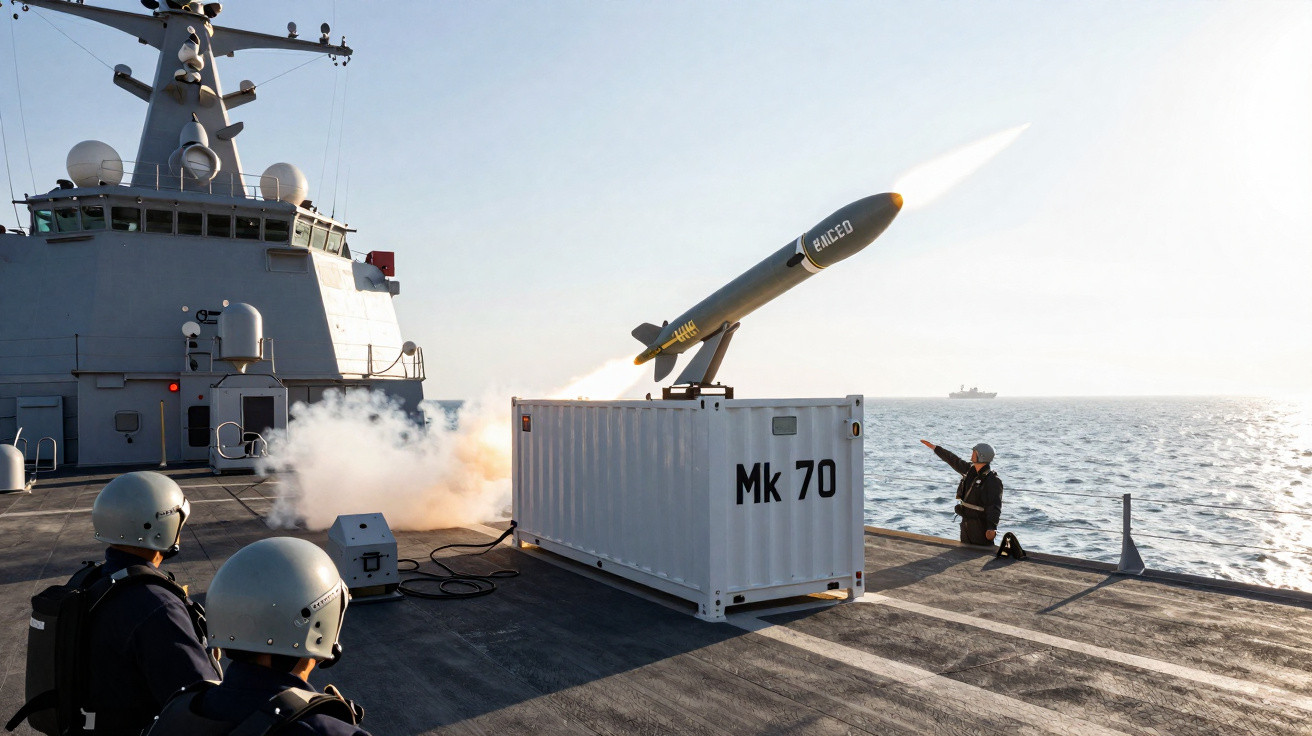
This work is linked to the modular nature of the Mk 70 Payload Delivery System (PDS), a containerised launcher that adapts the Mk 41 VLS - the standard system on destroyers and cruisers - into a transportable configuration: a 40-foot ISO container with four cells, proven electronics and gas-management systems optimised to support multiple launches before more substantial maintenance is needed. Its operational benefit lies in scalability - adding capability in four-cell increments - and relocation, two factors that improve survivability and increase uncertainty for an adversary. Within this concept, Chinese media outlets and institutions argue that the United States' approach could challenge their country's hypersonic missile development.
Mk 70 Payload Delivery System and naval testing
At sea, the Mk 70 Mod 1 has already undergone live-fire testing. The US Navy launched an SM-6 from USS Savannah (LCS 28) using the system, specifically from the helicopter deck, illustrating the core of the concept: “adding VLS where none exists”, including on light platforms. The next step now being explored - a shipborne Patriot system - reflects the same priority: multiplying defences without redesigning vessels. This is especially relevant given the pace at which China is proliferating missiles and drones in the Indo-Pacific.
Typhon and the shift between land and sea missile systems
The containerised element connects directly with the land domain. The US Army's Typhon system is essentially a rapid-deployment variant of the Mk 70/Mk 41 ecosystem, intended to fire SM-6 and Tomahawk missiles from land. It demonstrates a broader trend: naval missiles moving ashore and land-based defences moving to sea, all within the same logistical and integration framework. The intended outcome is a more distributed layered defence, with more firing points and less reliance on individual high-value platforms.
According to the technical information issued by the company that developed the module, the Mk 70 is a containerised combat launcher housed in a 40-foot ISO container. It is equipped with four vertical launch system (VLS) cells and adapts the Mk 41 VLS architecture used by the US Navy on Ticonderoga-class cruisers and Arleigh Burke-class destroyers into a rapidly deployable and relocatable system.
The company states that, following more than $500 million invested throughout the Mk 41's lifetime and with around 13,000 VLS cells integrated by 15 international navies, the Mk 70 retains electronics and capabilities that have already been proven. Its structural design, materials and components have been optimised to lower production and life-cycle costs. It also incorporates proprietary gas-management technologies that increase the number of launches possible before refurbishment work is required. In operational terms, its modular design allows capacity to be scaled in four-cell increments and, through dynamic alignment with the combat system, supports rapid launcher relocation, improving survivability and increasing adversary uncertainty.
You may be interested in: The US Army will deploy its new Typhon missile launcher system in Japan for the first time



Comments
No comments yet. Be the first to comment!
Leave a Comment