
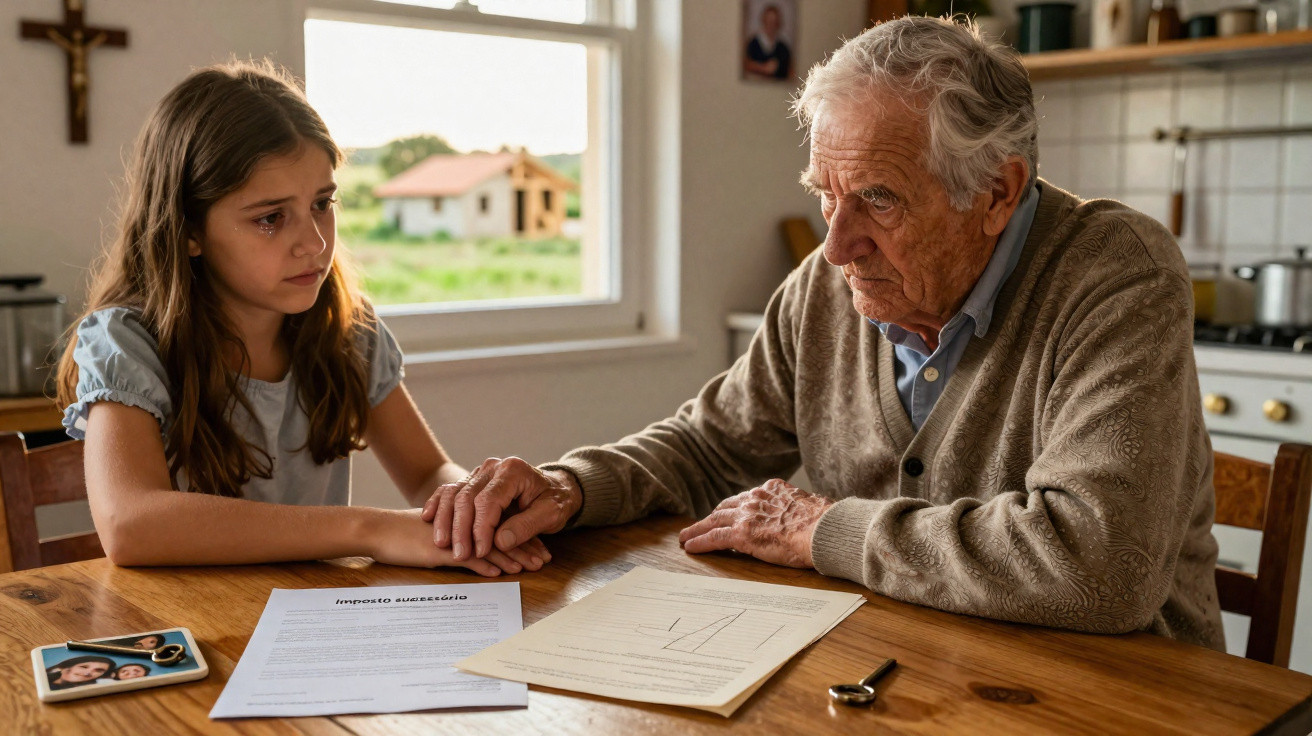
The telephone rang on a Tuesday morning, as the kettle continued to whistle. Gérard, a 72-year-old retired bricklayer, had only just opened his notebook of household bills when his daughter’s name appeared on his screen. He answered with a smile, until he noticed the tremor in her voice. A tax demand had arrived: a five-figure inheritance tax bill linked to the plot of land he had given her “to help with the house project”.
At first, he assumed it had to be a mistake. He was alive, had made no will and had never discussed “estate planning” with a notary. Years earlier, he had merely signed over the land to his daughter because she hoped to build there. Yet the tax authorities now regarded that act as a taxable transfer of wealth, as though he were a property developer operating a tax arrangement.
Looking at the notice, he voiced the reaction many parents might have had.
“This is just helping my family, not a business.”
When a family gift appears to be a tax scheme on paper
To Gérard, this land had never been an “asset class”. It was the field where he had played as a boy, bordering his parents’ small farm, a patch of ground he had held on to for sentimental rather than strategic reasons. When his daughter asked whether she could put up a modest home there, he did not imagine a future tax disaster. He pictured his grandchildren living nearby, Sunday meals and the sound of children in the garden once more.
A notary dealt with the formalities, outlined several rules and referred to thresholds and allowances. Gérard listened and agreed. He had faith in the process. Like his father before him, he signed wherever he was instructed, trusting that anything arranged “within the family” would remain straightforward. The years went by, the house was built and everyday life continued.
Then came a new assessment. Changes to planning rules had sent the land’s value soaring. The tax office reclassified the transfer and recalculated the amount due, making the once “simple family gift” appear, in official records, to be a profitable property transaction. The gift was now subject to inheritance-style tax, with late-payment penalties added as well.
Accounts like Gérard’s are increasingly appearing on forums, Facebook groups and late-night television discussions. People share photographs of official notices, with passages marked in yellow, and ask strangers whether such a result can genuinely be correct. Some claim the state is taking advantage of pensioners. Others respond with detached legal points about fairness, public funding and rules that had always existed but were overlooked.
Beneath this argument is a genuine divide. One generation regards land as a family inheritance, handed on like a story or recipe, with little thought given to documentation. The tax system, meanwhile, deals in figures, dates, valuations and an obligation to apply the same treatment to every wealth transfer, whether it concerns a millionaire’s investments or a retired bricklayer’s field.
Law, fairness and the narrow divide between a gift and an advantage
Legally, the state does not take account of embraces, assurances or Sunday lunches. Its concern is value passing from one person to another. Giving land to a child means transferring wealth that could otherwise fall within inheritance tax. The law seeks to make such transfers visible and taxable, ensuring that people able to pass on valuable assets contribute to public finances as this happens.
Tax authorities use formal classifications. A gift that exceeds the official tax-free allowance is viewed as an advance on inheritance. If the land’s value rises suddenly, the “kind gesture” begins to look like wealth planning. Although the parent may never have considered it in that way, the system is intended to identify precisely this type of unspoken enrichment.
Supporters of the tax rules argue that they create fairness between households. Why should the child of a renter pay full tax on earnings while another receives a building plot worth hundreds of thousands for nothing, entirely free of tax? Opponents answer that Gérard is not a company, and that treating him as a tax planner disregards the emotional bonds that keep families together. To them, there is a moral distance between the account set out in law and the way family life really happens.
How families can avoid a Gérard-style land gift tax shock
One modest, unglamorous action can make a significant difference: speak with a specialist before putting pen to paper. This should not be a brief exchange at the end of an appointment when dozens of documents are waiting to be signed, but a proper conversation centred on a single question: “If I gift this to my child, what happens in 5, 10, 20 years?” It involves asking about changing property values, thresholds, future siblings and the consequences if somebody dies sooner than expected or requires long-term care.
For many parents, that may feel burdensome and somewhat impersonal. Their aim is simply to offer help today, not to plan for every possible turn of events. However, families that avoid the harshest surprises are often those that approach the gift as a small project. They consider whether dividing the land, spreading gifts over several years or using formal gift allowances could reduce the impact. Let’s be honest: nobody really does this every single day. That is why notaries and tax advisers exist.
The greatest danger is believing that “because it’s my child, the state won’t get involved”. That assumption belongs to a different age. Databases now communicate with one another, property values are monitored, and a signature made years ago can acquire an entirely new significance. Some parents also fail to speak candidly with all their children, believing they will “sort it out later”. Resentment can then become entangled with tax demands, leaving an emotional price far greater than the financial one.
Gérard says he would still have gifted the land.
“What breaks my heart isn’t paying,” he confides. “It’s feeling treated like a cheat when all I did was help my daughter have a home.”
- Check the land’s true value today – Use not only your own estimate, but also figures from local estate agents, online tools or tax records.
- Ask about official gift allowances and family exemptions – They may turn a severe tax shock into a more manageable cost spread over time.
- Set down the family agreement in writing – Clarify who receives what, under what conditions and what will happen if circumstances alter.
- Retain copies of all documents.
- Prepare the emotional discussion as carefully as the legal one – Siblings, in-laws and future partners will all become part of the situation eventually.
A quiet storm where love, law and money meet
When cases such as Gérard’s reach the headlines, public reactions are telling. Some immediately support him, angry that a pensioner is pursued for tax over what they consider ordinary family support. Others point out that hospitals, pensions and schools require funding, and that land wealth remains genuine wealth even when it is not held in a bank account.
Most people live in the untidy space between those positions. We want to help our children get on the property ladder. We also want equitable rules, so that opportunity is not merely inherited but earned. There is loyalty to our own relatives, alongside a quieter duty to the broader community that helps us when circumstances become difficult. We’ve all been there, that moment when you realise a “small favour” is bigger than it looked.
Legal wording may be unambiguous on paper, but human lives are not. A field may be both a childhood play area and a taxable asset. A signature may be both an act of love and a financial transaction. The debate this pensioner has unintentionally prompted reaches far beyond his boundary line. It concerns how one generation hands its world to the next, what constitutes privilege and how far the state should enter the private realm where parents are simply trying to help their children become independent.
| Key point | Detail | Value for the reader |
|---|---|---|
| Hidden tax risks | Land gifts may be reassessed years later as taxable wealth transfers | Prepare for possible bills rather than discovering them during retirement |
| Role of specialists | Notaries and advisers can organise gifts within legal allowances | Lower the financial and emotional cost of supporting your children |
| Family dialogue | Frank discussions about who receives what and why | Reduce sibling disputes and prevent feelings of unfairness |
FAQ:
- Question 1 Can a simple gift of land to my child really trigger inheritance-style tax?
- Question 2 What’s the difference between a “normal” gift and a taxable transfer in the eyes of the tax office?
- Question 3 Is there a way to help my child build on family land without a massive tax bill later?
- Question 4 What happens if the value of the land rises sharply after I’ve already gifted it?
- Question 5 How can we talk about these issues in the family without creating tension or jealousy?






Comments
No comments yet. Be the first to comment!
Leave a Comment