
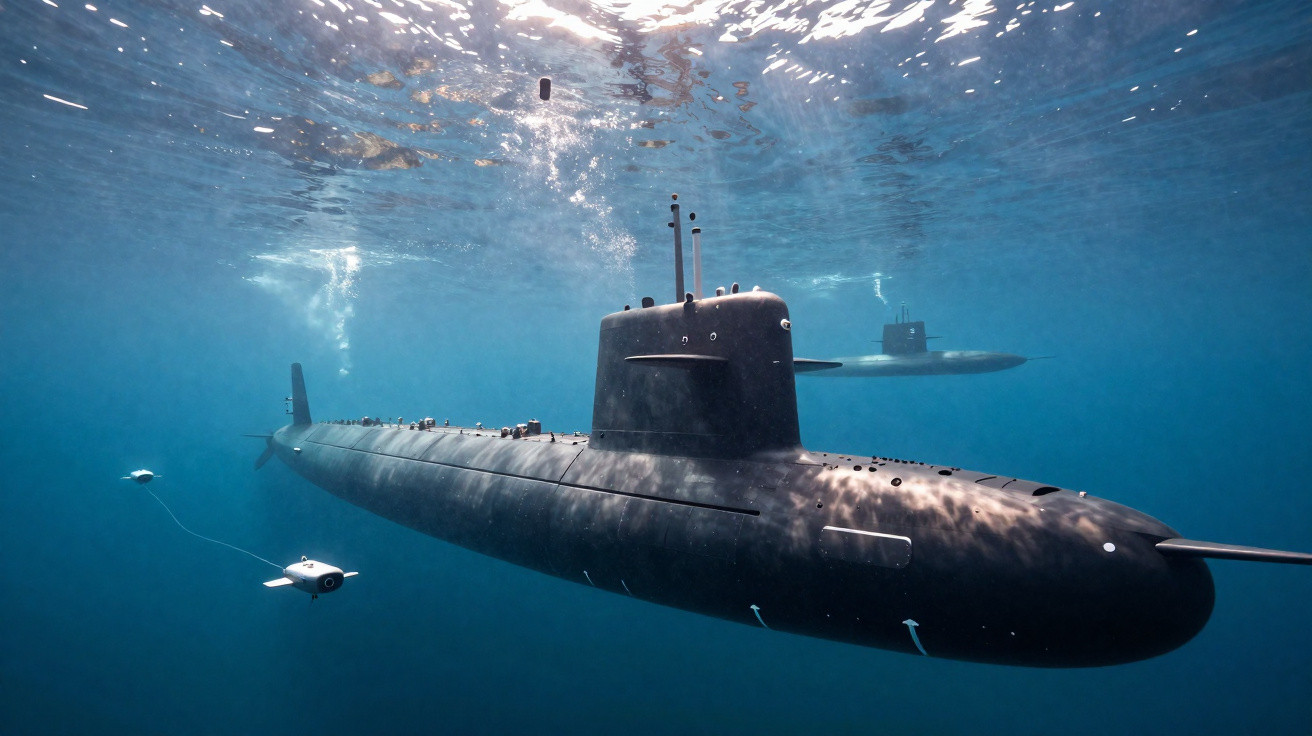
During a hearing entitled “A Part of Their World: The Undersea Competition Between the US and China”, naval officers and analysts told the US-China Economic and Security Review Commission that, by 2035, half of the Chinese Navy’s submarine fleet is expected to be nuclear-powered. The assessment was disclosed early in an extensive briefing by Rear Admiral Michael Brookes, the current commander of the Office of Naval Intelligence.
China’s submarine fleet and its nuclear transition
Expanding on the key details, Rear Admiral Brookes said that the Asian giant currently operates one of the world’s largest submarine fleets, comprising more than 60 vessels. Of these, six are nuclear-powered attack submarines (SSNs), two are fitted with precision-guided missiles (SSGNs), and six carry ballistic missiles (SSBNs). Most of the fleet therefore still consists of conventional diesel-electric submarines, including boats fitted with the latest air-independent propulsion (AIP) systems from the Yuan and Song classes.
Against this backdrop, the briefing stated that the Chinese Navy is moving to substantially increase its number of nuclear-powered submarines. This will particularly involve the development of a new variant known as the Type 041, or Zhou class: a design comparable in size to a conventional submarine, but offering greater endurance. Beijing could therefore obtain a platform with better performance than the vessels that currently make up most of its undersea capability, while keeping expenditure below that required for a large and powerful SSBN or SSGN.
Type 041 Zhou class and long-range strike capability
This does not mean the larger, more capable platforms will be withdrawn. Estimates indicate that China intends to retain them in service throughout the 2030s and beyond, which would require advances in sensors and weaponry. The briefing also outlined China’s interest in developing new technologies to lower its acoustic signature, alongside improvements to the design of its propulsion reactors. The strategic effect of this approach is clear: it would give the Chinese Navy greater and improved long-range strike capabilities in the event of a conflict.
Chinese submarine production capacity
Alongside these expansion plans, the report presented by Rear Admiral Brookes acknowledged that China has markedly increased its production capacity, stating:
“China has dramatically increased its domestic submarine production capacity through major infrastructure investments at three major shipyards, accelerating output from fewer than one nuclear submarine per year to significantly higher rates. These expansions include the construction of extensive facilities that have tripled shipbuilding capacity, enabling higher production rates for conventional submarines, while the improved infrastructure now allows advanced, larger-diameter submarines to be built at all three sites.”
Images used for illustrative purposes.
You may also be interested in: With the deployment of 60 ships, submarines and aircraft, the Indian Navy concluded the multinational MILAN 2026 Exercise




Comments
No comments yet. Be the first to comment!
Leave a Comment