
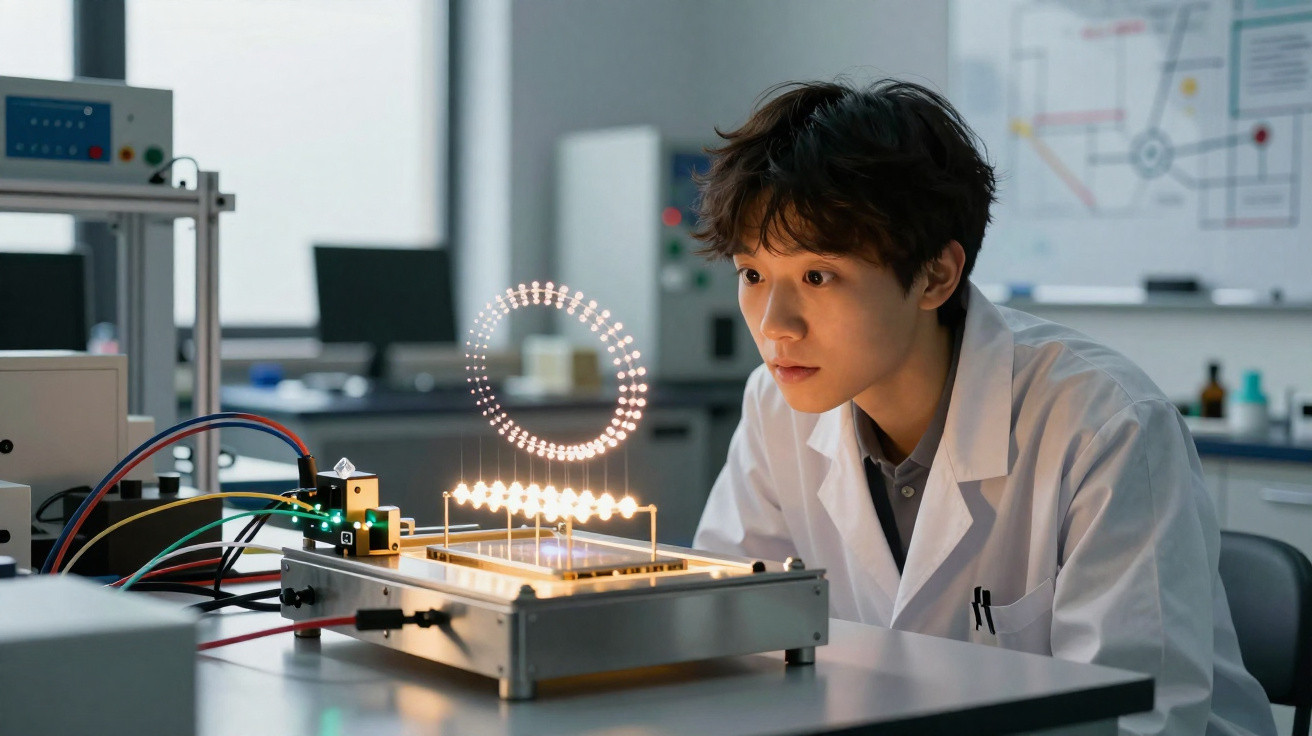
For several months, researchers have been speculating that time crystals may finally have been produced: unusual crystals whose atomic arrangement repeats through time as well as space, allowing constant oscillation without energy.
That possibility is now official. Researchers have set out, in detail, how these extraordinary crystals can be made and measured. Two separate scientific groups also say they have created laboratory time crystals by following this blueprint, supporting the existence of a completely new phase of matter.
Although the finding may seem highly theoretical, it signals a new direction for physics. For decades, scientists have examined matter described as being ‘in equilibrium’, including metals and insulators.
Yet the Universe is predicted to contain many more unusual forms of matter that are not in equilibrium and have barely been investigated. Time crystals are among them, and it now appears that they are real.
Having the first example of non-equilibrium matter could advance our understanding of the surrounding world and support technologies such as quantum computing.
“This is a new phase of matter, period, but it is also really cool because it is one of the first examples of non-equilibrium matter,” said lead researcher Norman Yao from the University of California, Berkeley.
“For the last half-century, we have been exploring equilibrium matter, like metals and insulators. We are just now starting to explore a whole new landscape of non-equilibrium matter.”
What are time crystals?
The idea of time crystals has been discussed for several years, so it is worth revisiting the concept.
Nobel Prize-winning theoretical physicist Frank Wilczek first predicted them in 2012. Time crystals are structures that seem to move even when they are at their lowest-energy condition, called the ground state.
Normally, a material at its ground state - also termed a system’s zero-point energy - should theoretically be unable to move, as motion would require energy to be used.
Wilczek suggested that time crystals might be an exception.
Conventional crystals have atomic arrangements that recur in space, such as the carbon lattice in a diamond. However, like rubies and diamonds, they are stationary because they remain in equilibrium at their ground state.
Time crystals, by contrast, have a pattern that repeats through time as well as space. They continue oscillating while in their ground state.
They can be compared with jelly: tap it and it wobbles repeatedly. Time crystals behave similarly, except that their movement takes place without energy.
A time crystal is therefore like jelly that continually oscillates in its natural ground state. This inability to stay still is what makes it an entirely new, non-equilibrium phase of matter.
Norman Yao’s blueprint for time crystals
Predicting the existence of time crystals is one challenge; producing them is another. That is where the new study becomes important.
Yao and his colleagues have produced a detailed blueprint explaining precisely how to create a time crystal and measure its characteristics. It also forecasts the various phases around time crystals, effectively mapping the equivalents of solid, liquid and gas phases for this new form of matter.
In the paper, published in Physical Review Letters, Yao describes the work as “the bridge between the theoretical idea and the experimental implementation”.
The work goes beyond theory. Using Yao’s blueprint, two independent teams - one at the University of Maryland and the other at Harvard - have followed the method to produce time crystals of their own.
Both results were announced late last year through the preprint website arXiv.org (here and here), and each has been submitted to a peer-reviewed journal for publication. Yao is a co-author of both papers.
Until the papers are published, the two claims should be treated with scepticism. Even so, it is encouraging that separate teams have used the same blueprint to form time crystals from very different systems.
University of Maryland and Harvard experiments
At the University of Maryland, time crystals were made from a chain of 10 ytterbium ions, with the electron spins of all the ions entangled.
Chris Monroe, University of Maryland
To convert this arrangement into a time crystal, the team needed to keep the ions out of equilibrium. They did so by alternately striking them with two lasers: one laser generated a magnetic field, while the other partially flipped the atoms’ spins.
Since every atom’s spin was entangled, the atoms formed a stable, repeating spin-flip pattern characteristic of a crystal.
That part was relatively ordinary. For the system to qualify as a time crystal, however, it needed to break time symmetry. When the researchers watched the chain of ytterbium atoms, they found an unusual effect.
The two lasers periodically disturbing the ytterbium atoms caused the system to repeat at twice the period of the disturbances - something a normal system could not do.
“Wouldn't it be super weird if you jiggled the Jell-O and found that somehow it responded at a different period?” said Yao.
“But that is the essence of the time crystal. You have some periodic driver that has a period 'T', but the system somehow synchronises so that you observe the system oscillating with a period that is larger than 'T'.”
Changing the magnetic fields and laser pulses would cause the time crystal to shift phase, much as an ice cube changes as it melts.
Norman Yao, UC Berkeley
Harvard’s time crystal used a different arrangement. Its researchers employed tightly packed nitrogen-vacancy centres in diamonds, but achieved the same outcome.
“Such similar results achieved in two wildly disparate systems underscore that time crystals are a broad new phase of matter, not simply a curiosity relegated to small or narrowly specific systems,” explained Phil Richerme from Indiana University, who was not involved in the study, in a perspective article accompanying the paper.
“Observation of the discrete time crystal… confirms that symmetry breaking can occur in essentially all natural realms, and clears the way to several new avenues of research.”
Yao’s blueprint is published in Physical Review Letters, while the Harvard time crystal paper can be found here and the University of Maryland paper here.
Update 31 January 2017: We previously described the continuous oscillation of time crystals as perpetual motion in a ground state, but that comparison was inaccurate. This explanation has now been amended.



Comments
No comments yet. Be the first to comment!
Leave a Comment