
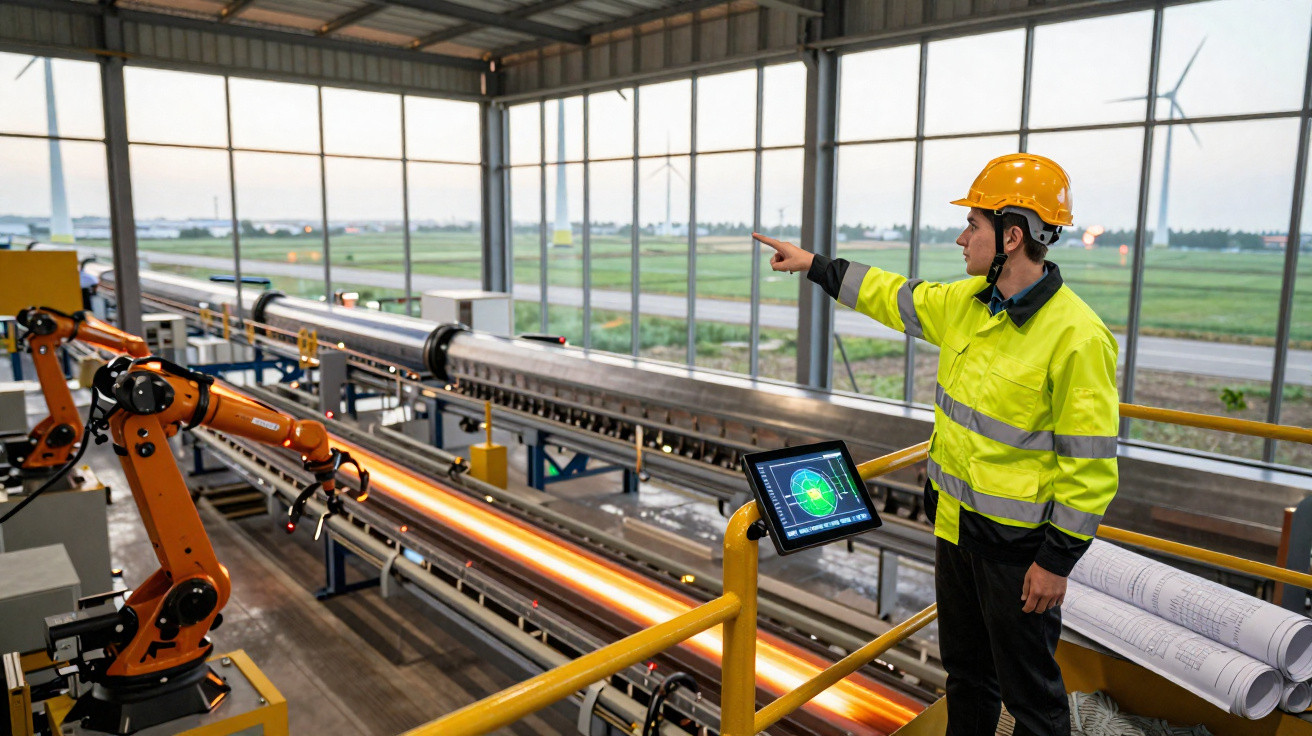
Introduction – On a blustery industrial plain in northern France, an unassuming building site signals a potentially significant change for European manufacturing.
Beyond the hoardings and cranes, a €500 million development is emerging. Its purpose is not merely to produce steel, but to transform the role steel will play in the next phase of electrification across Europe and further afield.
A €500 million commitment to electrical steel
France is placing a substantial bet on the energy transition through a €500 million factory in its northern industrial region, dedicated to what is known as electrical steel.
This specialist material, also referred to as electric steel or grain-oriented steel, is essential in transformers, electric motors and generators. Without it, large-scale deployment of electric vehicles, wind turbines and modernised electricity grids would come to a halt.
The plant targets a slice of a global electric steel market projected to reach around €57 billion by 2032.
The project is intended to establish a European source of this vital material just as demand is accelerating and geopolitical tensions are highlighting the dangers of depending on Asian imports.
Why northern France was selected
Northern France was chosen for clear reasons. The area combines decades of steelmaking expertise with established logistics infrastructure and a sizeable industrial workforce.
- Rail links provide direct access for heavy freight.
- Major Channel and North Sea ports are nearby.
- The region already has a well-developed network of metalworking and automotive suppliers.
- Former mining and steelmaking towns have high unemployment, creating a workforce that can be retrained.
Local authorities are presenting the scheme as part of a wider drive to convert a formerly declining industrial area into a centre for low-carbon manufacturing. Construction and machinery are being financed through a combination of public funding, EU green funds and private investment.
A €57 billion electric steel market at stake
Electrical steel may appear to be a specialised product, but the scale of the market is considerable. Manufacturers of transformers and motors worldwide are rapidly increasing their orders as electricity networks are upgraded and electric vehicle sales rise.
French officials cite market analysts who anticipate that global demand for electrical steel will more than double by 2032, taking the market to approximately €57 billion. Europe currently has less production capacity than Asia, making carmakers and energy businesses vulnerable to supply constraints and price volatility.
The French factory aims to anchor at least part of that rising demand within the EU, reducing dependence on imports from China, Japan and South Korea.
Those behind the plant are relying on long-term agreements with European vehicle manufacturers, transformer makers and renewable energy firms that want supply chains which are more secure and easier to trace.
What electrical steel really is
Electrical steel is far more than standard steel given a sophisticated name. It is an alloy containing carefully managed levels of silicon and other elements, processed specifically to control its response to magnetic fields.
This is important because transformers and electric motors continually alter magnetic fields to transfer energy. Steel with poor properties loses some of that energy as heat, whereas electrical steel limits those losses and improves efficiency.
The two principal electrical steel types
| Type | Main use | Key feature |
|---|---|---|
| Grain-oriented | Power transformers, high-voltage equipment | Optimised in one direction to reduce core losses |
| Non-oriented | Electric motors, generators, EV drivetrains | Performs evenly in all directions, ideal for rotating machines |
The French facility is expected to serve both markets, particularly by producing grades for electric vehicle motors and compact transformers used by charging infrastructure.
Employment, expertise and regional politics
For local politicians, the development is as significant politically as it is industrially. Northern France has experienced factory closures and social unrest, so a prominent factory focused on the future conveys a very different message.
Hundreds of direct jobs are promised, with training programmes in metallurgy, advanced rolling, and quality control.
Technical schools and regional training centres are already developing revised courses. The objective is to bring together established steelmaking knowledge and new capabilities in digital process management and energy-efficient manufacturing.
Trade union representatives have given the announcement a cautious welcome, while seeking assurances on employment conditions and long-term job protection. Local people, familiar with ambitious plans that have sometimes failed to materialise, are waiting to see tangible progress before accepting the claims fully.
Electrical steel as a climate and industrial policy instrument
The factory has a role beyond employment: it supports a broader aim of reducing the carbon footprint of European industry while retaining high-value manufacturing within Europe.
Making electrical steel in Europe, particularly with low-carbon electricity, could cut emissions compared with importing material transported over long distances. It would also give policymakers greater scope to impose standards for traceability and recyclability.
France and the EU are increasingly describing materials such as electrical steel as “strategic” because they support critical systems including high-voltage grids, data centres and electric vehicle supply chains.
Having at least one large-scale European supplier offers some insurance in case of trade disputes or export restrictions from major producer countries.
The risks within the €500 million investment
A €500 million factory carries significant risks. Electrical steel is a technically demanding product, while established Asian manufacturers benefit from decades of expertise and economies of scale.
The commercial case could deteriorate if demand expands more slowly than forecast or lower-cost overseas rivals drive prices down. Securing raw materials at dependable prices, notably high-quality iron ore and alloying elements, is another challenge.
Technological changes present a further uncertainty. Some areas of demand could shift more rapidly than expected if vehicle makers adopt motor technologies requiring less electrical steel, or if solid-state transformers gain widespread use.
How the project could affect everyday life
For most people, electrical steel remains largely unseen, even though it is found in many familiar products and services.
- Whenever a phone is charged, electricity passes through transformers containing electrical steel cores.
- Electric vehicles need high-performance motor laminations to achieve greater range.
- Wind turbines and hydroelectric plants use generators containing stacks of accurately cut electrical steel sheets.
- Hospitals and data centres rely on dependable transformers to maintain clean, reliable electricity.
Should the northern France factory prove successful, it could reduce costs and improve the availability of these essential components across Europe. This could in turn enable a quicker expansion of charging points, renewable energy schemes and more efficient household appliances.
Key terms and possible future outcomes
As the development progresses, two technical terms are likely to feature regularly: “core losses” and “high-frequency grades”. Core losses refer to the watts of energy dissipated within the magnetic core of a motor or transformer. Lower losses reduce wasted electricity and heat. High-frequency electrical steel grades can cope with the rapid switching required by modern power electronics, especially advanced inverters and fast chargers.
Analysts set out two plausible paths for the French factory. Under a high-demand scenario, electric vehicle sales continue to increase, grid operators make major investments in renewal, and Europe supports local-content requirements. The factory would then operate close to full capacity, potentially leading to expansion and related facilities for recycling, coating and cutting.
Under a more difficult scenario, growth weakens, competition intensifies and customers force down prices. To remain profitable, management would have to concentrate on premium high-efficiency grades while increasing automation across the production line.
For surrounding towns, either outcome represents a transition: away from the smokestack steelmaking of the 20th century and towards quieter, more specialised production central to the electricity networks of the 21st century.


Comments
No comments yet. Be the first to comment!
Leave a Comment