
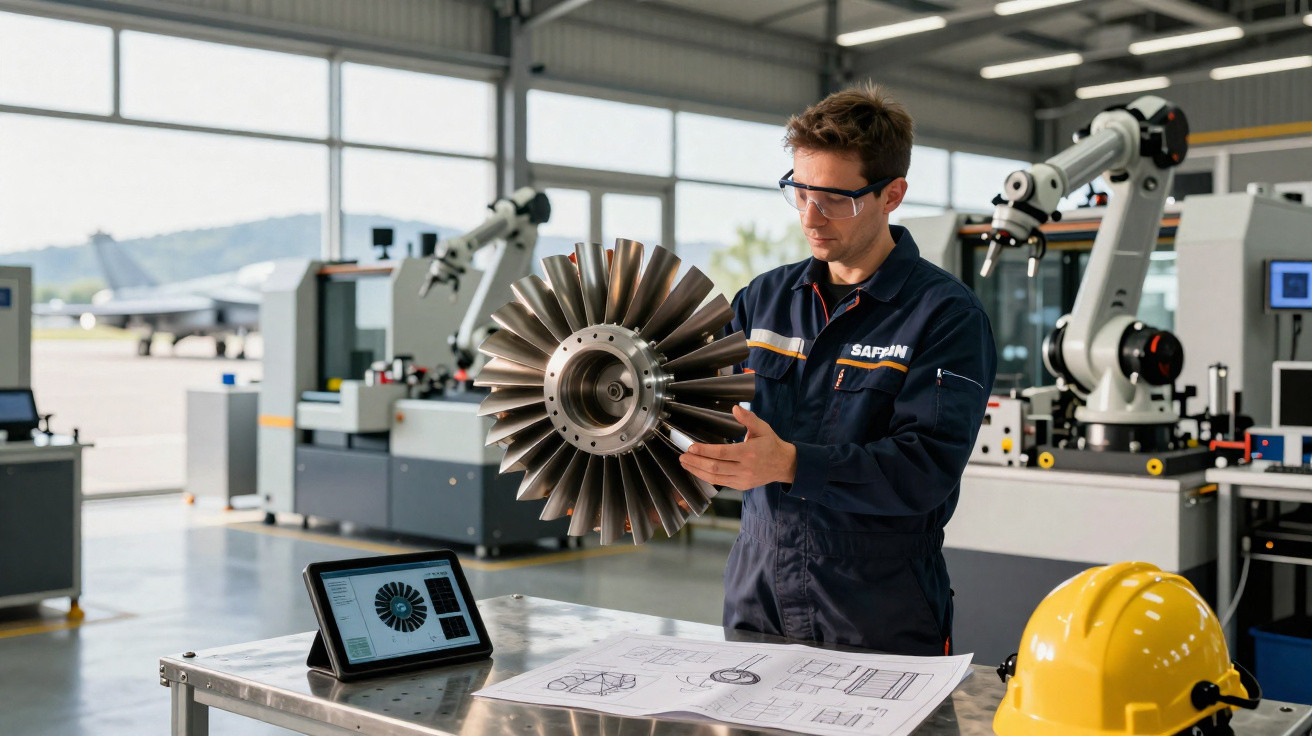
In Le Creusot, Burgundy’s long-established steelmaking centre, Safran Aircraft Engines is undertaking a substantial modernisation of its plant. The project will transform the facility from a low-profile supplier into a central part of France’s Rafale fighter programme.
Safran’s €70 million investment in Le Creusot
Safran is committing approximately €70 million to enlarge its Le Creusot factory by 9,000 square metres, bringing its overall industrial footprint to about 26,000 square metres. The additional facilities are scheduled to be completely operational in 2029, following a gradual rise in activity beginning in 2026.
Until now, the plant’s role has been highly specialised: it machines low-pressure turbine discs for LEAP and CFM56 engines, the widely used powerplants fitted to numerous Airbus A320 and Boeing 737 aircraft around the world.
The expansion represents a significant step up. Safran intends to introduce manufacturing lines for highly intricate rotating components used in two strategically important engines: the M88 powering the Rafale fighter and the GE90, which has been fitted to many Boeing 777 long-haul aircraft.
Le Creusot is moving from a specialised civil aerospace workshop to a strategic node for France’s premier combat aircraft.
From civil to military: increased criticality
Producing rotating components for a military jet engine presents very different demands from making parts for commercial airliners. The tolerances are stricter, operating temperatures are greater and the certification process is considerably more exacting.
Safran plans for Le Creusot to become a second source of complex M88 rotating parts, complementing its existing Evry-Corbeil facility near Paris. This additional capacity matters greatly to Rafale operators, particularly export customers seeking assurance that engine spares will remain available for decades.
France and its partners have recorded hundreds of Rafale orders since 2015, as Egypt, India, Greece and other countries have signed contracts. Growing export demand requires engine output to match it, since a bottleneck affecting one critical component could hold up delivery of the entire aircraft.
By doubling up key M88 production capabilities, Safran aims to shield Rafale output from shocks in supply chains, politics or logistics.
Why sovereignty is built into the factory
French officials and Safran leaders frequently refer to “industrial sovereignty”, an expression that may appear abstract until considering a fighter engine. Every disc and rotating component embodies years of metallurgical expertise, sophisticated heat-treatment techniques and rigorous non-destructive testing.
Sending such work to third countries would create security concerns and increase exposure to export controls. Retaining these activities internally and within France gives the French state, as well as its export customers, greater control over quality and availability.
For purchasing nations ranging from New Delhi to Cairo, the message is straightforward: the Rafale relies on a resilient, largely domestic supply chain rooted in sites such as Le Creusot, rather than a vulnerable collection of subcontractors spread worldwide.
The M88: a small engine with major ambitions
Safran developed the M88, a twin-spool afterburning turbofan, specifically for the Rafale. Although relatively compact at around 3.5 metres long and with a dry weight of just under 900 kg, its current principal version produces up to 75 kN of thrust using its afterburner.
Safran is already developing enhanced versions, notably the M88 T-REX, which is intended to raise thrust by roughly 20% for future Rafale standards including the F5 configuration. Greater thrust improves payload and range, while also imposing more demanding operating conditions on components manufactured at Le Creusot.
| Key M88 features | Details |
|---|---|
| Engine type | Afterburning twin-spool turbofan |
| Typical thrust class | Approx. 50 kN dry, 75 kN with afterburner |
| Main application | Dual-engine installation on Rafale fighters |
| Design approach | Modular, with rapid maintenance in mind |
Inside Safran’s ‘closed-door’ factory
Le Creusot already serves as one of Safran’s leading examples of “Industry 4.0” principles. Its machinery communicates with central systems, information is exchanged in real time and automation is extensively deployed.
Its most notable method is “closed door machining”. Under this arrangement, groups of multi-axis machine tools operate for hours without human involvement. Operators prepare the work, shut the doors and allow robots and cutting tools to continue throughout the night.
Sensors constantly monitor temperatures, vibrations and tool wear so that machines can correct course mid‑process or flag anomalies before a part is lost.
This system offers several benefits: more consistent quality, better use of costly equipment and fewer production stoppages. When machining discs positioned only millimetres from gases approaching 2,000°C inside a jet engine, even minor variations are important.
Jobs, skills and the local effect
The Le Creusot facility currently has around 200 employees. Safran expects to recruit approximately 100 additional staff by 2032, once the new lines attain full capacity. These jobs will extend beyond traditional machine-operator roles, increasingly combining practical machining, data analysis and upkeep of advanced machinery.
- Precision machinists working with nickel and titanium alloys
- Process engineers supervising automated lines
- Quality specialists concentrating on non-destructive testing
- Maintenance technicians trained to work with intelligent, connected machinery
For the wider region, which has a deep industrial heritage but has also experienced deindustrialisation, this kind of advanced investment can keep skilled work local and draw younger employees to an area often viewed as ageing.
How Le Creusot fits Safran’s French network
Safran’s French strategy depends on a closely connected network of specialist facilities. Le Creusot is not an isolated site, but one element of a deliberately balanced system.
Near Paris, Safran’s Villaroche facility undertakes assembly and testing for numerous engines, while Evry-Corbeil concentrates on critical rotating components, including M88 elements. Gennevilliers focuses on maintenance and repair. Elsewhere in France, other subsidiaries manufacture landing gear, avionics and defence electronics.
By distributing capabilities, Safran reduces the risk that a single incident - from a fire to a cyberattack - can halt production of an entire engine family.
Within this network, Le Creusot acts as a precision metalworking centre with an expanding role in military programmes. For the Rafale, this redundancy is an advantage in discussions with export customers, who closely assess life-cycle support as well as aircraft performance.
What “rotating parts” actually means
The term “rotating parts” may seem imprecise, but for an engine such as the M88 it includes some of the most challenging components to manufacture:
- High-pressure and low-pressure turbine discs, which retain blades rotating at thousands of revolutions per minute
- Compressor discs that compress incoming air to high pressures
- Shaft components that transfer power through the engine
These parts must withstand immense centrifugal loads and repeated thermal cycles over many years. A microscopic flaw within the metal, or a burr on a machined surface, can initiate a crack that enlarges with every flight cycle. This explains why Safran invests heavily in non-destructive testing, including ultrasonic inspection and advanced X-ray systems, at facilities such as Le Creusot.
Risks, scenarios and potential problems
If a production facility such as Le Creusot encounters difficulties, a major interruption could reduce M88 engine deliveries, delaying new Rafale aircraft or leaving some aircraft grounded because spare parts are unavailable.
The consequences are not purely financial. For air forces relying on the Rafale for deterrence or combat operations, these delays may disrupt operational planning. Capacity shared between several factories limits this exposure. The new investment therefore functions as a form of insurance for France and its export operators alike.
There is also a geopolitical dimension. If relationships deteriorate with particular supplier states, or export controls on certain materials and components become more restrictive, carrying out more value-added work domestically gives Paris greater room for manoeuvre.
What this means for the future of European air power
The Le Creusot expansion comes as European defence budgets face pressure from security concerns in Eastern Europe and the Middle East. Many governments are reviewing their fighter fleets, comparing European platforms such as the Rafale and Eurofighter Typhoon with US-built aircraft.
For France, a robust and resilient industrial foundation behind the Rafale is vital to its argument: a combat aircraft supported by predominantly European technology, supply chains less vulnerable to Washington’s export regulations and a manufacturer capable of adapting production rates rapidly.
In the longer term, the experience gained in M88 rotating parts at Le Creusot could contribute to future engine projects, including those associated with the Franco-German-Spanish Future Combat Air System. Expertise in high-temperature alloys, precision machining and automated inspection rarely remains restricted to a single engine.
For readers less familiar with aerospace, Le Creusot illustrates a simple point: future air power depends on more than pilots and designers. It also relies on unobtrusive workshops, sophisticated lathes and milling machines, and employees who ensure a turbine disc is accurate to within a few microns. Without their work, even the most advanced fighter aircraft remains firmly on the ground.




Comments
No comments yet. Be the first to comment!
Leave a Comment