
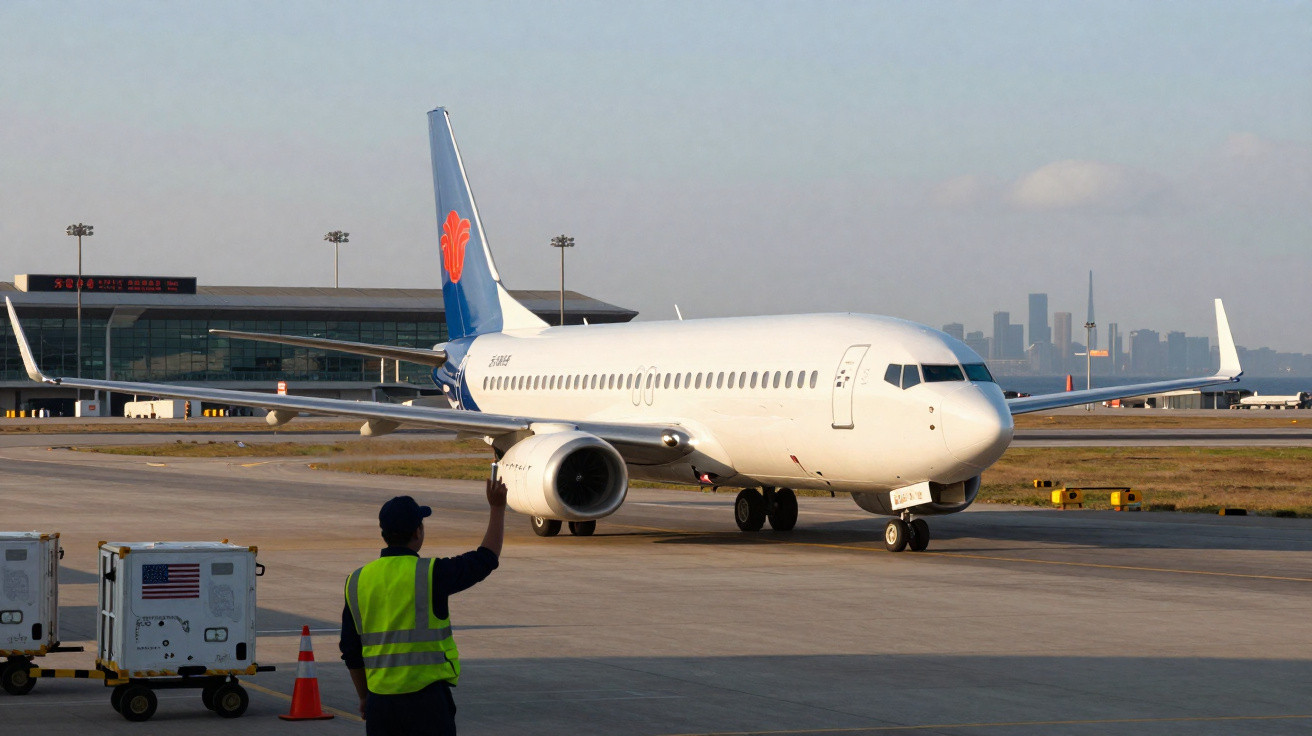
On a grey Seattle morning, with low cloud pressing over Puget Sound, a line of white-and-blue Boeing aircraft stood silently on the apron. Chinese airline logos remained on their tail fins, faded slightly after months of rain and wind. Ground staff worked around them with familiar efficiency, yet there was nothing ordinary about the scene. These were not freshly delivered aircraft departing for new routes; they were planes returning to their point of origin.
Some had carried thousands of passengers around China. Others had scarcely left the production line before becoming trapped in regulatory uncertainty.
China is now beginning to return Boeing aircraft to the United States.
No one on the apron needed to spell it out: a significant change was under way.
Why Chinese Boeing jets are suddenly flying in the opposite direction
When a nation starts returning aircraft to their manufacturer, it represents more than a practical transport decision. It sends a message.
China’s move to send certain Boeing jets back to the US sits at the meeting point of politics, safety worries and uncompromising financial calculations. Airlines that once competed fiercely for delivery positions are reassessing their fleet plans from the ground up.
For Boeing, every aircraft that returns reflects confidence that was lost and only partially regained. For Chinese airlines, the decision is about limiting losses in a market where traffic flows, passenger behaviour and alliances have shifted more rapidly than their order books could accommodate.
Consider the 737 MAX, an aircraft whose name became associated with aviation disruption long before these planes began their journeys back to America.
Before the crashes and worldwide grounding, Chinese airlines ranked among Boeing’s keenest customers. They ordered dozens of aircraft, paid for them and, in many cases, had them built, painted and parked while awaiting approval. The model was then grounded, route networks changed and passenger demand collapsed during Covid.
Several of these aircraft never entered service in the way airline planners had envisaged. Instead, they remained in storage and lost value on balance sheets as operators gradually recognised that they owned assets no longer suited to their circumstances.
The returns currently taking place amount to a discreet reset. In financial terms, they appear to be sensible portfolio decisions: reducing capacity, spreading risk, simplifying fleets and arranging new agreements with Airbus or alternative leasing firms.
On the ground, however, they point to something broader. China and the US remain locked in an extended economic confrontation, with aviation becoming another area of pressure. Every aircraft returned slightly reduces reliance on an American supplier and brings Chinese airlines closer to relying on Airbus-and, ultimately, domestically produced COMAC aircraft.
This isn’t just a story about airplanes; it’s a story about who gets to build the future of flight.
How the Boeing aircraft “reverse pipeline” operates
What happens when China concludes that a Boeing jet is more useful back in the US than flying in Chinese airspace?
The procedure is more sensitive than it might appear. It starts with discreet talks involving the airline, Boeing and frequently the leasing companies positioned between them. Teams then work through complex contracts clause by clause, disputing penalties, storage charges, repainting costs and the technical modifications required to make an aircraft attractive to another customer.
Only after the paperwork is finally settled are the aircraft ferried away. These carefully crewed positioning flights usually have empty cabins and no passengers, with an air of unresolved business in every seat.
Most people recognise that point at which they realise they are keeping something costly that no longer suits their life.
For one large Chinese airline, that realisation reportedly emerged during a difficult internal review late in 2023. Executives examined spreadsheets showing unused capacity, postponed routes and growing maintenance bills for aircraft that rarely flew. At some stage in that meeting, someone raised the question no one wanted to hear: “What if we send the planes back?”
That question led to weeks of discussions with Seattle, prolonged refinancing negotiations and, eventually, a plan to return a group of 737 MAX aircraft across the Pacific. It was a quiet withdrawal, carried out one plane at a time.
Behind the drama lies straightforward reasoning. If traffic growth is below expectations, political tensions make approvals uncertain and Airbus is prepared to offer more favourable conditions, stored Boeing aircraft can appear less like an opportunity and more like a liability.
In truth, few people study every long-term fleet agreement before the world changes. But these contracts become extremely important once an airline wants to leave an arrangement. Lawyers debate delivery schedules and performance guarantees, engineers inspect every part, and financiers assess how much value can be recovered by placing aircraft with US or other non-Chinese operators.
What appears externally to be “China sending jets back” is, internally, a complicated combination of risk control, pride and practicality.
What Boeing returns mean for travellers, investors and aviation enthusiasts
For an ordinary traveller searching for affordable fares, these strategic decisions may seem remote. Nevertheless, they influence the way people fly.
As Chinese airlines reduce their exposure to Boeing, they commonly depend more heavily on Airbus fleets for regional services and international expansion. This affects the aircraft seen at the gate, the connections offered and even the comfort of a future long-haul journey.
In the US, returned aircraft could begin second lives with low-cost airlines, appearing on domestic routes with refurbished cabins and another opportunity to collect loyalty points.
For investors, this exchange is a reminder that aviation is never solely about impressive new aircraft. Timing matters just as much.
Investing in Boeing, Airbus or airline shares without considering these geopolitical crosswinds is like boarding a flight without reviewing the forecast. Share-price charts cannot fully capture how quickly a regulatory ruling in Beijing or Washington can redirect equipment worth billions of dollars.
A frequent error is to treat orders as permanent. They are not; they are relationships. Relationships can deteriorate, grow distant or be quietly dismantled at 3 a.m. during a video call between two exhausted executives.
The people nearest to these events-pilots, engineers and planners-usually describe them in more practical language than headlines do.
“Aircraft don’t care about politics,” one veteran maintenance engineer in Chengdu told me over a scratchy line. “They just want to fly. We’re the ones who decide where they sleep at night.”
Their everyday work consists of checklists rather than geopolitics, but they experience the effects of decisions made far beyond their level of responsibility.
- Watch the fleet mix – Shifts in airline fleets can reveal long-term strategic changes and future route maps.
- Track regulatory moves – Approvals or restrictions affecting particular aircraft types can rapidly alter traffic flows.
- Follow delivery and return patterns – Aircraft returning to the US often point to deeper financial or political pressure.
- Listen to earnings calls – Airlines and manufacturers often indicate these trends quietly before they reach the headlines.
- Look beyond logos – A Chinese tail fin on a Boeing fuselage shows that global trade still depends on shared equipment, even as countries move apart.
Where the Boeing–China relationship may go next
Chinese-liveried Boeing aircraft arriving on US soil are likely to represent only one chapter in a longer and more complicated story. Some will be dismantled, refurbished and operated by airlines that care little about their intended first destination. Others may be placed in desert storage, awaiting a market that feels less unsettled.
At the same time, China is advancing its own aircraft programme through COMAC’s C919, with the ambition of eventually replacing at least some of the aircraft currently supplied by Boeing and Airbus. In ten years, the returns seen today may be viewed as early signs of a more fragmented aviation industry, in which regions rely less heavily on a single Western manufacturer.
For frequent flyers and aviation enthusiasts, the emotional point is straightforward: aircraft are designed to go forwards, not backwards.
Yet this reverse movement of aircraft across the Pacific conveys an honest truth about the present moment. Countries are hedging their positions. Companies are defending margins. Safety regulators are protecting their standing after painful failures. No one wants to be left with the wrong aircraft at the wrong time.
In one sense, China returning Boeing planes reflects globalisation encountering turbulence-and attempting, imperfectly, to regain level flight.
| Key point | Detail | Value for the reader |
|---|---|---|
| China is returning Boeing jets | Some 737 MAX aircraft produced for Chinese airlines are being sent back to the US through negotiated agreements | Helps you understand headlines about “returned aircraft” as strategic decisions rather than isolated events |
| Politics and profit are intertwined | Fleet decisions now lie at the intersection of US–China tensions, safety concerns and post-Covid changes in demand | Provides context when route changes, aircraft substitutions or aviation share-price movements occur |
| Aircraft returns influence how we fly | Returned jets may be redeployed on US or other routes, while Chinese airlines rely more on Airbus and domestic alternatives | Explains why the aircraft at your gate-and the options in your booking app-continue to change |
FAQ:
- Question 1 Why is China returning Boeing aircraft to the US?
- Answer 1 Primarily because earlier fleet strategies no longer fit current demand, regulatory conditions and political tensions, meaning some aircraft are more valuable being remarketed than remaining unused in China.
- Question 2 Does this mean Chinese airlines are finished with Boeing?
- Answer 2 Not completely, but it does indicate a clear effort to reduce dependence and rebalance fleets, with Airbus and domestic manufacturers gaining influence.
- Question 3 Is it safe to fly on these returned planes once they enter US service?
- Answer 3 Yes. Before carrying passengers for a new operator, they undergo stringent inspections, receive upgrades where required and gain new certification under local aviation rules.
- Question 4 How does this affect ticket prices?
- Answer 4 Additional capacity returning to Western markets can help sustain competitive fares, while lower capacity on certain China-related routes may keep some prices high.
- Question 5 What should I follow if I am interested in this story?
- Answer 5 Monitor announcements about Boeing’s order book, COMAC’s progress and any new regulatory action by Chinese and US aviation authorities-they provide early signs of the next change.


Comments
No comments yet. Be the first to comment!
Leave a Comment