
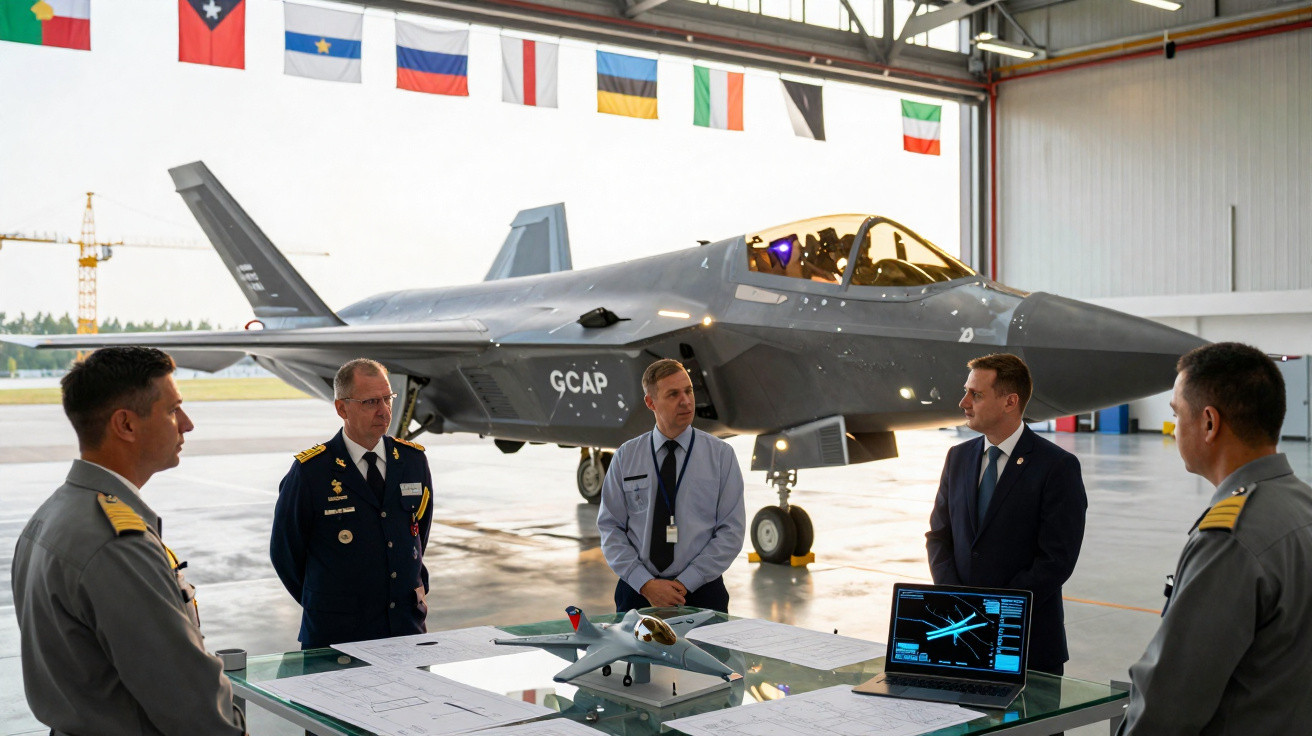
After months of mounting friction with France, driven by the struggle between Airbus and Dassault Aviation for supremacy within the FCAS Programme, the German government appears increasingly willing and closer to exploring potential participation in the Global Combat Air Programme (GCAP). This is the joint UK, Italian and Japanese effort to develop a new sixth-generation fighter aircraft. While it remains at the research and development stage, its partners expect it to enter service in 2035.
Germany considers the Global Combat Air Programme
During German Chancellor Friedrich Merz’s recent visit to Italy, European media reported that Rome had indicated it was open to considering Berlin’s possible accession to the programme. GCAP is led by Mitsubishi Heavy Industries in Japan, BAE Systems in the United Kingdom and Leonardo in Italy. It envisages a stealth fighter capable of operating alongside drones and collaborative combat systems and is also intended as the eventual replacement for the Rafale and Eurofighter Typhoon.
Germany’s potential move towards GCAP comes against a backdrop of continuing tensions within the FCAS (Future Combat Air System) programme, the French, German and Spanish project to create a sixth-generation air combat system with an operational target of around 2040. Launched more than eight years ago, FCAS has encountered problems over the allocation of industrial work and technological leadership between Dassault Aviation and Airbus Defence and Space.
By December 2025, sources indicated that Dassault was seeking control of 80% of the programme, a claim rejected by the French company. French sources, meanwhile, accuse Airbus of seeking to extend its decision-making influence by leveraging its role as the industrial representative for Germany and Spain. These disagreements have delayed the move into the technology demonstrator phase, creating uncertainty over the programme timetable.
FCAS tensions and Germany’s GCAP interest
Against this background, Germany has displayed stronger interest in GCAP. However, although the reasons behind this stance have not been entirely clarified, some observers argue that it may be seen both as a strategic alternative and as leverage in negotiations with France. From this perspective, Europe’s division between two major sixth-generation programmes - FCAS and GCAP - raises questions over the financial and industrial feasibility of sustaining parallel developments amid limited resources and intensifying global competition.
Whatever its outcome, Germany’s move highlights an ongoing reshaping of Europe’s defence-industrial architecture, in which traditional alliances are coming under pressure from the technological and economic scale involved in developing the continent’s future air power. In the coming days, officials from Japan’s foreign affairs and defence ministries will travel to Germany to attend the Munich Security Conference, where analysts believe Germany’s potential participation in the GCAP programme could be discussed.



Comments
No comments yet. Be the first to comment!
Leave a Comment