
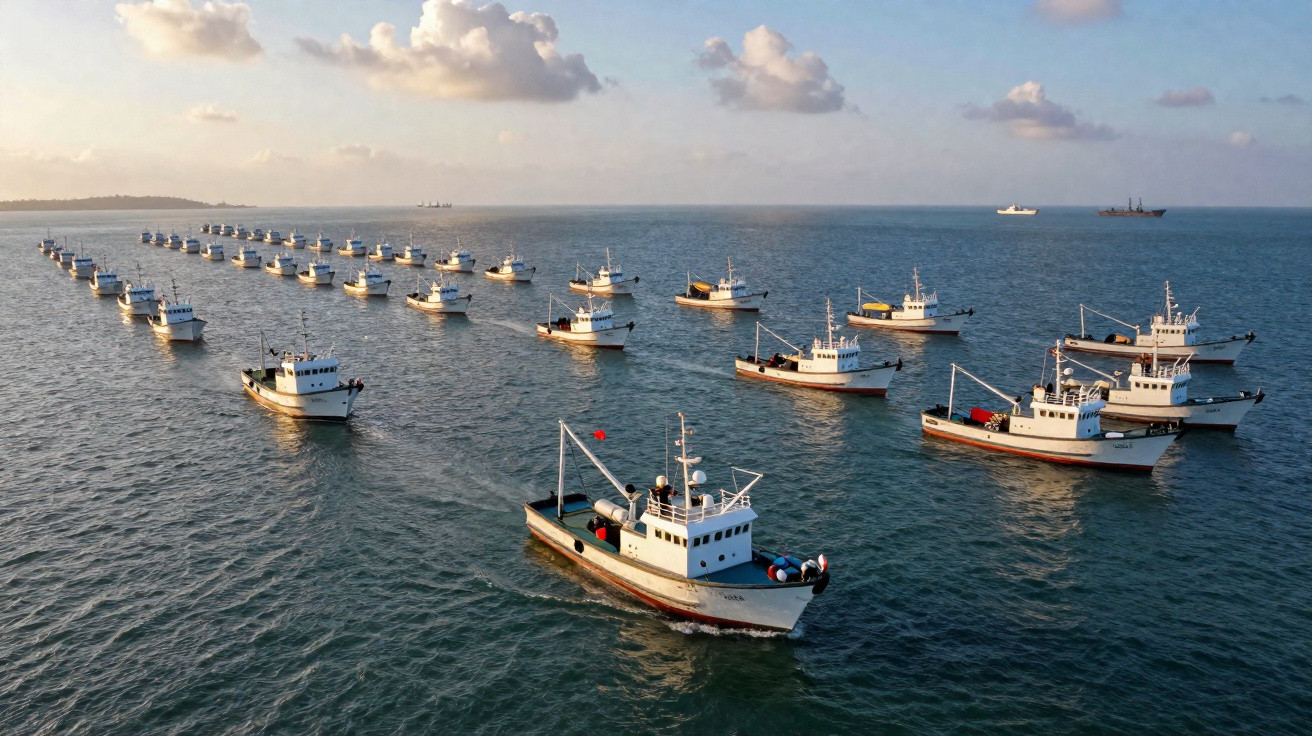
What initially appeared to be an ordinary surge in fishing activity rapidly became something else entirely: more than 1,400 Chinese fishing vessels were directed into a compact formation spanning about 200 nautical miles, forming a man-made obstruction through which commercial ships reportedly had to navigate.
China’s 1,400-ship wall at sea
International media, citing satellite images and maritime traffic records, reported that the mobilisation occurred in the East China Sea in mid-January, a region already marked by intense territorial disputes.
Fishing vessels suddenly stopped their usual work and departed from several ports along China’s coastline. Within a few hours, they had gathered within a clearly defined maritime area more than 200 miles long.
The density of vessels grew so high that several merchant ships reportedly altered course, zigzagging to avoid the floating barrier.
Nor was this an isolated or unusual occurrence. On 25 December, tracking maps showed a comparable arrangement: two extended, parallel lines of Chinese fishing vessels ran for over 466 kilometres, creating an inverted “L”. Analysts believe the two incidents indicate deliberate organisation, not an improvised response.
For Beijing, the exercise demonstrated a capability that concerns regional authorities more than an individual naval drill: the ability to incorporate civilian vessels smoothly into strategic operations.
Fishing fleet or tactical formation?
Maritime security specialists say the deployment fulfilled several strategic purposes simultaneously.
- Control of disputed areas: A large group of slowly moving fishing boats can physically obstruct, delay or make it more difficult for foreign vessels to pass through sensitive waters.
- Test of logistics and command: Bringing together more than a thousand civilian vessels at short notice demonstrates substantial centralised control and coordination.
- Political pressure without open warfare: These actions deliver a clear message to competing states without deploying grey-hulled vessels or firing a single shot.
The manoeuvre fits what Western analysts commonly call China’s “maritime militia” approach: fishing vessels that are privately owned or locally managed but can be rapidly assigned to state-led tasks.
China is blurring the line between fishing boat and strategic asset, turning everyday vessels into instruments of pressure at sea.
By filling contested waters with civilian hulls instead of warships, Beijing makes any response more complicated. Interfering with or ramming a fishing boat brings very different political consequences from confronting a naval destroyer, even where the impact on shipping lanes may be comparable.
Why the East China Sea matters
Located between China, Japan, Taiwan and South Korea, the East China Sea is a shallow, congested and resource-rich body of water with overlapping territorial claims. Major shipping lanes run through the area, transporting energy supplies and manufactured products across Asia and further afield.
China’s manoeuvres seem especially significant for Japan and Taiwan, which already challenge Beijing’s claims in surrounding waters and near island groups including the Senkaku/Diaoyu chain.
Governments in the region are concerned that recurring “fishing formations” could gradually make a new maritime status quo seem normal. Should foreign vessels repeatedly confront Chinese-controlled barriers, effective control could change hands without any treaty or official declaration.
How satellites detected the operation
Although the planning was discreet, the January formation was far from undetectable. Commercial satellites followed the vessels’ clusters of Automatic Identification System (AIS) signals, while shipping-data platforms identified the abrupt and uncommon pattern. Analysts subsequently matched the vessel tracks with high-resolution satellite imagery.
| Aspect | January operation | 25 December operation |
|---|---|---|
| Number of vessels | Over 1,400 fishing boats | Hundreds of vessels in two main lines |
| Area/length | More than 200 miles of sea covered | Approx. 466 km in an inverted “L” |
| Impact on traffic | Merchant ships altered routes | Increased congestion near formation |
| Suggested purpose | Barrier and coordination drill | Patterned formation training |
Italian news outlet Agenzia Nova noted that the actions reflect an established doctrine: civilian fleets are used as the first layer of control, supported by coastguard vessels and, behind them, the navy.
New playbook for conflict without combat
For military planners, the central warning lies not only in the formations’ scale but in the prospect that they could become routine. Combining economic, civilian and military instruments in a coordinated action corresponds with Beijing’s wider use of so-called “grey zone” operations.
Instead of classic naval battles, regional tensions now unfold through fishing bans, port calls, coastguard stand-offs and dense walls of trawlers.
This approach allows China to gauge foreign responses, collect information and demonstrate determination while keeping an official conflict just beyond reach. A fishing-boat wall is difficult to overlook, yet equally difficult to define. Is it a navigational danger, a political signal or an undeclared blockade?
Risks for regional shipping and navies
For commercial shipping operators, such formations create a direct operational problem. Tankers and container ships work to strict timetables and follow routes planned in advance. Diverting around mobile barriers increases fuel expenditure, extends voyages and raises additional safety issues.
The challenge is more complex for naval forces. Warships crossing a dense concentration of fishing vessels face real risks of collision. Even an accidental incident could escalate rapidly if either party portrays it as hostile conduct.
- Poorly judged manoeuvres may lead to ramming incidents.
- Rescue missions become more difficult in congested waters.
- Communications become confused when hundreds of small vessels transmit, or switch their radios and AIS on and off, at will.
What “maritime militia” really means
The term “maritime militia” may sound theoretical, but it generally means real people aboard everyday-looking boats. Many are genuine fishers, although some receive subsidies, training or direct assignments from local authorities or maritime bodies.
In practical terms, this may include:
- Quickly answering orders to gather in specified areas.
- Following or crowding foreign ships entering disputed waters.
- Collecting intelligence and relaying it to coastguard or naval forces.
When hundreds of vessels move together in this way, they become a floating picket line, indicating who holds authority without making any formal declaration.
What could happen if tensions spike
Strategists in Tokyo, Taipei, Manila and Washington regularly model scenarios of this kind. One frequent concern is a minor event that rapidly develops into a wider crisis: a fishing vessel collides with a foreign coastguard ship; a distress signal is issued; larger vessels converge; and two or three states suddenly have assets in the same location, each facing domestic pressure not to retreat.
Were such a crisis to occur near a 1,400-ship barrier, rescue routes might be obstructed and sightlines reduced by the sheer volume of masts and hulls. That would make restrained, carefully calibrated action more difficult precisely when it is most essential.
Some analysts advocate clearer procedures for dealing with massed fishing fleets, including standard radio wording, emergency passageways through formations and improved satellite-data sharing. Others fear that codifying these measures could quietly grant legitimacy to the barriers.
For readers seeking to understand the terminology, one distinction is helpful: navies project power through warships, whereas a maritime militia projects presence through sheer numbers. Combined with coastguard patrols and legal claims, the result is a gradual tightening of control over contested waters-one dense fishing line at a time.




Comments
No comments yet. Be the first to comment!
Leave a Comment