
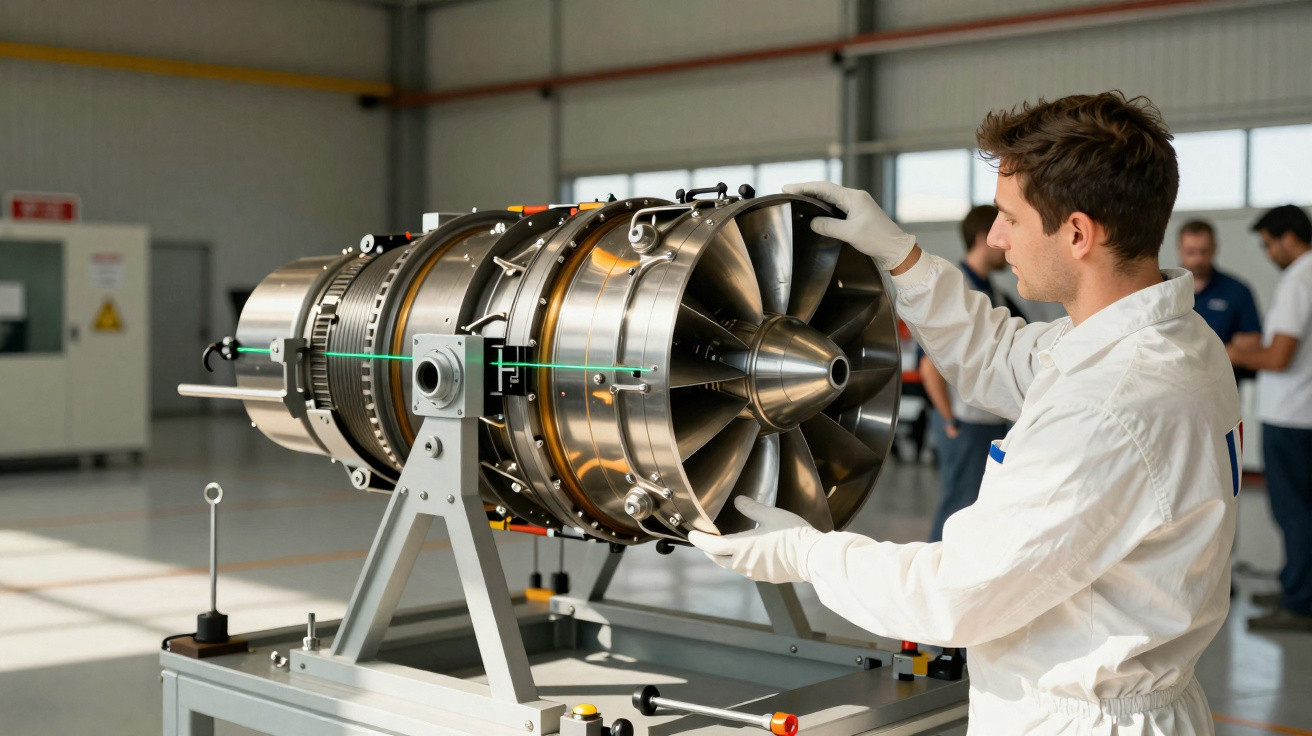
The trials are noisy, highly technical and at times punishing, but they influence France’s efforts to remain airborne, autonomous and competitive in an increasingly intense worldwide arms race.
France’s little-known advantage in the air
France frequently highlights its Rafale fighter aircraft. Much less attention goes to the M88 engine that powers it, or to the people developing its future. Central to this work is the DGA, France’s defence procurement and technology agency, which works closely with engine manufacturer Safran.
At Saclay, south of Paris, the DGA operates a test centre that French officials say has no equivalent elsewhere in Europe. The site can replicate with exceptional accuracy the air drawn in by a fighter engine at extreme speed and altitude. This degree of control, together with demanding trials, gives France a capability unmatched by any other European country at present.
France’s Saclay site is the only facility in Europe able to reproduce, in such detail, the real breathing conditions of a jet engine in combat flight.
The purpose goes beyond marginal engine improvements. It is to redesign critical components to endure temperatures that would defeat conventional metals, reduce fuel consumption and retain French control over the entire supply chain.
Inside the Saclay test bay
Since autumn 2025, DGA teams have operated future M88 versions on a test rig, taking them to their limits. The engines are run under simulated conditions similar to those a Rafale could encounter during a fast, high-altitude turn.
Reproducing a Rafale at 15,000 metres
The Saclay centre can adjust temperature, pressure and humidity in considerable detail. Its technicians can recreate a fighter travelling at about 15,000 metres and roughly Mach 1.5 through a turn, with the engine taking in cold, thin air.
They can reverse those conditions too, suddenly directing heated air at the engine to represent severe and repeated stresses over time. This “accelerated ageing” process lets engineers observe within hours deterioration that would otherwise require years of flight operations.
By compressing years of wear into a short test campaign, DGA engineers can spot weak points long before they show up in operational fleets.
Each trial is followed by work that is almost forensic in nature. The engine is dismantled, its parts are examined with microscopes and, in some instances, transferred to another DGA facility specialising in aerospace methods for more detailed assessment. Every fracture, distortion and sign of discolouration is used to refine the design models.
Turenne: taking materials towards their melting point
The principal innovation programme now under way is called “Turenne”, a DGA-financed initiative involving Safran. It concentrates on the most vulnerable and hottest section of a jet engine: the high-pressure turbine.
The turbine operating like a blast furnace
Positioned immediately behind the combustion chamber, the high-pressure turbine is exposed to gas temperatures exceeding 1,800°C. Within it, very small turbine blades rotate at extremely high speed. A fault in this section can have catastrophic consequences.
Engineers working on Turenne are testing advanced ceramics, new metallic superalloys and protective coatings to increase the temperatures the turbine can withstand. The higher the turbine inlet temperature, the more power and efficiency the engine can deliver.
| Component | Technology under test | Primary aim | Target temperature | Main partner |
|---|---|---|---|---|
| High-pressure turbine module | Technical ceramics | Raise turbine inlet temperature | Above 1,800°C | Safran Aircraft Engines |
| Rotor blades | Next-generation superalloys | Improve mechanical strength | 1,500–1,800°C | Safran Aircraft Engines |
| Surface coatings | Ceramic protective layers | Lengthen blade service life | Not specified | Safran Aircraft Engines |
| Engine operating conditions | Controlled atmospheric simulation | Replicate altitude and speed | -50 to +50°C / multiple altitudes | DGA Essais propulseurs |
In effect, this turns engine development into a sophisticated metallurgy laboratory. Engineers must balance competing factors: a ceramic with strong insulating properties may be fragile, whereas a durable superalloy may add weight. Saclay’s trials establish which solutions genuinely endure under realistic operating conditions.
Why France is unique in Europe
The UK, Germany, Italy and Spain all have significant aerospace industries, but France belongs to a small group of nations able independently to design, test and manufacture a complete modern fighter engine. That group generally includes the United States, Russia and, increasingly, China.
Together, the Saclay facility and Safran’s design and production capabilities enable France to:
- Move new materials from laboratory specimens to full-scale engine components
- Verify designs in combat-like environments without overseas assistance
- Keep sensitive information within a national classified framework
- Secure spare parts and upgrades without dependence on outside suppliers
Control over testing, design and production means the French state does not need foreign approval to modify, export or upgrade its fighter engines.
Paris does not regard this as a luxury, but as a strategic decision. Fighter engines lie at the intersection of advanced physics, dual-use technology and export policy. Losing control in this field would affect every part of French defence and diplomacy.
A global race that will not pause
As France refines the successors to its M88, its competitors are continuing their own work. In the United States, General Electric is developing “adaptive cycle” engines intended to alternate between high-power and fuel-saving settings. China is reported to be conducting intensive trials of its WS-15 engine for next-generation fighters. Russia continues to develop powerplants such as the Saturn 30, which is intended to improve the performance of its Su-57.
Against this backdrop, the DGA considers the Saclay programme essential simply to remain competitive. The concern is not that France will suddenly be overtaken overnight, but that competitors could build decisive advantages in range, thrust or maintenance costs over a decade.
There is an environmental aspect as well. More efficient engines use less fuel, increase combat radius and lower total emissions. Armed forces face pressure to demonstrate that they can reduce their carbon footprint without sacrificing capability, and engine technology is among the limited areas they can directly influence.
From metallurgy to sovereignty
Behind the technical terminology is a political objective: command of these extreme materials demonstrates sovereignty. France seeks to ensure that its fighters can continue flying and can be exported regardless of changing alliances or trade restrictions.
The Turenne programme illustrates this arrangement in practical terms. The French state finances research and defines the strategic objectives. Safran provides industrial expertise. The DGA operates the test infrastructure and carries out validation. Collectively, they convert theoretical progress into physical equipment for the Rafale and, later, future combat aircraft.
A network of defence technology agencies
France is not, however, becoming inward-looking. In 2025, the DGA concluded a strengthened cooperation agreement with India’s DRDO. It covers sensitive sectors including military AI, cyber defence, propulsion technologies, advanced materials and quantum research.
This partnership forms part of a wider network of defence research organisations. Many are now pursuing alliances to share costs and speed up innovation cycles.
| Country | Agency | Main function | Connection with DGA |
|---|---|---|---|
| France | DGA | Defence-system design, testing and acquisition | Central hub, leads international agreements |
| India | DRDO | R&D and manufacture of military equipment | Formal cooperation agreement since 2025 |
| United States | DARPA | High-risk, high-payoff technology projects | Limited cooperation through NATO and industry |
| United Kingdom | Dstl | Scientific and technical support for the MoD | Bilateral activity within NATO frameworks |
| Germany | BAAINBw | Procurement and support for the Bundeswehr | Partner on the Future Combat Air System |
| China | CASIC / CETC / NORINCO | Integrated development of weapons and sensors | No direct partnership |
| Israel | IMOD DDR&D | R&D involving sensors, drones and cyber | Links principally through industrial partners |
| Japan | ATLA | Technological modernisation of self-defence forces | Naval interoperability talks continuing |
Key principles behind these “super engines”
For readers without specialist knowledge, several terms associated with these programmes may appear unclear. The following are particularly useful to understand:
- Superalloy: a metal alloy designed to retain its strength at extremely high temperatures. Nickel-based superalloys are widely used for turbine blades.
- Ceramic coating: a thin layer sprayed or bonded onto metal components to shield them from heat and corrosion, in much the same way as heat-shield tiles protect spacecraft.
- Turbine inlet temperature: the temperature of the gas entering the turbine. Increasing it without melting engine parts is one of the principal ways of improving efficiency.
- Adaptive cycle engine: an engine design able to move between “high power” and “high efficiency” settings by directing air through different paths inside the engine.
Saclay’s role can be imagined as testing a car engine not on a basic bench, but on a rolling road able to simulate mountain routes, Arctic mornings and desert heat in a single day. Then reduce the size of the parts, multiply the temperatures and make every failure politically significant. That gives a broad sense of the challenge involved.
In future wars, the force able to keep its fighters airborne for longer, with fewer refuelling missions and reduced maintenance time, will have a clear tactical advantage. France is wagering that highly precise trials, advanced materials and firm command of its engine technology will keep it competitive, at least through the next generation of combat aircraft.




Comments
No comments yet. Be the first to comment!
Leave a Comment