
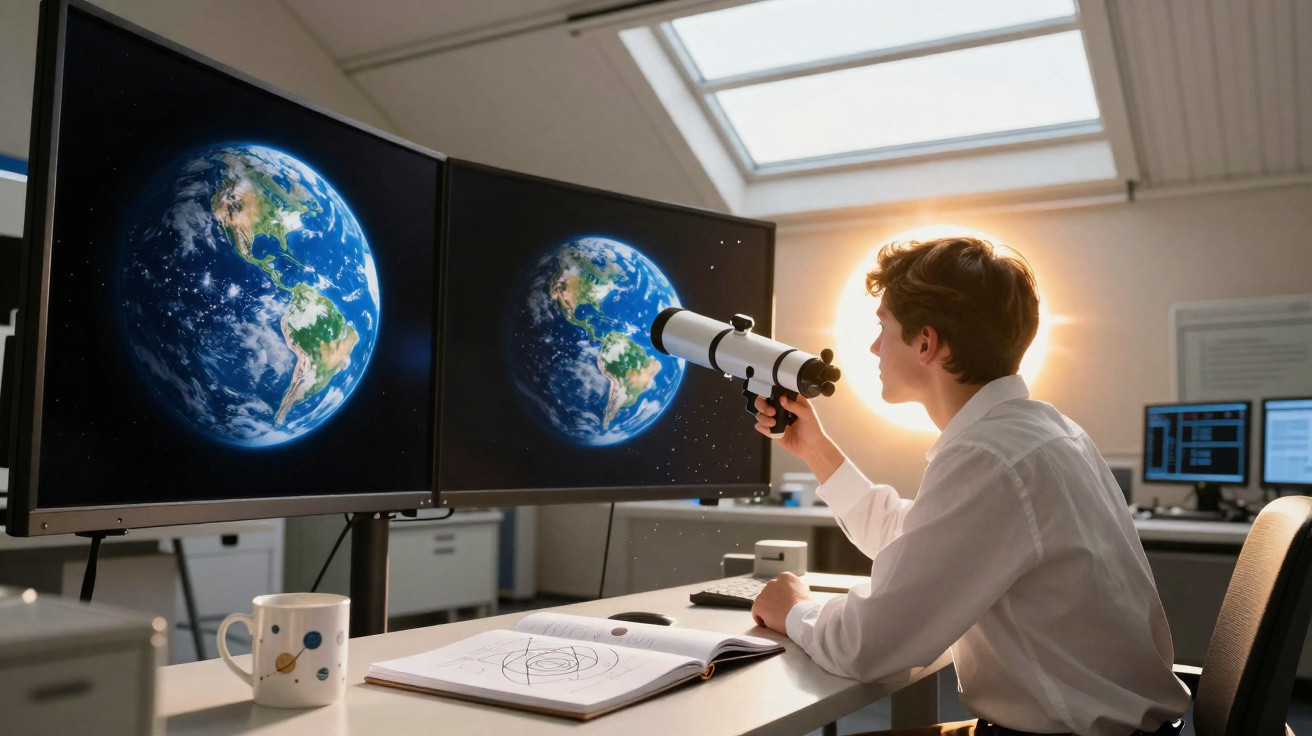
For decades, an inconspicuous celestial body has been travelling around the Sun almost in step with Earth – entirely unnoticed by the public.
Only modern telescopes and sophisticated analysis software revealed this quiet companion. A tiny asteroid, barely larger than a house, has shared an orbit with our planet for around 60 years. Researchers describe this as a “quasi-moon” configuration – one that says more about Earth’s vulnerability than many would like.
A long-standing companion nobody noticed
In August 2025, the Pan-STARRS telescope system in Hawaii recorded an unremarkable point of light in the constellation Piscis Austrinus. At first, it appeared to be an ordinary near-Earth asteroid. A more precise analysis of its orbit then delivered the surprise: the object, designated 2025 PN7, travels around the Sun on an orbit almost identical to Earth’s.
The researchers involved subsequently searched archived observations. They found imagery from 2014 in which the asteroid was already visible, although nobody had identified it as an unusual case at the time. Orbital modelling now indicates that 2025 PN7 has accompanied our planet for roughly six decades.
This places the rock in a highly exclusive group of celestial objects known as “quasi-moons”. They are not true moons, but remain linked to Earth through a long-term stable orbit.
Asteroid 2025 PN7 has shared Earth’s orbit for around 60 years without being its true moon.
Why 2025 PN7 is not a “second moon”
Calling it a “second moon” may seem obvious at first glance, but the label is inaccurate. A conventional moon orbits a planet directly and is firmly bound by its gravity. In physical terms, 2025 PN7 instead orbits the Sun – just as Earth does.
The key point is that both bodies take almost exactly the same amount of time to complete an orbit. Specialists call this a 1:1 resonance. The asteroid effectively travels ahead of or behind Earth along its path, while maintaining a respectful distance.
Some key facts about 2025 PN7:
- Diameter: about 20 metres, making it smaller than many city-centre residential blocks
- Distance from Earth: varies broadly between 4 and 60 million kilometres
- Orbit: very similar to Earth’s, around the Sun rather than Earth
- Dynamics: stable over the long term, likely to accompany Earth for several more decades
By comparison, the average distance to our actual Moon is only about 384,000 kilometres. The quasi-moon therefore never comes close enough to Earth to be seen with the naked eye.
What a “quasi-moon” means in practice
From an astrometric perspective, 2025 PN7 belongs to the group known as Arjuna asteroids. These objects follow orbits very similar to Earth’s, with only slight differences in eccentricity and inclination. They are classed as near-Earth asteroids, but are also regarded as dynamically relatively “quiet”.
For specialists, bodies of this kind are a fortunate discovery. A stable, Earth-like orbit provides many recurring observation windows and enables detailed studies of their composition and surface. However, the small size of 2025 PN7 remains challenging, as it is difficult to resolve even with large telescopes.
Quasi-moons such as 2025 PN7 are too distant to be genuine twins of our Moon, but close enough to provide fascinating laboratories for celestial mechanics.
How quasi-moons are reshaping our view of the Solar System
The discovery of 2025 PN7 joins a small but growing list of similar objects. Names such as Kamoʻoalewa and Cardea are already familiar within the scientific community. Together, these celestial bodies demonstrate how complex and finely balanced motion in the inner Solar System truly is.
A 1:1 resonance with Earth means that both bodies complete their orbits over the same period. Yet they oscillate around an average position, influenced by the gravitational fields of Earth, the Moon and other planets. Small disturbances can produce major changes over long periods, which is why the orbits of such objects are recalculated regularly.
At the same time, the finding shows that the notion of a neatly ordered inner Solar System is misleading. Asteroids, mini-moons, captured objects and quasi-moons form a whole spectrum of companions that cannot easily be contained within simple categories.
Is a new classification for Earth companions on the horizon?
The boundary between a moon, a mini-moon and a quasi-moon is fluid. Earth’s conventional Moon remains unique: it is large, massive and permanently bound by Earth’s gravity. Alongside it, temporary mini-moons occasionally appear – small asteroids captured by Earth for a short period before being released again after several orbits.
Quasi-moons such as 2025 PN7, by contrast, keep their distance. They travel in a region where their orbit comes very close to an Earth-like path without falling into Earth’s direct gravitational domain. To non-specialists, this may sound like splitting hairs; for research, it contains a great deal of physics.
| Type | Motion | Connection to Earth | Example |
|---|---|---|---|
| Moon | Orbits Earth | strong, permanent | our Moon |
| Mini-moon | Temporary orbit around Earth | temporarily captured | 2016 HO3 (temporarily) |
| Quasi-moon | Orbits the Sun on an Earth-like path | indirect only, through resonance | 2025 PN7 |
What the discovery reveals about monitoring the sky
For specialists, the fact that an object such as 2025 PN7 went unnoticed for decades is both fascinating and uncomfortable. A body only 20 metres across may be small, but a direct impact in a populated area could still cause damage, depending on its composition and angle of entry.
The discovery highlights the limitations of current monitoring programmes. Many telescope systems focus on larger asteroids that would have global consequences in the event of a collision. Smaller rocks such as 2025 PN7 can more easily slip through the observational net or appear only as anonymous points of light in databases.
Automated sky surveys, artificial intelligence for pattern recognition and improved orbital calculations are intended to close these gaps gradually. Specialists already assume that further quasi-moons with similar orbits exist. They are simply waiting to be extracted from the noise in the data.
Risk or opportunity – how dangerous is 2025 PN7?
For now, the calculations offer reassurance. Based on current knowledge, 2025 PN7 will not approach Earth at a critical distance in the coming decades. Its orbit will remain such that a collision is virtually ruled out.
Over the longer term, the question is whether objects like these could make attractive targets for robotic missions or even crewed flights. Quasi-moons offer several advantages:
- relatively low launch energy compared with more distant asteroids
- repeated close-approach windows because of their similar orbit
- a suitable test environment for defence technologies against genuinely dangerous objects
- the possibility of analysing raw materials without travelling deep into the asteroid belt
This also brings a practical question into focus: objects such as 2025 PN7 could serve as natural “training targets” for testing methods that may one day be used to deflect a large impactor. Mission profiles could be trialled with manageable effort, without having to place an artificial target in space.
How non-specialists can picture the phenomenon
A simple thought experiment offers a useful illustration. Imagine a running track around a stadium with two runners. Both complete a lap in exactly the same time. One runner starts in lane one and the other in lane two, separated by a few metres. They remain in broadly the same position, never overtake each other, but never truly come close either.
That is essentially what happens with Earth and 2025 PN7 – except that, rather than a tartan track, the stage is a vast orbit in space. The gravity of Earth, the other planets and the attraction of the Sun ensure that this shared movement does not break apart.
For anyone interested in near-Earth celestial bodies, the term “quasi-moon” is therefore a useful label for an entire class of objects that has received little public attention so far. 2025 PN7 is merely the latest example – and probably not the last quiet companion to reveal itself as a hidden neighbour of Earth.





Comments
No comments yet. Be the first to comment!
Leave a Comment