
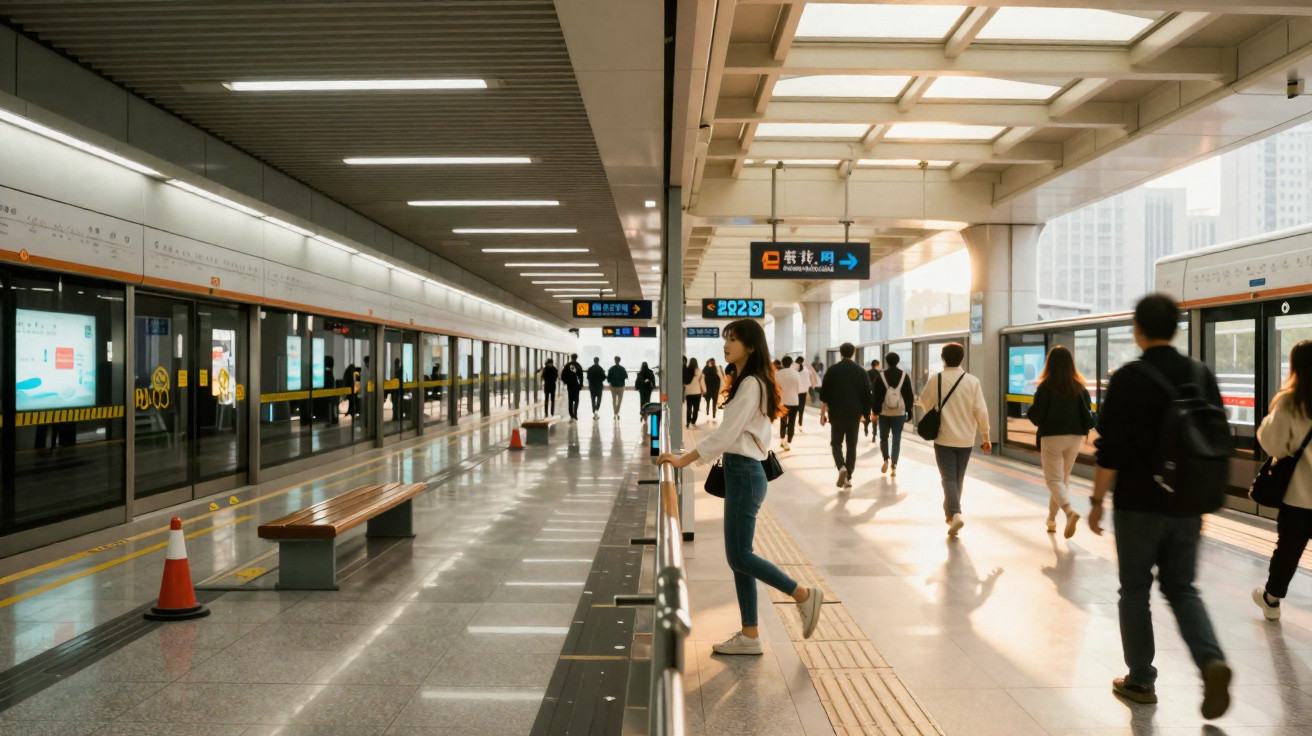
We have all experienced that moment when something seems completely absurd - only to realise, years later, that it was in fact remarkably logical.
That is precisely what happened with several metro lines China built in the late 2000s. At the time, brand-new stations appeared amid empty fields, dusty brownfield sites and roads without cars.
Photographs circulated on blogs, then on Facebook and Twitter: escalators descending into nothingness, platforms without passengers and illuminated signs for travellers who did not yet exist. Many people laughed, while others saw it as megalomania.
By 2025, those same stations had become vital hubs within enormous districts. Suddenly, the whole story looked very different.
From ‘ghost stations’ to the beating heart of new cities
These stations standing in emptiness acquired a nickname: ‘ghost stations’. They were underground stops so immaculate that you could almost hear your own footsteps, with just one uniformed employee watching the clock. Outside lay vacant plots, one or two cranes, and sometimes absolutely nothing.
Had you passed through one in 2008, you would probably have taken out your phone to film it. The escalators were running and the ticket gates worked, yet trains arrived half-empty and departed almost at once. The setting looked more like a science-fiction film set than functioning public infrastructure.
At the time, everyone asked the same question: why build a metro where there is literally nobody?
Consider the outskirts of Chengdu or Wuhan in the mid-2000s. Around some stations there were only rapeseed fields, a few low-rise homes and a cold wind sweeping across deserted car parks. Seventeen years later, those very car parks had become shopping centres, office towers and twenty-five-storey residential buildings.
The figures make the case even more clearly than the photographs. In Shenzhen, a station built in 2011 in the middle of nowhere recorded fewer than 1,000 passengers a day when it opened. By 2024, it was handling more than 60,000 daily tap-ins, with rush hours in which people pressed against the doors just as they do on any overcrowded metro system in the world.
What once appeared ridiculous has become ordinary for local residents. The station is no longer an urban-planning curiosity: it is simply where they catch the metro to go to work, collect their children from school or go out in the evening.
The underlying logic was straightforward, almost ruthless. China did not build metros to serve existing neighbourhoods; it built metros to create future neighbourhoods. Transport lines became the framework around which housing, schools, hospitals and shopping centres were rapidly added.
Urban-planning conferences often refer to ‘transit-oriented development’, but here it was put into practice on a continental scale. Rather than waiting for demand to emerge, the state and municipal authorities imposed a vast supply, betting that demand would follow. And that is exactly what happened in most cases.
In 2025, looking at these formerly isolated stations offers a fast-forward view of 15 years of urban strategy: a long-term policy that was sometimes harsh and rarely subtle, yet surprisingly coherent.
How China used ‘empty metros’ as a time machine
Viewing these stations solely as transport infrastructure misses the essential point. China effectively used them as a time machine, building infrastructure not for the present but for a hypothetical 2030 or 2040. It accepted that, for years, this would look absurd.
The approach can be summed up in one sentence: build the skeleton first - the tracks, stations and tunnels - then allow the flesh, namely residents, businesses and jobs, to attach itself over time. This is the reverse of how most Western cities operate, where authorities struggle to adapt a metro to an urban fabric that is already overcrowded.
In 2008, this strategy produced photographs of empty platforms. By 2025, it had produced metropolises of 10 or 20 million inhabitants that could still breathe.
For many European and American city dwellers, the very idea of constructing a line through empty land appears ludicrous. In their cities, every station is subject to public consultations, reports and legal challenges. The metro follows the population, rather than the other way round.
In Beijing, Shanghai and Chongqing, the debate was radically different. The authorities planned in decades rather than electoral terms. Let us be honest: local democracies do not really do that every day. Public money was poured into tunnels leading nowhere, on the openly stated gamble that today’s ‘nowhere’ would become tomorrow’s ‘city centre’.
As a result, these metros became a compass for property developers, families and businesses: where a station existed, urban life would sooner or later follow. By 2025, it was clear just how powerfully that compass had shaped the real map of these cities.
“Build it, and they will come” was a rather naïve slogan in the 1990s. In China, it became state policy: build first, move in afterwards, and make a return much later.
For readers, this is not merely a textbook case of Chinese urban planning. It raises a direct question: what would happen if our own cities were willing to invest in something that looks unnecessary today in order to prevent tomorrow’s suffocation?
- Looking at a photograph of an empty station and picturing the future crowds is an exercise in projection that our societies have sometimes lost.
- Understanding the logic behind these ‘metros to nowhere’ helps us interpret the next major projects that may seem nonsensical to us - before they become indispensable.
What these ‘nowhere stations’ tell us about our future
In 2025, these once-isolated stations had become mirrors for the rest of the world. They force us to examine our own cities, traffic jams and unaffordable rents, and to ask an uncomfortable question: when should we have acted earlier, on a larger scale and beyond our immediate horizon?
China did not get everything right, far from it. Some stations remain underused, while certain planned districts never truly took off. Yet the broader picture conveys one simple lesson: urban planning is not only about managing what already exists; sometimes it means having the courage to bring into existence what is not there yet.
Within barely a decade and a half, the empty platforms of 2008 had become corridors of everyday life - places where people jostle, pass one another without seeing each other and where millions of stories overlap. Looking at these metros ‘built in the middle of nowhere’, we no longer see a miscalculation; we see a societal choice.
| Key point | Detail | Why it matters to readers |
|---|---|---|
| ‘Ghost’ stations | Built in almost deserted areas from 2008 | Understand why a decision considered absurd can become visionary |
| Long-term strategy | Networks were constructed before residents arrived in large numbers | Reconsider major urban projects in your own city |
| Cities of tomorrow | Metros shape the form and pace of new metropolises | Imagine what urban life may look like in 10 or 20 years |
FAQ:
- Were those ‘empty’ Chinese metro stations really used by nobody? Not quite. Passenger numbers were low at first, but workers, a small number of residents and construction staff still used them. Their emptiness was mainly relative to the enormous capacity that had been built.
- Did all of China’s ‘nowhere’ stations become successful? No. Some are still underused, particularly where property developments slowed or were cancelled. The broader strategy succeeded in many large metropolises, but it did not work uniformly everywhere.
- Why did Western cities not take the same approach? They face different electoral cycles, funding limits and public scrutiny. It is much harder to defend large-scale, long-term infrastructure that appears ‘useless’ for years in a democratic system.
- Is this model environmentally sustainable? When it succeeds, dense, transit-oriented districts can substantially reduce car use and emissions. The risk arises when overbuilding is combined with sprawl and unused infrastructure.
- What can other countries actually learn from this? Not to copy and paste the Chinese model, but to rethink timing: build transport slightly ahead of demand, plan around stations and accept that some returns will only arrive a decade later.





Comments
No comments yet. Be the first to comment!
Leave a Comment