
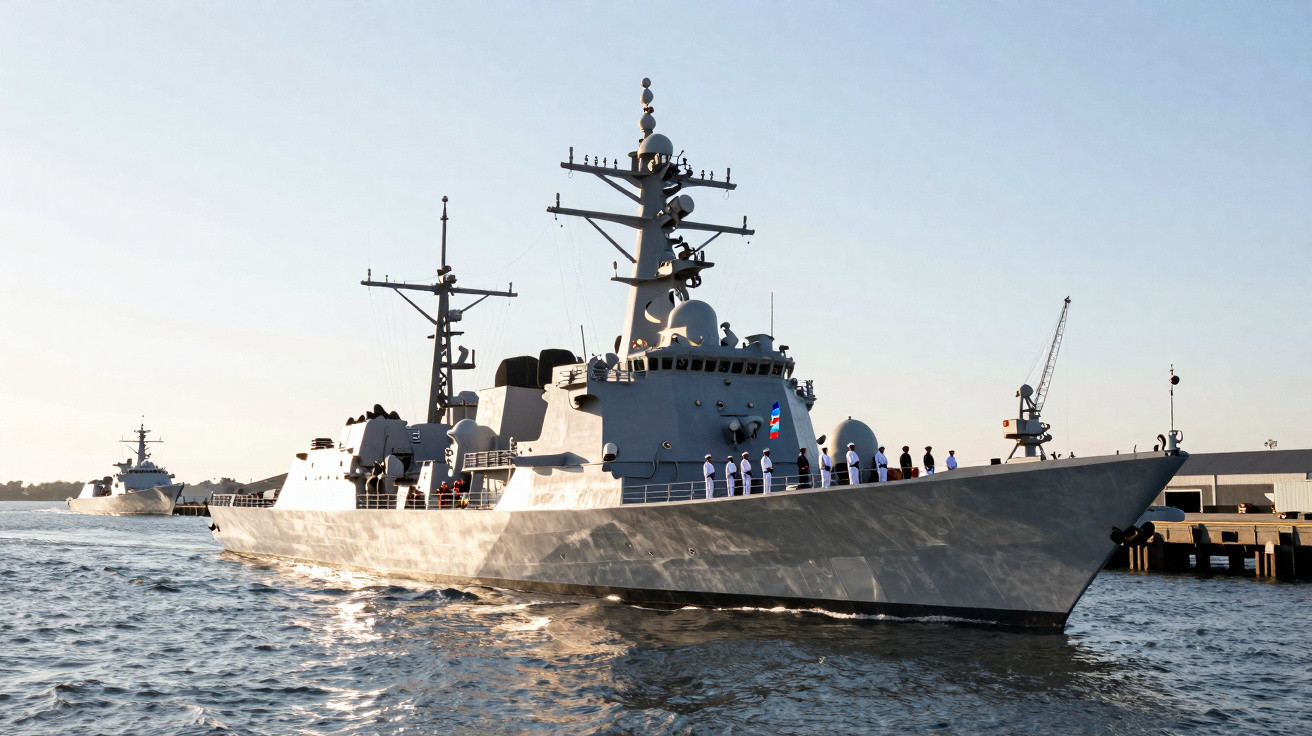
The United States Navy (US Navy) is nearing the commissioning of a new Arleigh Burke-class Flight IIA guided-missile destroyer. The future USS Harvey C. Barnum Jr. (DDG-124) arrived at its home port, Naval Station Norfolk, on 20 March, ahead of its scheduled commissioning ceremony on 11 April 2026. The vessel’s arrival is the final step before its formal commissioning and full entry into the US surface fleet.
USS Harvey C. Barnum Jr. and the final Flight IIA ships
DDG-124 belongs to the final production batch of Flight IIA destroyers, one of the most numerous and widely operated variants of the Arleigh Burke class. For decades, this class has formed the core of the US Navy’s surface fleet. Compared with earlier models, the variant includes substantial enhancements, such as the ability to operate helicopters, updated combat systems and improved capability for prolonged deployments.
The most recent vessel of this variant to enter service was USS John Basilone (DDG 122), in November 2024. It became the 74th ship in its class and the second to bear the name of John Basilone, honouring the legacy of the only enlisted Marine to receive both the Medal of Honor and the Navy Cross during the Second World War.
Against this backdrop, USS Harvey C. Barnum Jr. is regarded as one of the final examples of this configuration, as Flight IIA production is progressively brought to a close. Other units, including USS Louis H. Wilson Jr. (DDG-126), remain under construction or in the fitting-out phase, forming the final group before the complete transition to the new generation.
AEGIS combat capabilities
Like the other ships in its class, DDG-124 will be fitted with the AEGIS combat system, enabling it to undertake a broad range of missions, including air defence, anti-submarine warfare and surface warfare. These capabilities provide the flexibility to operate independently or as part of carrier strike groups and expeditionary forces.
Transition towards Arleigh Burke Flight III
The destroyer’s entry into the fleet comes alongside progress on Flight III vessels, which represent the latest development of the Arleigh Burke design. These newer ships feature the significantly more advanced AN/SPY-6 radar, improving their ability to detect and respond to air and ballistic-missile threats in more complex operational environments.
More broadly, the transition reflects the US Navy’s strategy of retaining a foundation of proven platforms, such as the Arleigh Burke class, while introducing technological improvements to meet current challenges. In this respect, the programme’s continuation supports both fleet renewal and standardisation. Looking ahead, USS Harvey C. Barnum Jr. is preparing to join a fleet that continues to expand and adapt to an increasingly demanding global strategic environment.





Comments
No comments yet. Be the first to comment!
Leave a Comment