
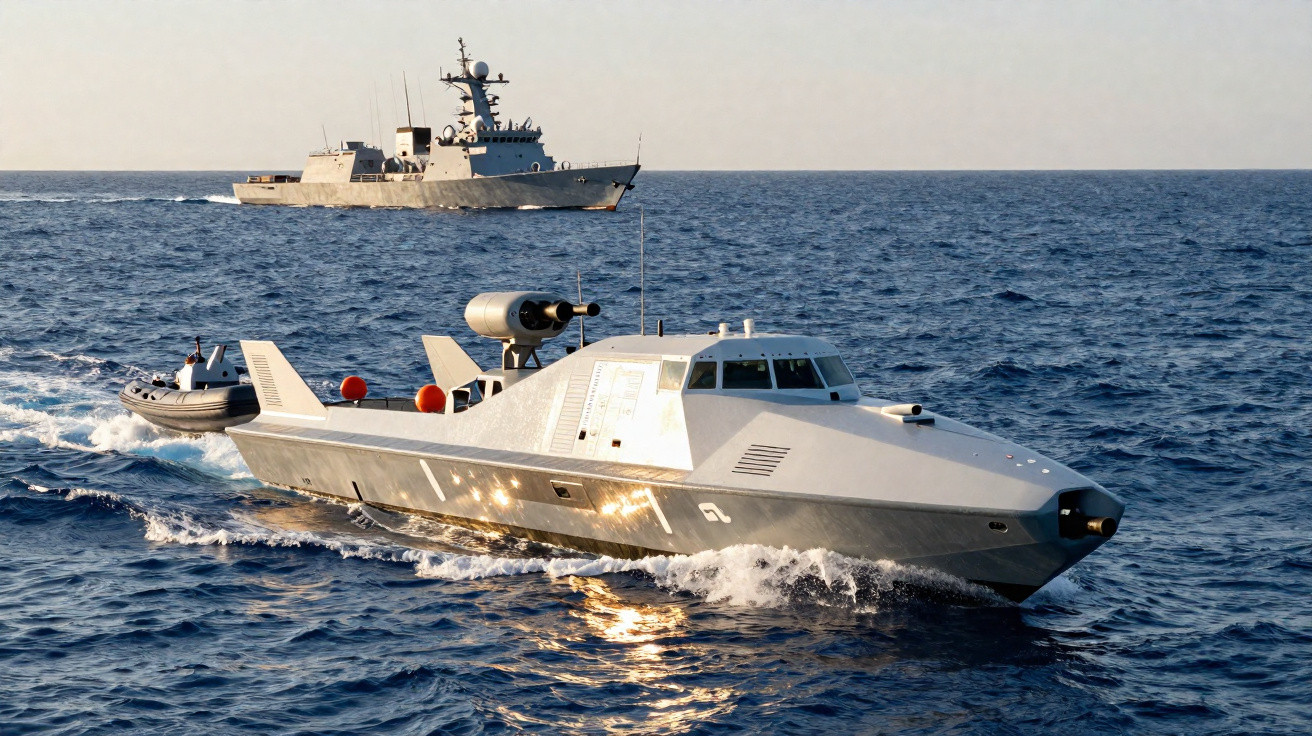
Supported by new autonomous surface drones, artificial intelligence and a substantial anti-drone budget, the French Navy is starting to patrol and fight at sea without invariably placing sailors in danger. From mine-hunting robots to laser weapons, Paris is wagering that unmanned systems will provide an advantage from the Mediterranean to the Indo-Pacific.
A 12-metre robot ship for waters where mines are hidden
The clearest sign of this transition is a 12-metre uncrewed surface vessel built for mine warfare. Supplied in early 2025 through the Franco-British MMCM (Maritime Mine Counter Measures) programme, it resembles a compact patrol boat. Its real role, however, is closer to that of a mobile underwater scanner.
A TSAM sonar towed by the drone searches the seabed, while a multiview SAMDIS sonar produces a detailed 3D image of any suspect object. Operators in a containerised operations centre called e-POC can oversee missions and direct the system using the M-Cube mission manager. Mi-Map, an AI-driven analysis tool, assists in separating genuine mines from harmless debris.
This new generation of mine-hunting drones allows France to clear strategic waters without pushing a single crewed ship into the danger zone.
The drones are intended to operate either from future dedicated mine-warfare ships, designated BGDM, or from land bases. They can be launched to scan for and classify threats while requiring very little human presence at sea. Ports, narrow straits and disputed coastal areas may therefore be inspected in hours instead of days.
Airlifted anywhere within 48 hours
Speed was also a French Navy requirement. Both the 12-metre vessel and its supporting equipment can be carried inside an A400M transport aircraft. A full system can consequently be flown close to a crisis area and made operational in less than 48 hours.
This rapid-deployment capability is aimed at situations including an abrupt mine threat near a commercial chokepoint, sabotage at an overseas harbour, or a coalition mission in which France contributes specialist mine-countermeasure capabilities.
- Transport: A400M airlifter
- Length: 12 metres (uncrewed surface vessel)
- Main role: detection and classification of naval mines
- Control: fully autonomous or remote-operated from ship or shore
- Key tools: TSAM towed sonar, SAMDIS multiview sonar, e-POC ops centre, M-Cube, Mi-Map AI analysis
Autonomous navigation enables the drone to follow planned search routes, although remote control remains possible during sensitive stages, including manoeuvres in busy ports. The intention is for algorithms to conduct repetitive scans, leaving people to assess difficult cases and take decisions.
AI reduces reaction times at sea
Mine-warfare sonar produces vast quantities of data, while operators quickly become fatigued when examining indistinct images of the seabed. In this context, AI is not merely an added feature: it is the only practical means of keeping pace with the information flow.
By bringing together multiview sonar imagery and pattern recognition, the French system seeks to achieve a very low false-alarm rate. This is important because every incorrect mine alert occupies a clearance team and holds up shipping.
Artificial intelligence turns hours of sonar review into near-real-time assessment, slashing the window between detection and decision.
Quicker assessment serves France's strategic objectives directly: maintaining open sea lanes, reassuring allies and sustaining naval activity in regions where mines and improvised explosive devices offer low-cost tools to weaker opponents.
From kamikaze drones to laser fire: the other battle at sea
Naval mines are not the sole threat. Small and inexpensive aerial drones have already troubled vessels in the Red Sea, the Black Sea and the Gulf, compelling France to adjust rapidly.
Electronic warfare alongside autocannon fire
In 2024, a French FREMM frigate in the Red Sea reportedly disabled a hostile drone with Neptune and MAJES DB6 jamming systems. These electronic-warfare suites attack drone control links and GPS signals, driving the aircraft off course or causing them to fall.
French ships trialled layered protection during the “Wildfire” exercise. Jammers were first used to interrupt approaching drones. Should that approach fail, 20 mm guns supplied close-range kinetic fire, while helicopters formed a final line of response, either destroying the drone itself or neutralising the platform that launched it.
| Layer | Type of defence | Typical target range |
|---|---|---|
| 1 | Electronic warfare (Neptune, MAJES DB6) | Stand-off, beyond visual range |
| 2 | Guns (20 mm, shipboard weapons) | Short range, close-in defence |
| 3 | Helicopters and ship manoeuvre | Flexible, depending on situation |
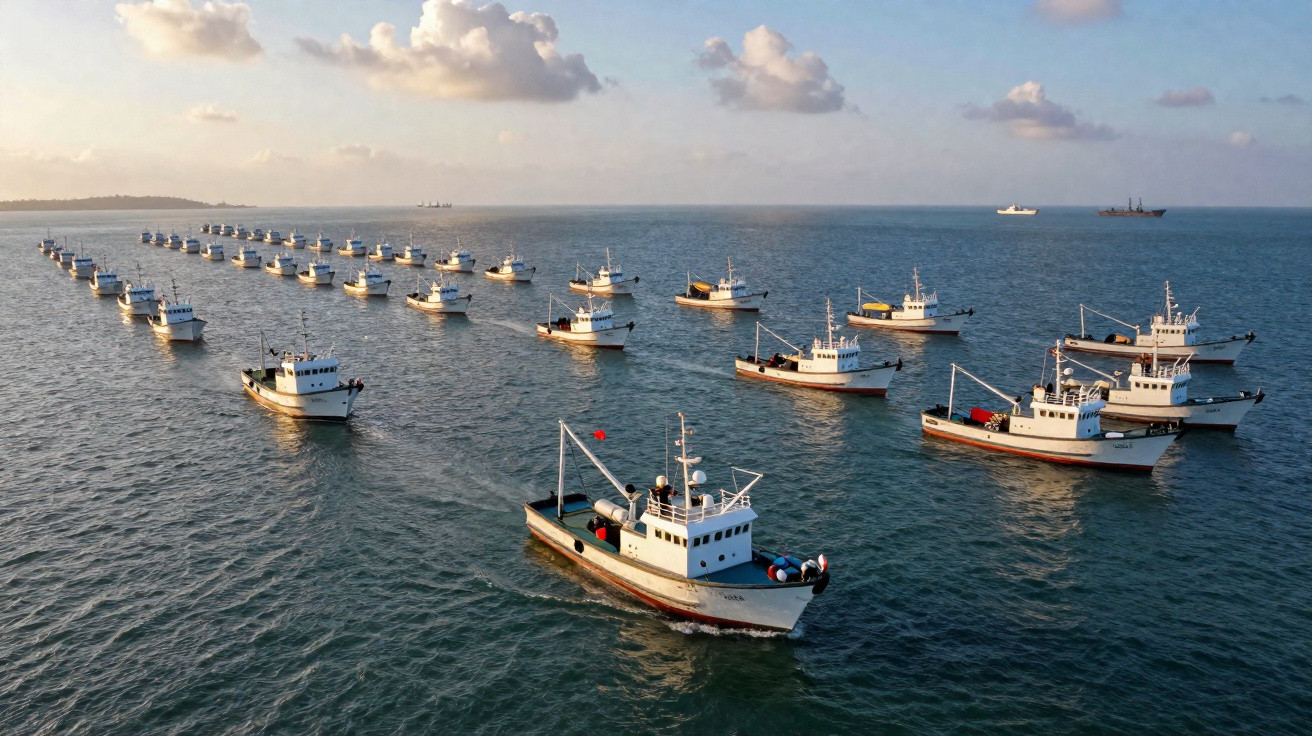
This combination reflects a move away from individual “anti-air” solutions towards responses using several tools, tailored for small and agile threats that operate at low altitude and may be launched from fishing boats or improvised barges.
Lasers move offshore
France is also investing in directed-energy weapons. CILAS's HELMA-P laser has already destroyed drones at a range of around one kilometre in sea trials. It delivers concentrated-energy bursts that burn or damage vital components, frequently without a visible explosion.
The Navy considers lasers a means of dealing with swarms of small drones without exhausting costly missile inventories. A laser engagement principally requires electricity and cooling rather than a missile costing several hundred thousand pounds.
HELMA-P tests have shown that a ship can silently burn down multiple drones in quick succession, turning the economics of attack and defence on their head.
French planners are examining broader deployment of these lasers aboard frigates operating in high-risk areas, including locations where non-state armed groups already employ commercial quadcopters and loitering munitions.
Five billion euros for the drone era
The 2024-2030 military spending law allocates approximately €5 billion specifically to anti-drone measures. This funding covers jammers, lasers, specialist radars and sensor networks along France's coast and at overseas bases.
The wider political objective remains a traditional one: preserving freedom of navigation and defending undersea cables, offshore energy fields and military deployments. The means used to achieve it, however, are changing rapidly.




Comments
No comments yet. Be the first to comment!
Leave a Comment