
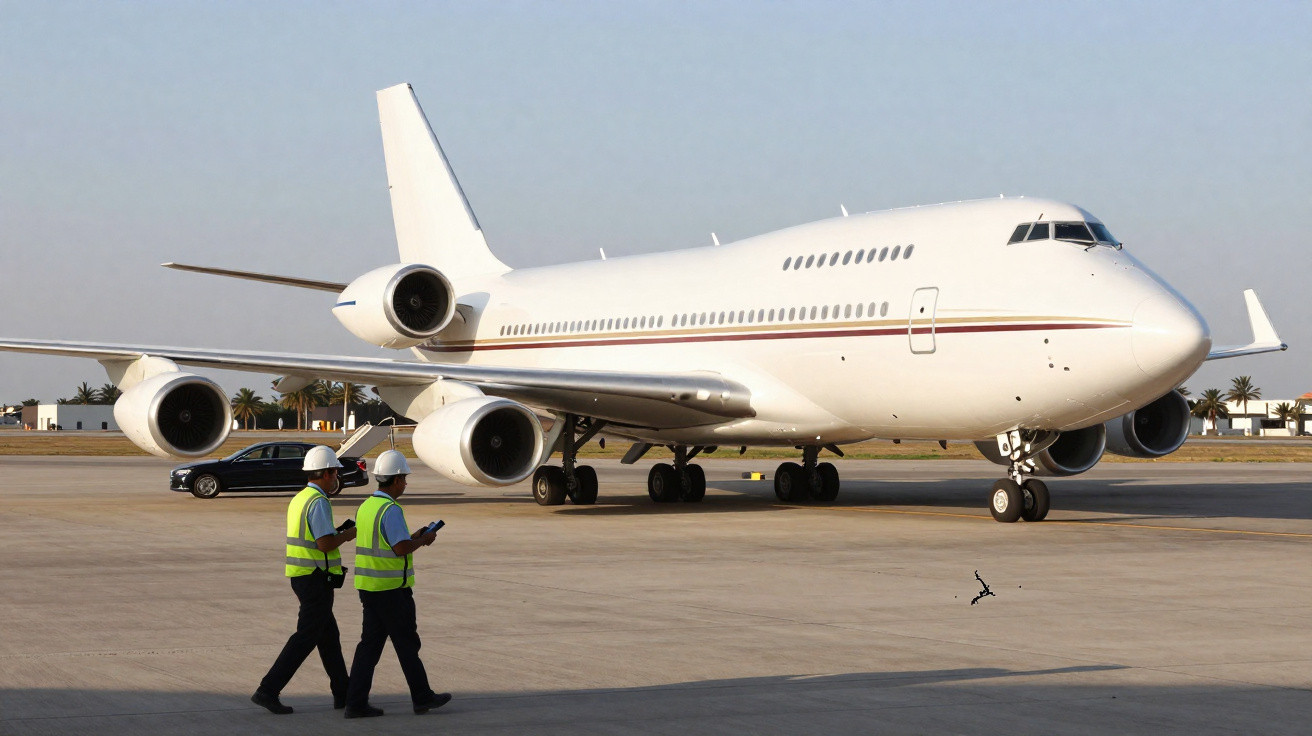
Budget flights arrive by the dozen, discreet billionaires glide in aboard private Gulfstreams, and the occasional footballer dashes over for a short island break. Then the Emir of Qatar’s private Boeing 747 passed above the bay, its shadow falling across the water as the terminal fell quiet. Ground workers paused and looked up.
The white-and-maroon giant travelled along the runway like a cruise liner on wheels, its engines growling into the Mediterranean breeze. Yet, once it had stopped, the spectacle continued. Airport engineers approached-not to welcome the royal party, but to examine the ground beneath it.
The aircraft was so heavy that the runway may have been put under strain.
The day a royal jumbo jet “tested” Palma’s runway
The Emir’s Boeing 747-8 is far more than a private aircraft. It is effectively an airborne palace housed inside one of the largest passenger aircraft ever constructed. When it arrived in Palma in late summer, aviation enthusiasts followed its route through flight-tracking apps as though it were a rare comet. On the apron, its size was almost difficult to comprehend.
This was not a typical streamlined business jet. It was a four-engined giant, 76 metres in length, with wings so broad that they appeared to nearly reach the taxiway edges. Visible from the other side of the bay, it shone in the Balearic sunlight and made the nearby Airbuses look like a superyacht moored in a fishing harbour.
Behind security barriers and away from the cameras, the contrast would have been equally striking. As holidaymakers in flip-flops queued at baggage reclaim, the jet was likely equipped with staterooms, lounges, meeting rooms and a complete royal suite: an island in the air arriving on an island.
The figures behind the arrival speak for themselves. At maximum take-off weight, a Boeing 747-8 can exceed 440 tonnes. Even configured for VIP use, without hundreds of economy seats, it remains an enormous machine. Palma’s principal runway is designed for substantial traffic, but airport engineers take no chances when an unusually heavy visitor arrives.
After the Emir’s jumbo came to a halt, airport teams reportedly checked the surface for indications of stress, including microscopic cracks, rubber accumulation and damage around the touchdown area. This was not a performance for cameras, but a measured and systematic inspection. Even so, the suggestion that one private aircraft could “challenge” a major European runway quickly spread.
Aviation relies on tolerances. Runways are planned around length, load-bearing strength and braking performance in wet or crosswind conditions. When a state aircraft such as this one arrives, those tolerances come sharply into view. The landing became more than a VIP visit; it was a subdued test of the island’s infrastructure in an era of mega-wealth and mega-jets.
When luxury meets limits: what a jumbo like this really means
For airport planners, an aircraft such as the Emir’s 747 is both a prize and a pressure test. Preparations begin long before its wheels reach the runway, with weight-and-balance calculations, NOTAMs, stand allocation and even checks on towing-tractor capability. An error does not merely delay operations; it can physically damage the pavement.
Like many holiday airports, Palma is accustomed to intense summer operations, although these are mainly mid-sized aircraft carrying tourists from northern Europe. A royal 747-8 belongs to another class entirely. Ground-handling teams must consider its turning circle, jet blast, and whether taxiways and parking stands can bear its weight over extended periods. What appears to be a straightforward arrival suddenly becomes a logistical puzzle.
We have all encountered the moment when something oversized has to fit into a place that was never properly designed for it. At home, it may be a sofa that cannot pass through the doorway. At an airport, it is an airborne palace testing every boundary marked on the layout plan. That tension helps explain why scenes like this are so compelling.
This is not only a matter of spectacle; it is also one of responsibility. When a heavy aircraft lands, immense kinetic energy is transferred into a narrow strip of tarmac. Each landing is a balance of friction, speed and temperature. On a particularly hot day, under high loads, the runway surface can soften at a microscopic level. Engineers understand this, and pilots understand it even more keenly.
That is why a runway inspection after landing represents discipline rather than drama. It is the quiet aspect of aviation that rarely appears in polished travel imagery. A team inspects the touchdown zone, sometimes using specialist vehicles, looking for foreign objects, rubber “marbling” or early signs of rutting. These seemingly ordinary checks prevent later aircraft from skidding, tyres from bursting and timetables from breaking down.
In truth, few people consider runway maintenance as they board with a beach bag and boarding pass. The Emir’s jumbo jet landing brought this invisible work into view. Suddenly, smartphones throughout the terminal were aimed at the same sight: the sheer scale of one person’s aircraft and the unseen network of rules and concrete required to accommodate it safely.
How airports quietly prepare for flying palaces
The hidden process behind such “wow” moments begins with classification. Every aircraft is allocated categories covering wake turbulence, wingspan and runway weight limits. Airports such as Palma maintain detailed charts showing exactly which taxiways and stands can accommodate each type. When an unusual VIP 747 is expected, operations teams consult those charts first and then begin arranging the choreography.
The advice aviation insiders often repeat is straightforward: large aircraft require generous margins. Teams may therefore assign a parking position away from vulnerable surfaces, clear nearby movements to prevent wingtip conflicts, and occasionally select the landing runway according to surface conditions. From outside the airport, it may simply appear to be an impressive aircraft arriving. Behind the scenes, a tightly managed dance is unfolding in real time.
For ground crews, the human challenge is to balance curiosity with professionalism. A royal flight brings extensive security, rigid timings and frequently considerable secrecy. The urge to take a photograph may be strong, but the duty to remain focused is stronger. Every mistake-whether a vehicle is parked a metre too close or a turn is rushed-places added pressure on infrastructure that is already being stretched. It is the sort of mistake people make only once.
There is also the question of public perception. When photographs of the Emir of Qatar’s jumbo jet appeared on social media, many people saw unrestrained excess. A private 747, at a time of climate concern and crowded commercial flights, readily becomes a symbol of inequality. Others viewed it differently: as an engineering achievement and a reminder that airports serve not only holidaymakers, but also heads of state, emergency flights and diplomatic missions.
A more empathetic reading of the scene acknowledges the mixture of fascination and discomfort it creates. There is, on one hand, the childlike excitement of seeing the “Queen of the Skies” in a bespoke royal livery. On the other is the awareness that one flight burns more fuel than entire villages use in a week. Both reactions can coexist, and that conflict is part of the story.
“When a 747-8 VIP lands on a holiday island,” one veteran airport engineer told me, “you don’t just see power. You see the strain on the concrete, on the people, and on the world we’ve built to keep up with it.”
What lingers after a day like this are the smaller details: the faint jet-fuel smell in the warm air, clusters of staff observing from a respectful distance, and radios seeming to crackle a little more frequently. The whole scene resembles a live infographic of modern aviation.
- Scale vs. space: the way one aircraft can dominate an entire apron.
- Luxury vs. limits: the divide between royal comfort and public infrastructure.
- Safety vs. spectacle: the unobtrusive runway checks behind every viral photograph.
- Prestige vs. pressure: the honour of handling such an aircraft alongside the pressure it creates.
- Tomorrow vs. today: what this sort of flight suggests about the direction of air travel.
What this giant jet says about our skies, and about us
Events such as the Emir’s 747 arriving in Palma are rare, which is precisely why they remain in the mind. One aircraft landing can act as a mirror: reflecting the ambitions of a small, wealthy state, the capabilities of a Mediterranean airport, and our own conflicting attitudes towards wealth, travel and climate. The runway inspection following touchdown was almost symbolic, as though the check extended beyond the tarmac to the limits of the entire system.
A jet of that size, arriving for private use, raises unspoken questions about what we regard as normal in an age of global mobility. Palma’s ability to receive it, inspect the runway and continue moving thousands of tourists in and out demonstrates how far commercial aviation has progressed. It also points towards a future in which such arrivals could become less unusual, as more states and ultra-high-net-worth individuals acquire airborne palaces of their own.
Whether the reaction is awe, unease or an untidy combination of the two, the sight of the Emir’s jumbo rolling beneath the Balearic sun is difficult to forget. The next time you look from a window seat at a slim runway far below, you may think of the engineers who inspected it after a royal arrival, the people watching through the terminal glass, and the invisible weight carried by our skies, flight after flight.
| Key point | Detail | Value for the reader |
|---|---|---|
| The Emir’s 747-8 is exceptionally large and heavy | State-configured jumbo jet with a maximum weight above 440 tonnes | Explains why Palma’s runway required a post-landing inspection |
| Runway checks are routine, not theatrical | Engineers examine the surface for stress, cracks and rubber build-up after heavy landings | Reassures readers about aviation safety and the unseen work behind every flight |
| Luxury flights highlight existing tensions in air travel | Private mega-jets contrast sharply with mass tourism and climate concerns | Encourages readers to consider inequality, infrastructure and the future of flying |
FAQ:
- Is it common for a runway to be inspected after a single landing? Yes. For particularly heavy or unusual aircraft, post-landing runway inspections are a normal part of safety procedures at many airports.
- Was Palma’s runway actually damaged by the Emir’s Boeing 747? No serious damage was reported. The inspection was precautionary and intended to verify that the surface could continue handling dense traffic safely.
- Why would a head of state use a Boeing 747 as a private jet? The 747 provides extensive cabin space, long range and significant redundancy. For royal families and governments, it can function as a palace, office and secure transport platform in a single airframe.
- Can all airports handle a 747-8 of this kind? No. An airport requires a sufficiently long and strong runway, suitable taxiways and stands with adequate load-bearing capacity, as well as equipment sized for the aircraft.
- Does this kind of flight have a big climate impact? Yes. Large four-engined aircraft, especially when carrying only a small number of people, have a high emissions footprint per passenger compared with most commercial flights.


Comments
No comments yet. Be the first to comment!
Leave a Comment