
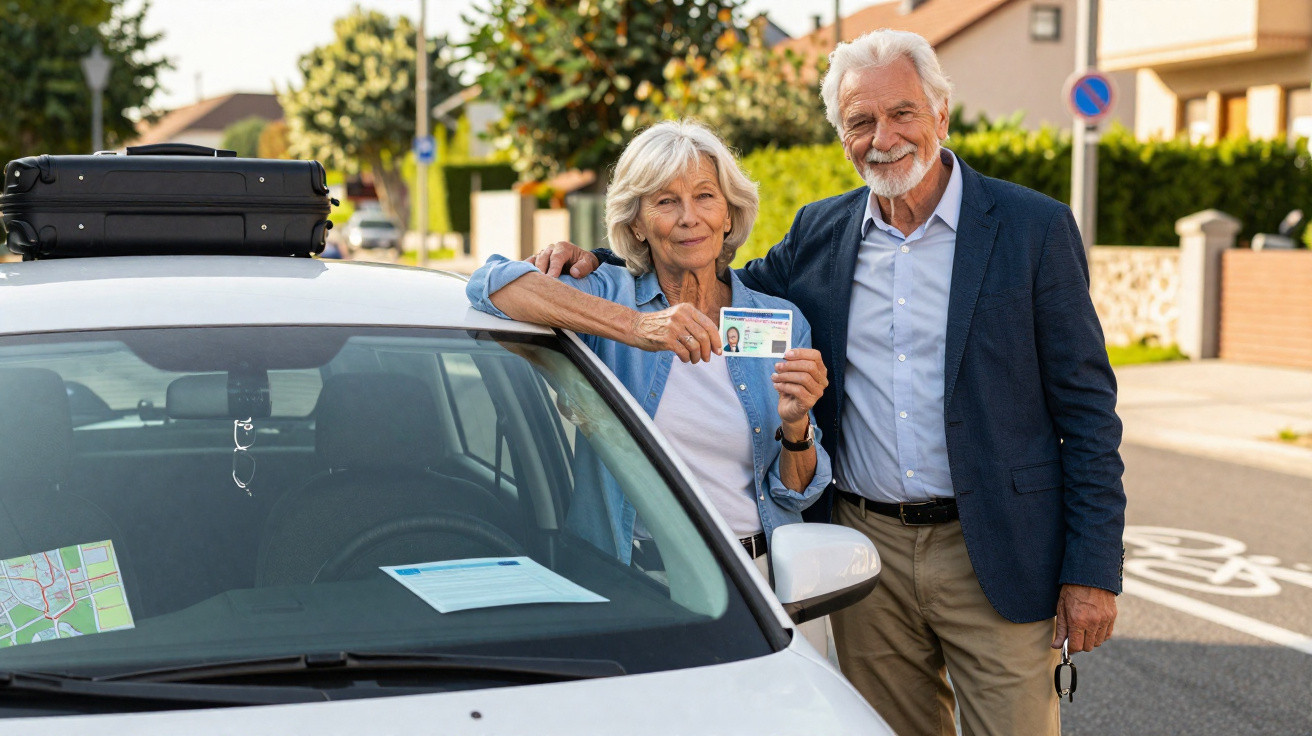
Across Europe, older people are following an unusual policy story closely: a proposal that could allow them to keep driving beyond 70 without another paperwork-heavy renewal, replacing anxious renewal dates with a quick tap on a screen. It could bring welcome relief to families, carers and anyone who still values the freedom of the road.
A man wearing a tweed cap rested on his walking stick and joked that the only thing moving more slowly than his ticket number was the printer at the desk. When somebody in the queue read aloud a report that Brussels was considering automatic licence renewals after 70, screens lit up, the muttering became optimistic smiles, and the line seemed slightly easier to bear.
What if there were no queue at all?
What is actually being proposed for automatic licence renewals after 70?
The European Commission’s proposed revision of the EU Driving Licence Directive imagines a system in which reaching 70 no longer starts a bureaucratic marathon. Its central proposal is automatic renewal for eligible older drivers through a standardised online procedure, supported by a health self-declaration and background checks for warning signs. The intention is to make the normal process less burdensome, rather than to offer an unrestricted pass.
Put simply, this could mean fewer compulsory visits to service counters, fewer blanket medical assessments and greater use of secure national eID systems to sign in and pay within minutes. It forms part of the wider move towards digital credentials first proposed in 2023: a licence held on your phone, accepted across borders, followed later by a plastic card. The aim is to bring order to the uneven mix of age-related rules among Member States while maintaining road safety.
There are safeguards in place. Member States would retain the ability to impose shorter validity periods or ask for checks, while targeted reviews would apply after a serious offence or medical warning. Parliament has made its position clear: there should be no universal testing based solely on age, with the focus instead placed on every driver’s fitness to drive. It is, in effect, a move towards fairness: identical rules and responsibilities, delivered in a manner suited to modern daily life.
Everyday lives that could be changed
Consider Maria, 74, who lives in rural Portugal and drives twenty minutes at dawn to her daughter’s café before collecting her neighbour for the weekly market visit. An online renewal would spare her a journey involving three buses to the district office, the anxiety of a missing document and a lost morning. Ten minutes at a laptop, with a cup of tea going cold beside her, and the task is complete.
Then there is John in County Kerry, who continues to coach youth football, has a clean licence and has his eyesight checked annually. He is not unusual; he represents the majority. Figures from several EU countries indicate that older motorists typically have fewer collisions per kilometre than younger drivers, although the injuries they sustain can be more serious when crashes occur. The Commission is betting that this approach keeps safe drivers on the road while directing limited resources towards the points where risk rises most sharply.
Most of us know the feeling when a brown envelope lands on the doormat and our stomach sinks. A simpler renewal process does not remove the duty to drive safely; it presents it differently: be truthful in your declaration, maintain your car properly and allow intelligent systems to identify the uncommon cases requiring closer scrutiny. This is where policy meets everyday life.
How the renewal process would work step by step
Under the model under discussion, your national licensing portal would contact you close to your birthday. You would sign in using your state eID, verify your address, complete a brief health checklist written in clear language and pay a modest charge. If national rules permit, a new photograph could be taken from your passport record or captured at home. A digital licence would appear in your wallet app almost immediately, while a physical card would be sent by post.
The detail matters. A recent serious offence, a collision involving injuries or a condition flagged by a doctor as affecting safe driving would send the application for human assessment. Before rushing through the health questions, take a moment to consider eyesight, medication and fatigue. After all, no one gets their eyesight prescription updated on the exact day it changes.
“Freedom doesn’t end at seventy; it changes shape. The road stays the same, but how we use it evolves.”
Here is a concise guide to the points many readers want answered now:
- Who qualifies: drivers with a clean record and no unresolved fitness-to-drive alerts.
- What it costs: fees remain national; expect parity with today’s renewals, not a surcharge.
- How long it lasts: validity periods still set by each country, with EU-wide minimums.
- What triggers a check: recent serious offences, crash history, or medical notifications.
- What you receive: immediate digital proof, plus a card for those who prefer a wallet.
The debate over safety, ageism and trust
Road safety organisations caution that self-declaration may fail to detect cognitive decline or gradual vision problems. Their concerns about exceptional cases are valid, which is why conditional triggers are important, alongside refresher courses that encourage people to update their knowledge without making them feel judged. For over-70 drivers, dignity and independence must sit alongside a duty of care, and effective policy needs to uphold both.
Motoring organisations argue that universal medical examinations are poor predictors of collisions, while insurers place greater emphasis on offences and distance travelled. Parliament has generally supported the view that age alone should not determine who must queue for a test, and many doctors agree that focused reviews are more effective than mass screening. Safety is not controlled by one factor; it depends on a network of driver behaviour, vehicle technology, road design and honest self-awareness.
Access is the other major issue. Not everyone owns a smartphone or has fast broadband, and some people will always prefer a counter, a person and a stamp. The draft provides for offline options through councils and post offices, while funding could support assisted digital services. The strongest systems do not leave people feeling diminished; they make minor tasks straightforward.
What it could mean for your family, street and next journey
A car key can be a lifeline: for getting to the GP, attending Sunday lunch or reaching a volunteering shift that gives someone purpose. A renewal completed quietly in the background may not make the news each day, but it could keep that routine of errands and visits running smoothly. This is not about being ageless; it is about remaining capable.
The policy wording also contains a cultural change. When governments offer older citizens a simpler route, the message works both ways: we expect honesty about your health, and we will remove barriers that add no safety benefit. That is a fair arrangement, and it encourages all of us to speak openly about eyesight, medication and tiredness before the warning lights appear.
For anyone caring for a parent who still drives, one fewer stressful appointment can make a real difference. In a village served by only two buses a day, it may be the difference between missing or making the final collection. Large policies become meaningful as small inconveniences disappear, one at a time.
| Key point | Detail | Why it matters to the reader |
|---|---|---|
| Automatic online renewal | Self-declaration, secure eID login, fast digital proof | Less time queuing, more control from home |
| Targeted safety checks | Triggered by offences, crashes, or medical alerts | Focus on genuine risk rather than age alone |
| Hybrid access | Digital by default with offline options retained | Works whether you are confident with technology or not |
FAQ
- Is this already law? Not yet. As of late 2025 the proposal is in EU negotiations; final rules and dates depend on Parliament–Council agreement and national implementation.
- Will every person over 70 be renewed automatically? No. The idea is a streamlined default for eligible drivers, with reviews where recent offences or medical flags exist.
- Are medical tests gone for good? Mandatory blanket tests tied to age are not part of the EU plan; countries may still require checks in targeted cases or set shorter validity periods.
- Can my country opt for stricter rules? Yes. Member States can keep or introduce tighter intervals or extra steps, as long as they respect EU-wide basics.
- What if I don’t use a smartphone? You’ll still be able to renew via postal or in-person routes; expect assisted digital points at local offices or post offices.






Comments
No comments yet. Be the first to comment!
Leave a Comment