
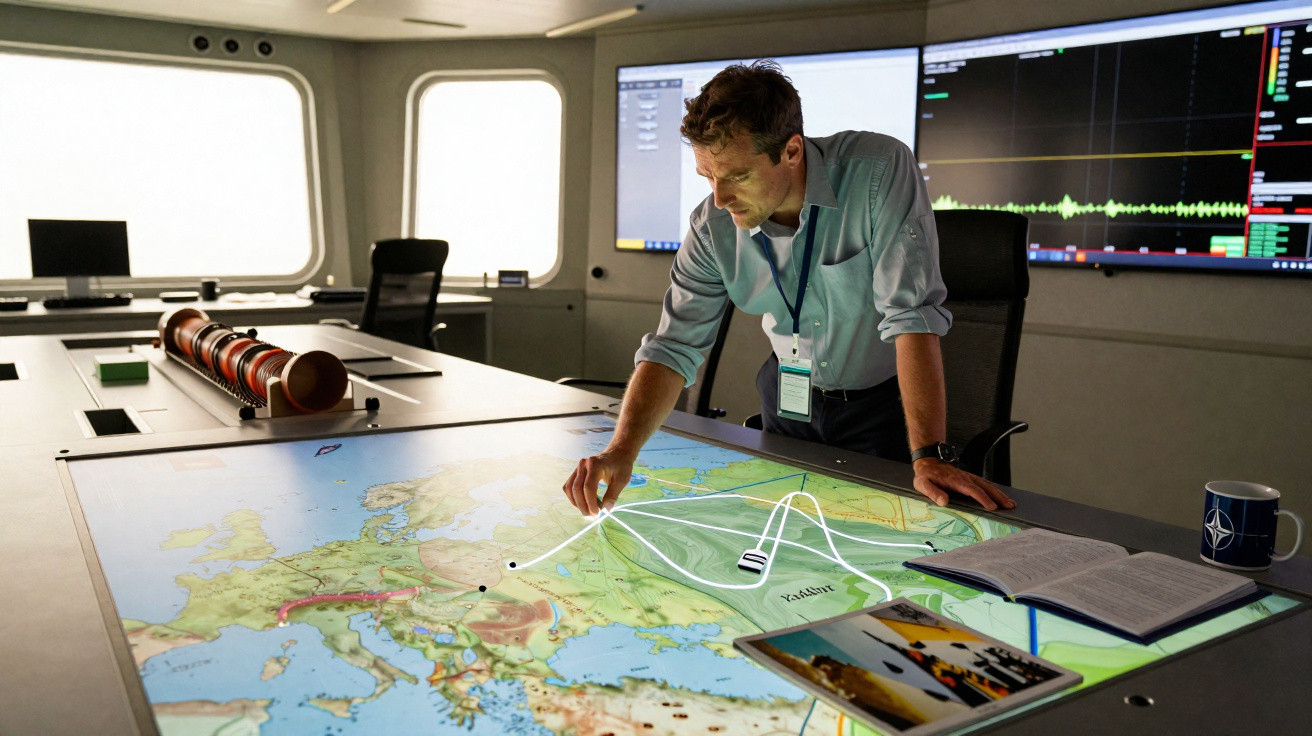
In recent hours, the UK Ministry of Defence, through its Secretary of State, reported that the Russian Navy research vessel Yantar had once again been detected near British waters, specifically around the far north of the English islands. In response, the Royal Navy deployed the Type 23 frigate HMS Somerset (F82), while the Royal Air Force (RAF) assigned a P-8A Poseidon maritime patrol aircraft to track and monitor the Russian-flagged vessel’s activities.
UK Defence Secretary John Healey himself informed the British Parliament of the development earlier today. He noted that this marked the second time this year that the Russian vessel Yantar had been found operating close to UK waters. In the British MP’s words: “This is a vessel designed for gathering intelligence and mapping our undersea cables.”
Russian Yantar surveillance near UK waters
For several years, the UK Ministry of Defence has regarded Yantar as a Russian “spy” ship, resulting in its close monitoring through the use of multiple naval and air assets. One of the most recent incidents took place at the start of this year, when one of the Royal Navy’s nuclear submarines surfaced near the Russian ship to deter it, as it was loitering around critical subsea infrastructure within the United Kingdom’s exclusive economic zone (EEZ).
Concern over the ship’s presence stems from the capabilities of this type of vessel. More specifically, Yantar is the lead ship of Project 22010 and belongs to the Main Directorate of Deep-Sea Research (GUGI). Although officially designated an “oceanographic research vessel” by the Russian Navy, it has attracted attention for several years after being observed conducting surveillance activities in the Atlantic, North Sea and Barents Sea, particularly near critical subsea infrastructure.
Yantar’s deep-sea capabilities and Russian Navy base
Among its other features, several reports support the view that Yantar may be able to intercept or cut undersea cables, as well as investigate and recover objects at depths of almost 5,500 metres. With Severomorsk as its home port, one of its most significant capabilities is the ability to deploy up to two types of autonomous submersibles designed specifically for deep-water operations: the Rus and Konsul classes.
The vessel is 108.1 metres long with a beam of 17.2 metres, and is based in Olenya Bay. This location hosts not only the aforementioned GUGI base, but also conventional and nuclear-powered submarines of the Russian Navy.
Observers further suggest that this second incident forms part of a wider Russian Navy intelligence-gathering and espionage campaign directed at the countries of the North Atlantic Alliance (NATO), among others, while operating within the administrative boundaries of Russia’s Northern Fleet.
A recent example emerged only days ago, when the Royal Netherlands Navy deployed its own units to conduct a surveillance mission on the Russian Navy research ship Yantar as it transited the North Sea. For the Dutch Ministry of Defence, the event was further evidence of an issue it has long suspected and warned the public about: Russia is increasing its naval presence in the region with research vessels that could be mapping key infrastructure lying beneath the sea.
You may be interested in: Russia has created a new branch within its Armed Forces specialising in drone warfare






Comments
No comments yet. Be the first to comment!
Leave a Comment