
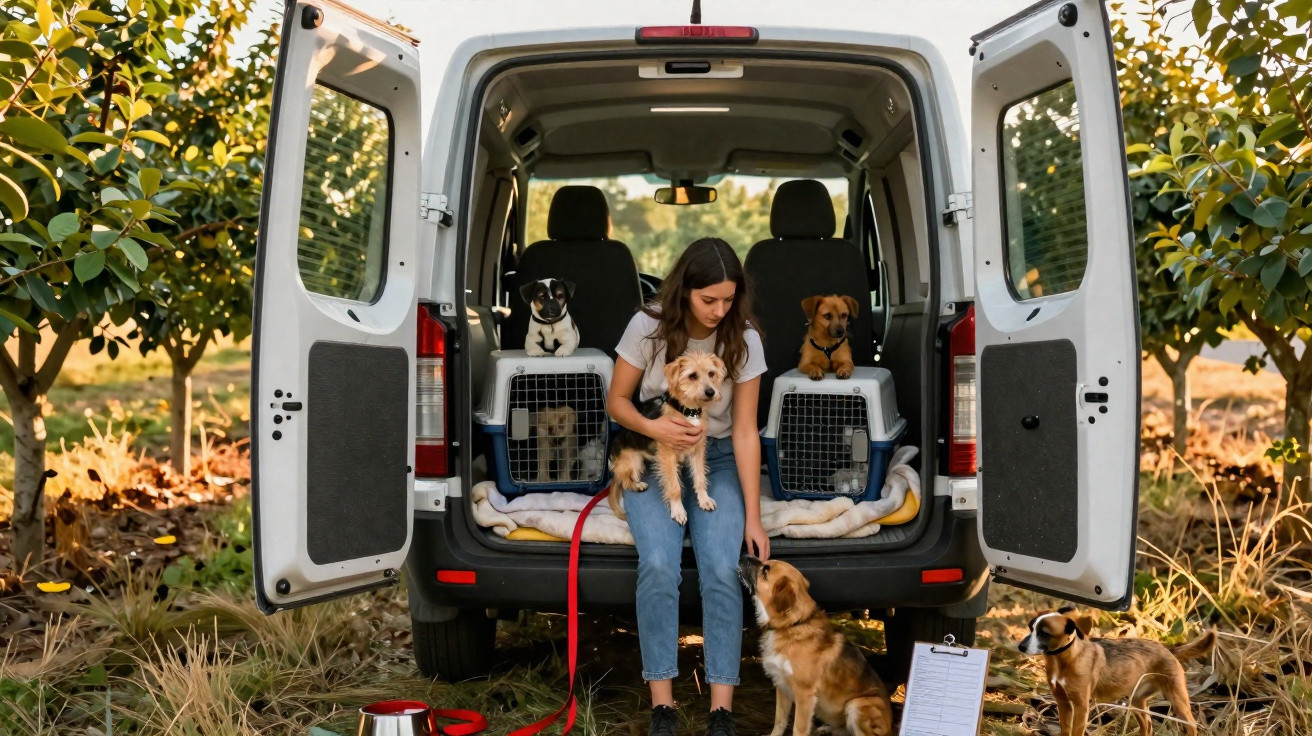
A rescuer called to help a small group of abandoned dogs on an isolated farm arrived to find something far beyond what she had anticipated.
What began as an effort to collect one mother dog and three puppies rapidly became an urgent rescue of hungry, trusting dogs living in a deserted orchard.
A call from a silent orchard
This began at a rural orchard on the edge of Fresno County, California, where nobody lives on the property. Staff arrive in shifts to look after the trees, but once they leave, the site is empty and quiet overnight.
A worker had spotted an underweight female dog moving through the tree rows with three young puppies. Clearly abandoned and in a poor state, the dogs began receiving food and water from him and his colleagues during their breaks and lunch hours.
They were the dogs’ only lifeline: no neighbours, no nearby houses, just seasonal workers slipping them leftovers between shifts.
Knowing this arrangement could not continue, the worker contacted Fresno Humane Animal Services. The report was assigned to rescuer Priscilla Wolcott. However, the orchard was a considerable distance away, so the team could not attend at once.
Two days elapsed between the call and the initial visit. For animals that were already hungry and exposed to the weather, those 48 hours were especially significant.
Fresno County orchard rescue reveals more dogs than expected
When Priscilla reached the edge of the orchard in her vehicle, she had prepared herself for four nervous stray dogs. Instead, she could already see tails wagging from a distance.
The first mother and her three puppies were exactly where the worker had said they would be. Nearby, in a shaded spot, another adult female was nursing a litter of newborn puppies. A further adult dog, probably connected to the group, also came over.
What was supposed to be a four-dog rescue suddenly became a 13-dog evacuation, with two mums, several tiny puppies and one extra adult.
Co-workers later verified that the second mother had delivered her litter during the days between the original call and the rescue team’s arrival. When Priscilla got out of her vehicle, the new mother was plainly tired and thin, though she raised her head as the rescuer came closer.
Rather than running away, the dogs approached her immediately. They wagged their tails, licked her hands and pressed themselves against her legs, seeming as though they had been awaiting her arrival.
A van filled far beyond its intended capacity
Rescue transport normally follows firm procedures. Animals are usually secured in crates, kept safely apart and never allowed loose on rear seats. That day, those rules had to be treated more flexibly.
Priscilla soon understood that her vehicle was not designed to transport 13 animals, particularly with newborn puppies among them. She had to make an agonising decision: transport as many as possible or leave some dogs behind until she could return.
She refused to leave even one dog in the orchard, deciding, “We’ll make it work. They’re all coming with me.”
She carefully placed the puppies in safe spaces one at a time, positioned both mothers where they could remain close to their litters, and found room for the additional adult dog. The rear seat, normally prohibited for transport, was even used for the final animals.
How the rescue vehicle was arranged
- Newborn puppies were kept with their mother in a secure, padded crate.
- The older puppies were placed together in a second crate within easy reach.
- Adult dogs were positioned so they could rest safely while being watched.
- Water bowls were secured to prevent spills during the journey.
The trip back to the shelter was not short. In the crowded yet secure van, the orchard dogs became calm, with some finally falling asleep. For the first time in days, or perhaps weeks, they were travelling towards a place where food, water and veterinary treatment were certain.
From neglected ground to organised care
After arriving at Fresno Humane Animal Services, the dogs underwent examinations, vaccinations, parasite treatment and checks of their weight and general condition. The mothers were especially underweight because they had used much of their remaining energy to nurse their puppies.
Although none of the dogs was critically ill, staff observed signs of neglect, including dull coats, dehydration and early skin problems. The puppies required frequent feeding routines and close observation, particularly the newborn litter.
| Dog group | Immediate needs |
|---|---|
| First mum & 3 older pups | High-calorie food, vaccinations, flea and tick treatment |
| Second mum & newborn litter | Quiet whelping area, monitoring of milk production, gentle deworming |
| Adult male dog | Neutering assessment, behavioural evaluation, routine medical check |
Ruff Day Rescue, a local rescue partner, later helped with placement and follow-up support. Small rescue groups frequently work alongside municipal services to ease the burden on busy shelters and improve dogs’ prospects of finding permanent homes.
Why orchards and farms attract abandoned dogs
Situations like this are common in agricultural parts of the United States. Large farms may be unoccupied overnight and outside the harvesting period, making them frequent places for people to abandon unwanted animals.
Dogs are drawn to discarded food, irrigation ponds and the occasional compassion of workers. They gather in loose packs, reproduce and form small hidden populations that may not be discovered until their numbers increase.
Rescue workers often describe a “multiplication effect”: if one unneutered female is left in this sort of environment, several litters may be born in difficult circumstances within a year.
What witnesses can realistically do
Anyone who encounters abandoned animals cannot necessarily fit a dozen dogs into their vehicle. Even so, members of the public play an important part in cases like these.
Steps to take if you find a group of abandoned dogs
- Leave clean water and food in one regular location away from traffic.
- Do not chase or suddenly try to grab the dogs, as this may scatter them and make rescue more difficult.
- Take clear photographs, and record the number of dogs and their approximate ages, such as puppy, adult or senior.
- Contact local animal control or a humane society, providing exact directions or GPS coordinates.
- If it is safe to do so, use cardboard or crates to provide temporary protection from rain or sun.
Such simple measures create valuable time. They are not a replacement for professional intervention, but they can prevent a dangerous situation becoming fatal while rescuers arrange vehicle transport and shelter space.
Why “no one left behind” matters
Animal welfare professionals frequently discuss the real-world constraints on rescue work: space, money and staffing are always limited. Still, decisions made at a rescue location can have lasting consequences.
Leaving even one sociable, unneutered dog in an isolated place may create the need for several further rescues. Removing every animal at the same time is not merely the kinder choice; it also limits future suffering and later callouts.
This orchard rescue also demonstrates how fast circumstances can change. Over only two days, one mother went from being pregnant to nursing puppies, which increased the risks involved. Even a brief delay can expose newborn pups to changing temperatures, predators or inadequate nutrition.
Readers concerned about animal welfare who feel unable to make a difference can still help to prevent similar cases: support affordable spaying and neutering schemes, assist local shelters or share reliable information when animals are found in distress.
At that remote California farm, one worker’s call and one rescuer’s decision not to leave a single animal behind gave 13 abandoned dogs a second chance at safety, care and, ultimately, suitable homes.



Comments
No comments yet. Be the first to comment!
Leave a Comment