
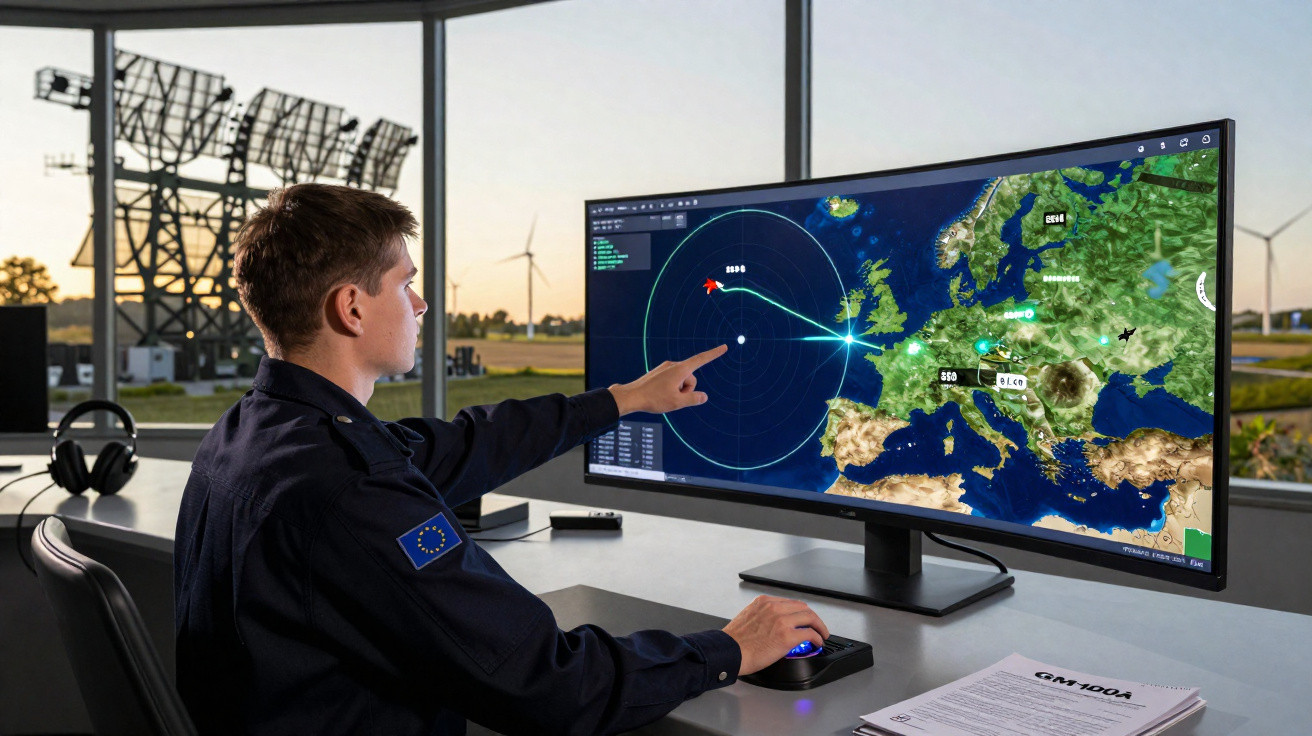
On a grey morning in Brittany, a row of radar domes shone faintly through the Atlantic haze. A handful of sailors smoked quietly on the quay while technicians in orange high-visibility vests worked over a metal framework covered in antennas. One sailor said, half in jest, “Looks like something out of a sci‑fi film.” No one laughed much. Everyone understood that the equipment being assembled would discreetly alter the balance of power in Europe’s skies.
Inside a nearby hangar, a display ran a simulation: a small point emerged hundreds of kilometres away, close to the edge of the map, before a stream of data followed. Range: 550 km. Origin: unknown. Above it all was a single clear label: GM400α.
A €1.1 billion wager that France no longer wishes to buy American eyes.
France’s €1.1 billion radar bet that Washington didn’t see coming
Officially, this is a radar modernisation programme. In practice, it resembles a quiet separation. France has chosen to invest around €1.1 billion in a new European early-warning “monster” with a 550 km range, built around Thales’s GM400α radar. Rather than automatically looking to the Pentagon catalogue for its next major sensor, Paris wants its own digital binoculars for monitoring a sky that is becoming busier, more hazardous and far harder to interpret.
The decision follows years of complaints within French defence circles: excessive reliance on US systems, too many black boxes and too many political conditions attached.
Known by some officers as “le monstre de détection”, the GM400α is more than another rotating aerial. It is a 3D AESA radar that can detect aircraft, cruise missiles and certain drone types at distances of up to 550 km, before distributing that picture to European allies in real time. From the ground, it appears relatively unassuming: a mast, panels and a shelter packed with electronics. On a screen, however, it is a very different proposition.
In one recent trial, engineers gave the system a disorderly simulation containing civilian airliners, military fighters and a low-flying missile moving along the sea. The radar did not falter. It distinguished targets, classified them and tracked them. One officer described the experience as “like switching from VHS to streaming in one night.”
Behind the technical claims sits an unmistakable political message. By committing to a European sensor rather than US-built systems such as the AN/TPS‑77 or other American radars, France is demonstrating that strategic autonomy is not just a Brussels slogan. It means budget allocations, prototypes and procurement deals signed in euros rather than dollars.
Russia’s war in Ukraine has sped up this process. NATO’s eastern flank has become a tense area of daily interceptions, unidentified objects and Russian probes. In that setting, depending on Washington to fill every capability gap increasingly looks less like protection and more like exposure. The GM400α is France saying: from now on, we watch our own sky first.
How the GM400α “detection monster” changes the rules in European skies
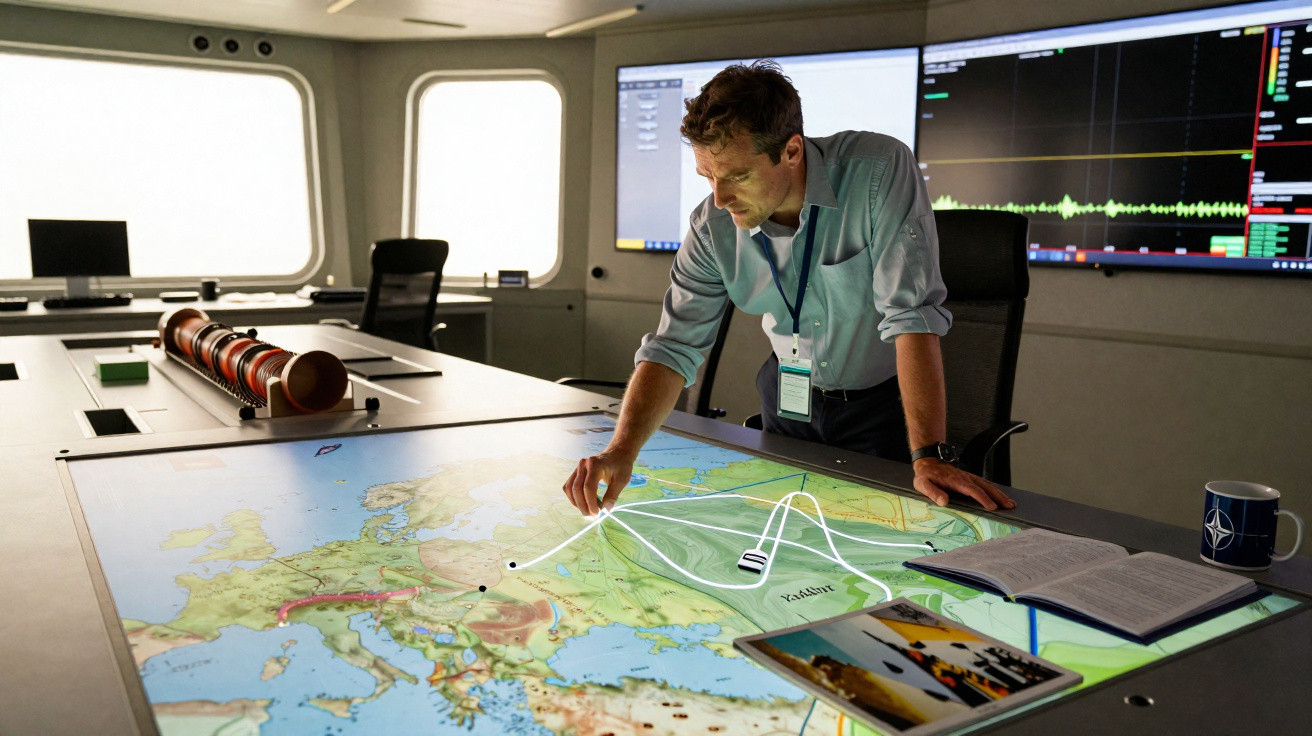
Every major military announcement has an ordinary reality behind it: people in darkened rooms studying screens. The GM400α programme is intended to change what happens in those rooms. Its approach is straightforward: expand the area visible to operators, improve the picture they receive and distribute it more rapidly than anyone else.
At a technical level, the radar combines thousands of small electronic “tiles” that direct its beam without physically rotating the entire aerial. It can therefore move from one target to another in microseconds, rather than mechanically scanning as older systems do. For air controllers, this should mean fewer blind spots, less interference and earlier alerts when a dangerous object emerges beyond the horizon.
The French Air and Space Force has already planned the locations for several of these systems. One will be near the Atlantic, while others will be positioned closer to the Mediterranean and Eastern Europe, connected to NATO’s integrated air-defence network. Together, they suggest a continent seeking to assemble a coherent shield, one component at a time.
The drone and missile strikes on energy facilities in the Middle East, along with cruise missiles travelling across Ukraine, jolted more than one planner in Paris. A 550 km range allows a threat to be identified well before it nears French or allied borders. It also gives civilian air traffic fewer unexpected disruptions when a crisis develops overnight.
Few people read a radar procurement contract from beginning to end. What they notice instead is a broader change. For years, European countries purchased sophisticated American radars almost automatically, drawn by proven technology and political reassurance. The calculation is now evolving. Keeping vital detection capabilities in European hands provides greater control over upgrades, data and exports.
There is a psychological dimension too. Through its major commitment to Thales and European partners, France is signalling to Berlin, Rome and Madrid: we can build the core of our own air shield. Washington remains an essential ally, but it is no longer the only engineer in the room. In geopolitical terms, that distinction is enormous.
What this move really says about Europe’s future defence-and our uneasy dependence on America
From the French perspective, the way this radar shift is being pursued says nearly as much as the reason for it. The state has not simply written one cheque and stepped back. Instead, it has created a multi-year programme combining upgrades to existing GM400 radars with brand-new GM400α units, introduced gradually across French and potentially European territory.
The strategy is incremental: increase range, sharpen resolution, strengthen resistance to jamming, and then link everything through secure networks so that one radar’s picture can reach neighbouring systems in near real time. This is not about a single miraculous device, but about creating a network. The €1.1 billion is funding for the framework, not the final sum.
For many Europeans, this exposes a familiar tension. There is a desire to reduce dependence on the United States, while American technology continues to dominate fighters, satellites and even some missile systems. Governments pledge autonomy, then discreetly approve fresh US contracts when pressure mounts. That is why the radar story strikes such a sensitive point.
Selecting a European “monster” instead of a US sensor is a specific and visible move. It also brings risks: fewer economies of scale, greater research-and-development difficulties and slower initial support. French officers are aware of this. Some complain privately, recalling US equipment that “just worked” on day one. The emotional reality is straightforward: detaching from Washington is exhilarating and frightening at once.
“This radar is not anti‑American,” confided a French defense official, visibly tired after a long briefing. “It’s pro‑European. We’ve learned the hard way that if you don’t own your sensors, you don’t really own your decisions.”
- Longer early warning: 550 km reach gives more minutes to react to a missile or unknown aircraft.
- Less political leverage from Washington: Europe reduces the risk of being pressured via access to critical detection data.
- Industrial sovereignty: Jobs, know-how and upgrades stay anchored in Europe instead of crossing the Atlantic.
- Better fit with EU defence ambitions: The system plugs directly into emerging European air and missile defence plans.
- Room for export and cooperation: Other EU states can buy or co-develop modules without Washington’s veto.
Beyond one radar: a quiet test of how far Europe really wants to go alone
Viewed more broadly, the GM400α is less a piece of equipment than a test. How far is Europe prepared to go when it stops purchasing American systems by instinct and begins building its own nervous system? That issue runs through every defence council, every late-night Brussels negotiation and every discreet telephone call between Paris and Washington.
We have all experienced the moment of realising that too much of daily life has been outsourced to someone else’s tools. For European governments, US radars, satellites and software have filled that comfort-zone role. France’s €1.1 billion wager is an initial crack in that shell. It will not end the alliance, and aircraft will continue crossing the Atlantic for a long time. Nevertheless, something more fundamental is changing: the sense that Europe must either become an actor in its own security or remain a market for someone else’s hardware.
| Key point | Detail | Value for the reader |
|---|---|---|
| European “detection monster” | GM400α radar with 550 km range funded by France for around €1.1 billion | Understand why this system is being called a game-changer in European air defence |
| Shift away from US tech | France prefers a European radar over US-made alternatives, signalling strategic autonomy | See how geopolitical power also plays out through who builds the sensors and networks |
| Impact on future conflicts | Earlier detection of aircraft, missiles and drones, plus tighter integration with EU/NATO systems | Grasp how this could shape Europe’s ability to react in a crisis or protect its airspace |
FAQ:
Is France completely abandoning US defence technology?
No. France still uses and will likely keep buying some US systems, especially where there’s no quick European alternative. The GM400α move shows a targeted push for autonomy in early warning and air defence, not a full break with Washington.What makes the GM400α different from older radars?
It uses advanced AESA technology, offers a range up to 550 km, and processes data much faster than legacy systems. That means better tracking of low-flying missiles and drones, fewer blind spots, and smoother integration into modern digital command networks.Will other European countries buy this radar too?
Several EU and NATO states are watching closely. Some already operate earlier GM400 versions, so upgrading to GM400α is a logical step. Others might choose it to reduce dependence on US radars or to align with EU defence initiatives.Does this weaken NATO cohesion?
Not necessarily. The radar is designed to plug into NATO’s air defence network. The political signal is about industrial sovereignty and decision-making freedom, not about leaving the alliance. Interoperability remains a key requirement.Could this radar really detect hypersonic weapons?
Detection of hypersonic threats is extremely challenging for any radar. The GM400α can improve early warning and tracking in some scenarios, but no one system alone is a silver bullet against hypersonic missiles. It’s one piece in a broader layered defence puzzle.



Comments
No comments yet. Be the first to comment!
Leave a Comment