
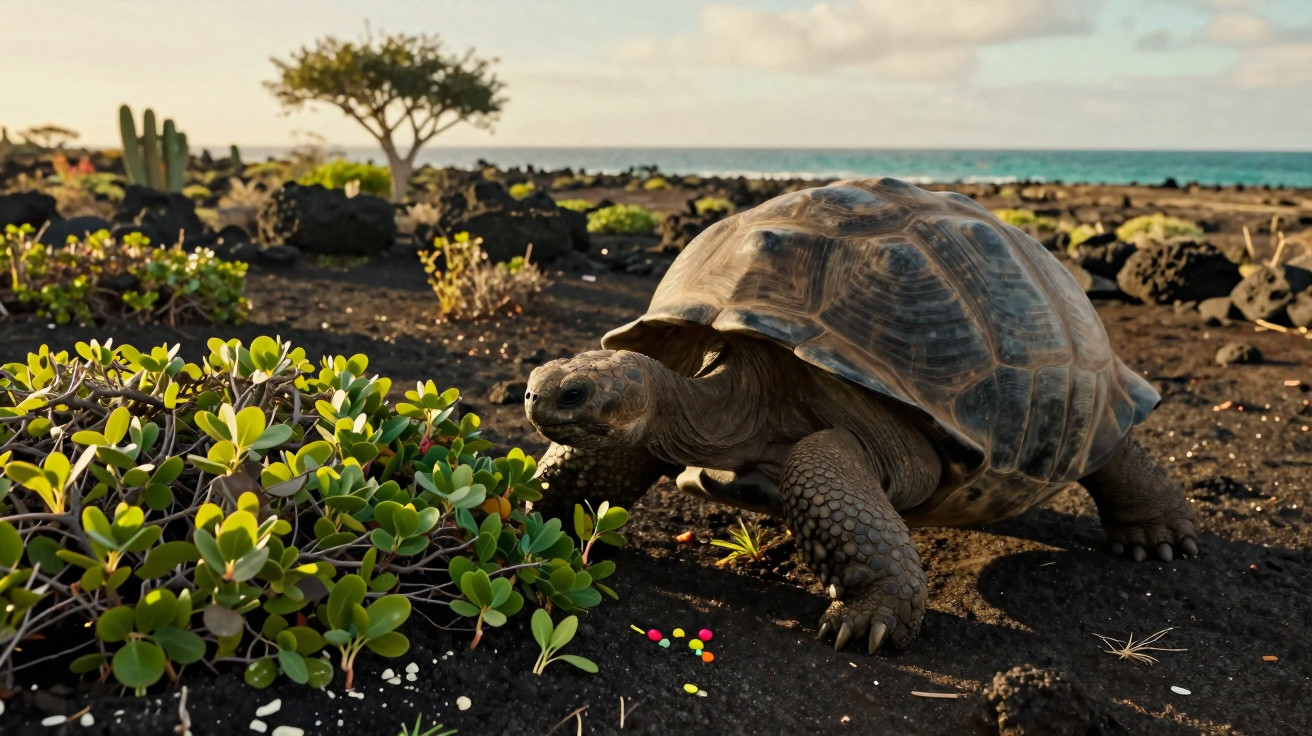
At dawn on Española Island, the sound comes first: branches cracking with a brittle snap across the dark lava rocks. Then the source emerges-vast, weathered-looking shells edging through a short, scrubby thicket, forcing stems apart as though they were no more substantial than paper.
A ranger wearing a sun-faded cap gestures towards recently disturbed earth, scattered with seeds encased in tortoise dung. Several metres away, a small clearing now lies open to the sun, where thick vegetation had stood only weeks before.
In this remote part of the Galápagos, more than 1,500 giant tortoises have returned after coming close to vanishing altogether. They are doing far more than persisting: they are setting entire ecosystems in motion again.
The process, however, resembles demolition played out in extreme slow motion.
When bulldozers have shells and travel at 0.3 km/h
Stand in the way of a Galápagos giant tortoise and it soon becomes clear which creature truly determines the shape of the terrain. It neither growls nor rushes forward, and it makes no threat. Instead, it presses its weight onwards until the shrub ahead buckles and splits, like a flimsy umbrella caught in a gale.
Every step creates a shaft of light within terrain formerly smothered by resilient scrub. A continuous green barrier becomes a pattern of scattered clusters, exposed soil and an unexpected abundance of seedlings. The tortoises continue at their unhurried pace, leaving a patchwork of small openings behind them.
That pattern had all but disappeared on Española. For many years, only a few elderly tortoises survived, while plant growth became dense, knotted and overgrown. Conservationists then began returning tortoises to the island-not in groups of two or three, but by the hundreds.
By 2020, more than 1,500 giant tortoises had been reintroduced to Española, all descended from only 15 animals rescued during the 1960s. Rangers noticed the shift before it appeared in graphs and datasets: underfoot, the landscape felt more open, routes became easier to follow and prickly scrub was less overwhelming.
Scientists later confirmed those observations with evidence. Sites used by tortoises contained substantially more bare ground and greater numbers of young plants from important native species. Seeds were being transported further in the digestive systems of these slow-moving animals, which could traverse whole valleys over several days. Seemingly purposeless roaming was, in reality, landscape management on a vast scale.
Ecologists describe this as “rewilding”, although on Española that term can seem rather too orderly. The island appears to be regaining a process that had long been absent. It is almost possible to feel the island recalling how it is meant to work.
The mechanism is straightforward, even blunt. Tortoises feed, tread on vegetation and defecate. Shrubs that had held the soil inside an unbroken green enclosure are broken, eaten and thinned out. Seeds that might otherwise have fallen directly beneath their parent tree instead arrive hundreds of metres away in a compact, fertilised parcel.
In time, this forceful treatment interrupts the uniformity of thick scrubland and restores a more varied, open landscape. Light reaches the ground in new locations. Water takes different routes. Certain plants decline while others flourish. Ground-nesting birds, including the waved albatross, once again have room to land and rear their young.
What appeared to be an excess of shrubs was actually evidence of a more fundamental breakdown. In the absence of the large herbivores that had historically moulded the island, vegetation developed in a rigid, unchanging form. Now that 1,500 slow bulldozers have resumed their work, that rigidity is beginning to give way.
How Galápagos giant tortoises quietly rewire an island, one slow step at a time
Watching one tortoise for an hour may give the impression that very little occurs. It nibbles a low-hanging branch, pulls its shell beneath a bush and stops for what seems an age. Yet small details gradually stand out: a broken stem, a newly deposited pile of dung, a seedling pressed into the earth by the edge of a foot.
Conservation biologists have become skilled at interpreting these small signs as a connected narrative. They use GPS to chart tortoise routes, calculate the distances seeds are carried and examine the sites where young plants establish most successfully. A consistent trend has emerged: areas with heavier tortoise use contain a wider range of plant heights, densities and ages.
The tortoises can be viewed as gardeners operating in slow motion, with a preference for disorder. They neither plant in straight lines nor follow a design. They react simply to hunger, shelter and gradients. Still, their continual choices, which appear random, produce a setting in which some plants are repeatedly grazed while others are able to rise between them.
Earlier human errors almost brought this system to a standstill. Goats introduced by people consumed vegetation down to the soil itself. Rats preyed on eggs and seedlings. The small number of tortoises left alive had scarcely any ecological function remaining. Once these invasive species were removed and tortoises began returning, the speed of the recovery took almost everyone by surprise.
Researchers documented shrubs being reduced not by fire or machinery, but by shells and beaks. They found sharply higher seedling densities in places where tortoises frequently rested. They also saw native trees, previously confined beneath a canopy of scrub, finally receiving sufficient light to develop.
What may look like indiscriminate trampling works instead as a reset mechanism for ecological functions that had become blocked. In some places, tortoises firm up the soil enough to form routes along which water can flow. Their dung adds nutrients to nutrient-poor volcanic earth. At important times of day, their bodies also provide shade for seedlings.
We often picture ecosystems as fixed scenes. The Galápagos repeatedly show that they are closer to films in constant motion. When the central actors disappear, the story does not merely stop; it changes into something different. Returning more than 1,500 giant tortoises is not an act of nostalgia, but an effort to resume a storyline interrupted halfway through.
What the giant tortoise return reveals about “fixing” nature
Conservation can invite an appealing fantasy: locate a damaged site, plant countless trees, erect a fence and leave. The work involving Galápagos tortoises presents a more complicated, yet unexpectedly reassuring, reality. At times, the most intelligent approach is to restore the right large animals and allow them to carry out the work.
The method used here is, in practical terms, almost the opposite of what might be expected. Rather than directing every element, scientists concentrated on three measures: eliminating the most harmful invasive species, safeguarding the remaining native wildlife and plants, and reintroducing a vital missing species at a meaningful scale. The tortoises then dealt with the finer adjustments.
This was not an unplanned or simple undertaking. Every tortoise release involved preparation, including health assessments, genetic screening and carefully selected release locations. Once the animals were free, however, the intention was not to control their movements. It was to let them roam, browse on shrubs and deposit seeds wherever their slow instincts took them.
Anyone who has listened to discussions about climate and biodiversity will recognise the guilt that can gradually enter the conversation. We are urged to recycle more, consume less meat, support suitable projects, remain informed, avoid flying and plant native species-the demands continue. Let us be honest: nobody really does all of that every day.
Seeing a tortoise force its way through an obstinate bush does not make that burden disappear. It does, though, suggest another perspective: rather than believing people must control every leaf and root, we can sometimes establish the conditions that allow other species to lead. Psychologically, this feels less like attempting to stop the sea with a bucket and more like opening the correct channels before standing aside.
This story also carries cautions. If conservation turns into a feel-good display, it can become detached from difficult realities. An appealing baby tortoise on Instagram cannot repair a damaged seed-dispersal network. Española is distinct because of time and persistence: decades of effort, experimentation and error, and a determination to measure recovery not only through animals saved but also through ecological processes restored.
“We didn’t bring tortoises back just to admire them,” one park ranger told me, wiping dust from his hands. “We brought them back so the island could remember how to breathe.”
Projects of this sort require patience and a long-term outlook. They also require clear narratives that others can relate to. In a crowded news feed, a slow reptile may struggle to compete with political conflict or celebrity gossip. Nevertheless, these animals are quietly changing the possibilities associated with “restoration”.
- More than 1,500 tortoises on Española are now altering shrubs, soil and seed movement.
- This is among the clearest real-world demonstrations of rewilding involving a large herbivore.
- Their gradual return questions our preference for rapid, tightly controlled solutions.
Why this slow revolution on a distant island matters to us
At first glance, a far-off Galápagos island and its giant tortoises seem disconnected from everyday life. You may never cross those lava fields or hear the unusual hiss made by a tortoise withdrawing its head into its shell. But the question beneath their story is uncomfortably familiar: what follows when we remove the powerful forces that once shaped our landscapes?
In urban areas, many of those forces have been eliminated: concrete prevents flooding, lawnmowers have replaced grazing animals and rivers have been channelled into pipes. In the countryside, large predators have disappeared, ancient woodland has been felled and seasonal fires have been suppressed. These systems still function, but with peculiarities and pressures that seem increasingly fragile each year.
The Galápagos tortoises provide an unusual and encouraging counterexample. A species pushed close to extinction is not simply remaining alive; it is actively reconstructing the setting required for its own survival. The shrubs they knock down are not merely “cleared vegetation”: they initiate fresh seed journeys, altered patterns of light and new nesting opportunities for birds.
On a human level, there is something steadying about recognising that repair does not always demand high-tech answers or flawless plans. Sometimes it involves trusting a heavy, determined reptile to travel where it chooses, then allowing it decades to demonstrate the consequences of that freedom. It means accepting a pace that conflicts with how we generally expect progress to be delivered.
The next time a headline about extinction or ecosystem collapse appears while you are scrolling, you may imagine one of these tortoises, dusty and partly hidden beneath a thorny shrub it has just pushed aside. In real time, the moment is quiet and almost dull. Its effects, however, spread across an entire island.
Perhaps that is Española’s most surprising lesson: meaningful change can be both dramatic and almost imperceptible from one day to the next. An animal moving at walking pace can alter the future of a landscape. And, in at least some places, our role is not to rebuild nature from the beginning, but to welcome back the slow forces that once understood how to keep it in motion.
| Key point | Detail | Why it matters to the reader |
|---|---|---|
| The large-scale return of giant tortoises | More than 1,500 tortoises reintroduced to Española after a historic population collapse | It shows how a species that was nearly lost can once again drive an entire ecosystem |
| An ecosystem engineer role | Tortoises break shrubs, disperse seeds and reopen the landscape for other species | It provides a clear example of how a large herbivore can restore damaged ecological processes |
| Another way to think about restoration | Less direct human control, more rewilding and more time left to the animals | It explores an approach to repairing living systems that does not require total human management |
FAQ:
- Are giant tortoises really strong enough to reshape entire landscapes? Yes. Their weight, together with their continual movement and feeding, enables them to break branches, open dense scrub and compact or disturb soil across extensive areas over many years.
- Why were tortoises removed or reduced in the Galápagos in the first place? Centuries of hunting by sailors, combined with introduced animals such as goats, rats and pigs, devastated tortoise populations and disrupted both reproduction and their role in shaping vegetation.
- How do tortoises help plants instead of just destroying them? They consume fruit and leaves before distributing seeds in nutrient-rich dung far from the parent plant, often in open areas where seedlings have a stronger chance of becoming established.
- Is this reintroduction project considered a success by scientists? Current research indicates strongly positive effects: more open habitat, improved seed dispersal and signs of native species recovering in areas where tortoises are active.
- Can similar “rewilding” with big animals work outside the Galápagos? It already does in certain places, through projects involving bison, beavers and large herbivores in Europe and the Americas, although every landscape and species requires its own careful plan.




Comments
No comments yet. Be the first to comment!
Leave a Comment