
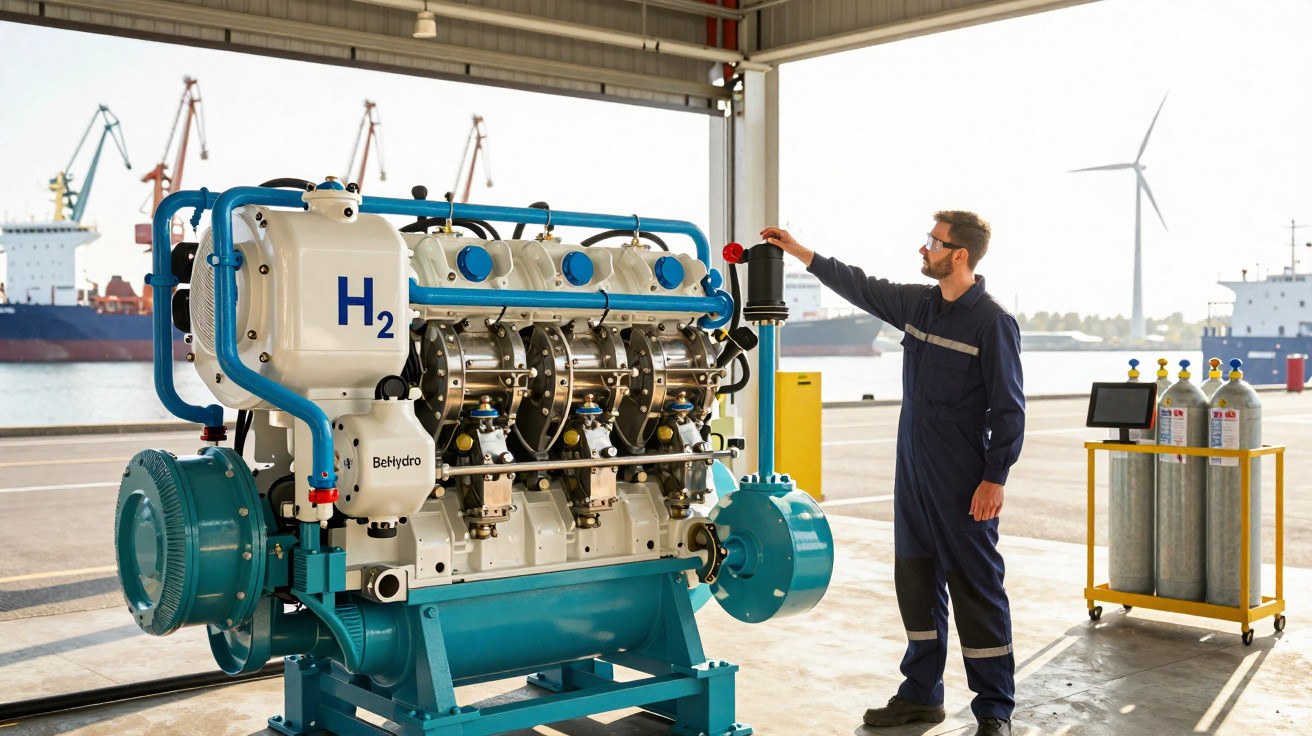
In a Flemish industrial workshop, the roar of a large engine retains the familiar harshness that makes windows tremble and drowns out conversations. This time, however, it is burning neither diesel nor natural gas: it runs on pure hydrogen. Belgium, often linked with its ports, its beers or its understated engineering expertise, has just made a striking move in the global race to decarbonise. The engine created by Ghent-based company BeHydro is described as the world's first to operate on 100% hydrogen and to receive approval from Lloyd’s Register. This is a distinctly practical breakthrough: before long, it could transform the air we breathe near docks, factories and construction sites. The potential is vast, and it reaches far beyond engineering circles.
In Ghent, a BeHydro engine far removed from a laboratory demonstration
What stands out most about this Belgian announcement is the machine itself: this is not a small-scale prototype displayed beneath a glass case. It is a substantial internal-combustion engine built for demanding applications, where batteries still have limitations, particularly on vessels, in generator sets and at certain industrial facilities. Formed through the partnership between manufacturer ABC and the DEME Group, BeHydro intends to bring hydrogen into sectors that consume large amounts of energy continuously and over long periods.
The engine delivers roughly one megawatt of power, equivalent to the simultaneous demand of several hundred homes. In a port, that level of output could power a berthed ship or industrial equipment without a diesel engine running for hours. We all know the moment when exhaust fumes become impossible to ignore on a quayside or beside a road; the aim here is to remove part of that nuisance rather than merely shift it elsewhere.
Lloyd’s Register, the British body widely recognised for maritime and industrial certification, has approved the technology, providing a much-anticipated signal to industry stakeholders. An innovation may look impressive on paper, but without independent scrutiny it often remains trapped at the stage of attractive promises. Approval provides a degree of technical assurance, particularly regarding the engine’s safety, design and integration. In the heavy-machinery sector, trust is earned on the test bench rather than through slogans.
Pure hydrogen: an ambitious answer, but not a magic wand
To grasp what is at stake, it is necessary to consider what this engine is intended to replace. Marine diesel and industrial fuels remain efficient, easy to store and widely available, yet their carbon footprint weighs heavily on the global transport and industrial balance sheet. When hydrogen is burned, an engine produces no tailpipe CO₂; its principal exhaust output is water vapour. This does not remove the need to monitor nitrogen oxides, which are linked to combustion temperatures, but it is nonetheless a genuine change.
Caution is still needed when referring to “clean hydrogen”. Its production method makes all the difference: hydrogen made using renewable electricity, known as green hydrogen, can substantially reduce emissions across its full lifecycle; when it is derived from natural gas, its record is far less favourable. Let us be honest: in everyday life, nobody really checks the source of every molecule of energy. Yet this is where a decisive part of Belgium’s climate promise will be determined.
For industry, the most practical approach is to assess each use case individually instead of searching for one universal miracle energy source. Short, predictable journeys can be well suited to electricity; lengthy operations, high-power requirements and equipment that is difficult to take out of service make more sense for hydrogen. The BeHydro engine does not claim that it will replace every car in Belgium tomorrow. It is aimed at situations where a giant battery would become too heavy, too slow to recharge or too bulky.
The real transformation will depend on ports, networks and habits
A common mistake would be to assume that an approved engine alone can create an entire supply chain. For a vessel or factory to use hydrogen, production capacity, suitable tanks, safety rules, trained teams and refuelling points are also required. As with the earliest electric cars, technology can sometimes progress faster than the charging points, stations and habits around it. Belgium has an unusual advantage here: its ports, chemical industry and location at the heart of European networks.
The Port of Antwerp-Bruges, Ghent’s industrial areas and links to the Netherlands and Germany could serve as key hubs. Hydrogen already circulates through some processes in these locations, although large-scale use as an energy source has yet to be built. The challenge is not only mechanical. It is logistical, financial and human: persuading a company to replace an engine is one thing; assuring it of dependable fuel for twenty years is another.
This Belgian breakthrough brings a straightforward idea into focus: major transitions do not always start with an elegant object held in the hand. Sometimes they begin amid the noise of a factory, around an engine that few people will ever see.
“Nothing is lost, nothing is created, everything is transformed.” - Antoine Lavoisier
- What is changing: a high-power engine can operate on pure hydrogen.
- What Lloyd’s Register validates: the technical credibility of a system intended for demanding applications.
- What still needs to be built: low-carbon hydrogen production, infrastructure and shared rules.
A Belgian invention that raises a question close to home
BeHydro’s achievement is more than an industrial accolade. It calls on us to view differently the infrastructure we can easily overlook: cargo ships in the distance, port cranes, generators behind hoardings and machinery operating while cities sleep. If green hydrogen fulfils its promise, some of this activity could become less polluting without losing its power. The route will be long, expensive and at times imperfect, but it is no longer abstract.
Belgium is therefore joining the global conversation with an invention that speaks as much to engineering as it does to energy independence. One almost personal question remains: are we ready to accept the works, investment and collective choices required to ensure that this technology does not remain merely a drawing-room source of pride? The coming years will show whether this engine born in Ghent becomes a remarkable exception or the first rumble of a new industrial landscape.
| Key point | Detail | Added value for the reader |
|---|---|---|
| A 100% hydrogen engine | The system developed by BeHydro is designed for demanding applications, with output of up to roughly one megawatt. | It demonstrates that hydrogen is not confined to experimental cars: it can target ships, ports and industry. |
| Lloyd’s Register approval | The approval provides crucial technical recognition in maritime and industrial sectors, where safety remains the priority. | The reader understands why this announcement goes beyond a simple Belgian prototype. |
| A promise with conditions | Its climate benefit depends largely on the origin of the hydrogen, the available infrastructure and control of associated emissions. | This nuance helps distinguish a tangible advance from an overly simplistic narrative about “clean” energy. |






Comments
No comments yet. Be the first to comment!
Leave a Comment