
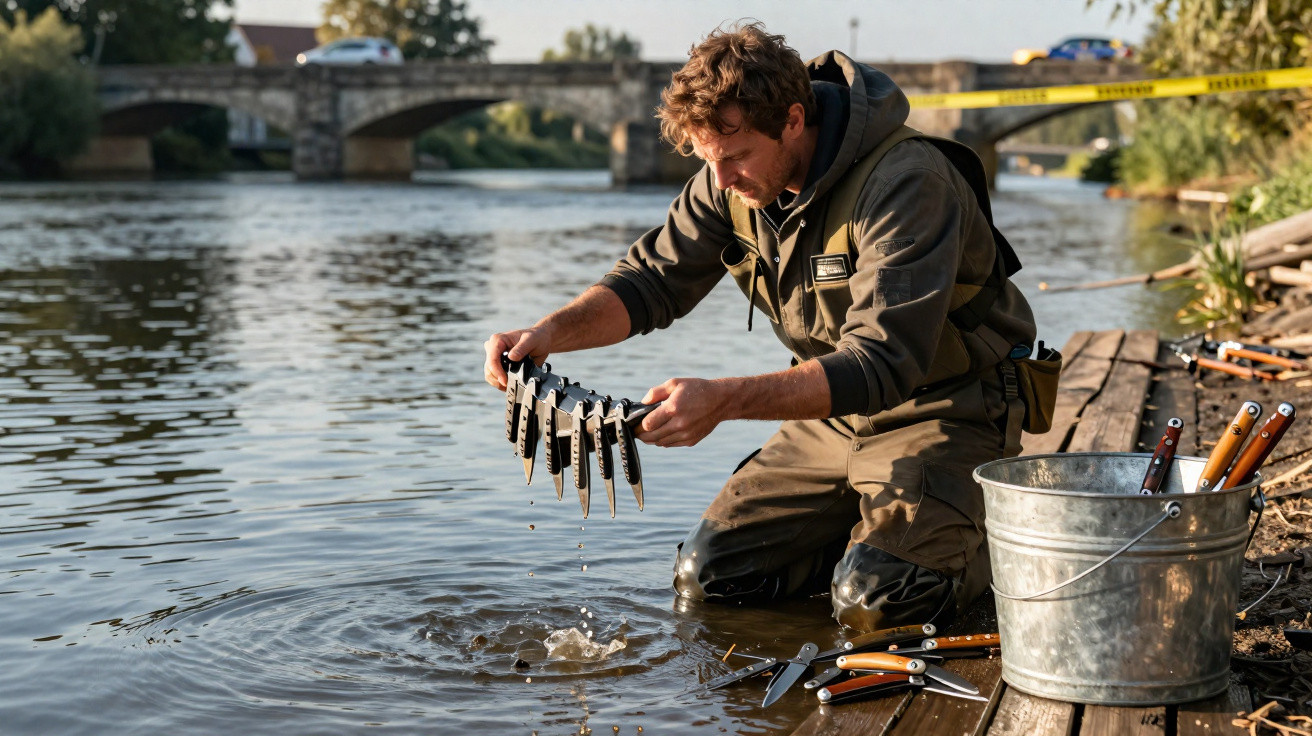
The rope suddenly jolted in the middle of a calm river, the sort of place where people usually fish for roach or walk their dogs. Two friends had arrived with a fishing magnet and gloves, expecting to pull up a few rusty nails or perhaps some old scrap metal. Instead, they retrieved knives. Then more knives. In all, almost 70 Laguiole knives, stuck together and darkened by silt but still clearly identifiable.
The find revived a memory many people had assumed was long buried: a theft reported almost thirty years ago at a small cutlery shop. At the time, investigators found neither the culprits nor the missing stock. Now, the river appears to have returned one piece of the puzzle. It may not have revealed everything.
Magnet fishing takes an unexpected turn
We all know how an ordinary outing can change without warning. Initially, the two metal-object hunters were making their way slowly along the bank, casting their magnet a few metres from the bridge, where the current slackens and debris tends to gather.
The first knife emerged from beneath a dense layer of mud. Its shine had gone, yet its slim profile, handle and folded blade left little room for doubt. The process then continued: cast, pull, rinse, count. In under an hour, their haul had reached 70 Laguiole-style knives.
What has unsettled local residents is not simply the quantity. The items appeared to come from one batch, with similar models and comparable markings, as though a crate had been emptied into the river in a single go. The discovery was too orderly to look like a straightforward domestic disposal.
The memory of an unsolved burglary
Some people in the village immediately referred to an old burglary committed during the 1990s. A cutlery store room was reportedly forced open overnight, and several dozen knives intended for sale vanished before opening time. CCTV systems were uncommon then, while the available evidence was extremely limited.
Thirty years on, the coincidence warrants at least some scrutiny. A batch of 70 items, discarded a short distance from a road and recovered in shallow water, could point to a hurried escape or a clumsy attempt to dispose of evidence. Let us be honest: this is not something anyone really does every day.
Laguiole knives also have a particular value, even when damaged. Certain handcrafted examples, fitted with handles made from fine wood, horn or bone, may appeal to collectors. The term “Laguiole” refers both to an iconic knife shape and to a world of craftsmanship associated with Aveyron and its traditional skills.
What should you do when a suspicious item comes out of the water?
The first instinct should be to avoid cleaning the object too harshly. A blade, serial number, inscription or corrosion mark may help establish its age and origin. It is better to take several photographs at the scene and record the time, approximate location and exact condition in which it was found.
A common mistake is to assume that an object found in a river automatically belongs to the person who recovered it. It is not that straightforward. Property that may result from a theft, a recent loss or an old case should be reported to the relevant authorities, particularly where such an unusual collection is involved.
In circumstances like these, caution safeguards both the finder and any possible owner.
“What appears to have been abandoned may still have a history, a value and sometimes an owner,” says a principle often quoted by responsible detecting enthusiasts.
A few steps can prevent considerable complications:
- photograph the objects before handling them for any length of time;
- inform the local police, gendarmerie or town hall, depending on the location;
- never sell, dismantle or restore a questionable find;
- check local rules before taking part in magnet fishing.
What these 70 Laguiole knives reveal beyond the news story
A river holds on to everything: happy memories, lost belongings, rubbish thrown away too hastily and, at times, traces of a night no one has forgotten. These 70 knives, recovered after three decades, give tangible form to an old local mystery: an unanswered burglary and a haul that may have rested beneath a few centimetres of silt.
Some very simple, persistent questions remain: who threw them there? Why were they not sold on? Was this really the stolen stock, or merely a group of items discarded by a business that had disappeared? Analysis, archive records and witness accounts may yet make these silent blades speak.
The story is also a reminder that adventure can sometimes be found just around the corner: in a ditch, a loft or beneath an old bridge. Sharing a photograph, speaking to the village elders or finding a forgotten receipt can sometimes be enough to stir a collective memory thought to be lost.
| Key point | Detail | Added value for the reader |
|---|---|---|
| Unusual discovery | Almost 70 Laguiole-style knives found in a river | Understand why such a volume is immediately intriguing |
| Old mystery | The find may be linked to a theft dating back around thirty years | Appreciate the value of archives and local testimony |
| Best practice | Photograph, report and do not restore suspicious objects | Avoid mistakes if making a similar discovery |






Comments
No comments yet. Be the first to comment!
Leave a Comment