
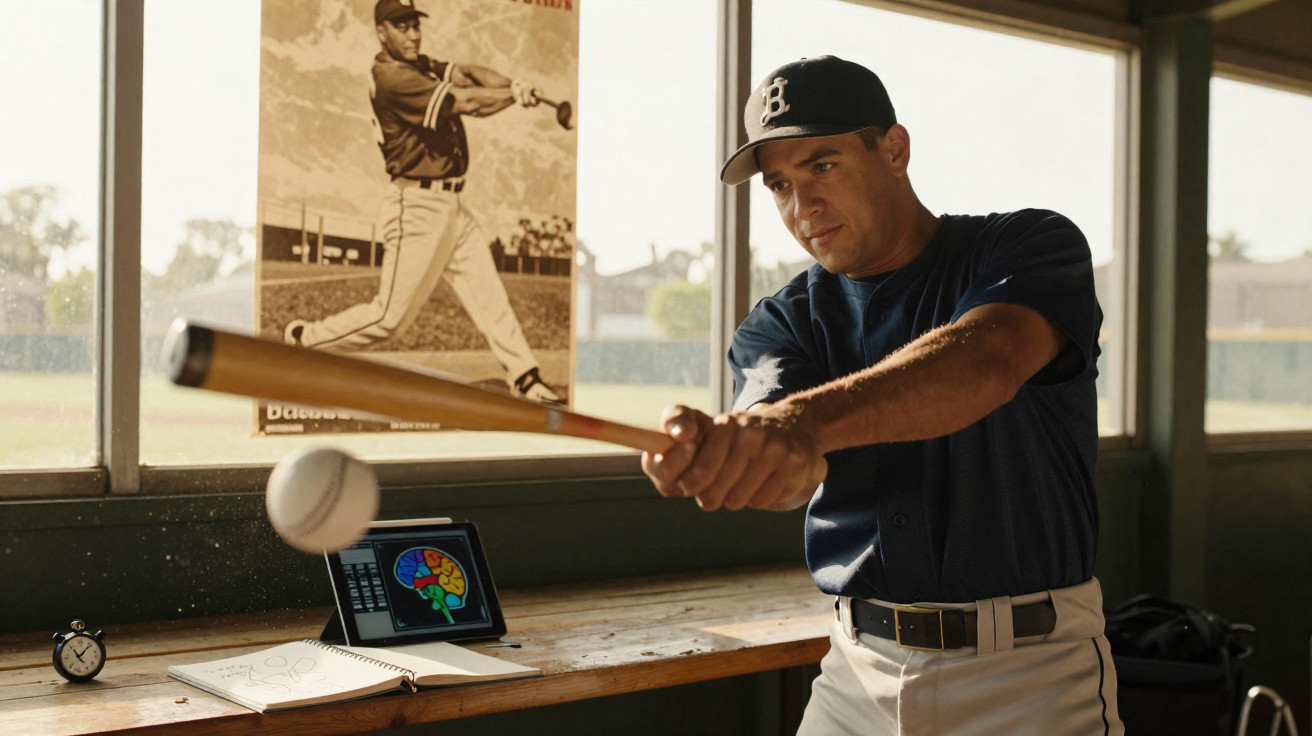
In 1920, George "Babe" Ruth began his first season with the New York Yankees.
That year, he hit a remarkable 54 home runs - more than any entire team managed.
Yet "The Bambino", as he was known, hardly appeared to embody peak athleticism. He was overweight, disliked training, and was regularly spotted at parties drinking and gambling.
How, then, did he become so exceptional on the baseball diamond?
Seeking an answer, Hugh Fullerton, a leading sports journalist at the New York Times, approached the psychology laboratory at Columbia University. There, postgraduate researchers Albert Johanson and Joseph Holmes were asked to investigate.
Fullerton's question was straightforward: if Ruth's success was not down to physical ability, what other influences could explain it?
The researchers were unsurprised to find that Ruth scored above the population average in every psychological test he completed.
His test results became the foundation for Fullerton's Popular Science Monthly article, titled: "Why Babe Ruth is greatest home-run hitter".
The findings reshaped popular views of sporting performance. They indicated that physical characteristics were not the sole reason athletes could excel: mental skills had finally moved into the spotlight.
The development of sport psychology
Ruth performed better than ordinary people in tests of attention, memory and cognition.
Sport scientists needed almost a century to establish whether such advanced abilities were typical of elite athletes, or whether Ruth was simply an exceptional genius.
In an exploratory meta-analysis published in 2018 and focused solely on athletes, my colleagues and I found that athletes engaged brain regions linked with attention, memory and motor control when making sport-related decisions.
In 2022, Nicole Logan and colleagues at Northeastern University in the United States reviewed 41 studies that compared professional athletes with ordinary control participants - people like us.
The data from 5,339 participants, including 2267 athletes, were meta-analysed. The findings revealed that professional athletes achieved significantly higher attention and decision-making scores than ordinary people.
Athletes therefore tend to outperform us in cognitive tasks - but what explains this advantage?
The rise of cognitive neuroscience enabled researchers to map the neural networks involved in sporting imagery - for instance, athletes' capacity to recreate sport-related scenarios in their minds - as well as their decision-making during matches.
Elite athletes are smarter than amateur athletes too
Decision-making is a human ability that improves with practice.
However, effective decision-makers, including elite athletes, also depend on other cognitive abilities to mentally simulate the possible outcomes of a particular situation.
Consider a rugby league match.
A halfback begins a move while their team is close to the try line. Although several teammates are available for a pass, the player tucks the ball under an arm and runs in to score a try after noticing a gap in the opposition's defensive line.
Within a split second, the halfback must decide using the information available. Through imagery, they need to account for every player's position on the pitch and work out the best route for every possible pass or run.
This demands intense attention to scan the pitch visually and prevent distractions from interrupting thought; memory to retain and retrieve information while evaluating every option; and creativity to picture the same move from alternative perspectives.
These three capabilities - attention, memory and creativity - are respectively known as inhibitory control, working memory and cognitive flexibility.
They are the brain's three central executive functions for carrying out complex tasks.
The most influential study into executive functions and sporting performance was published in 2012.
Torbjörn Vestberg and colleagues at Sweden's Karolinska Institute compared the three core executive functions of elite first-division soccer players with those of fourth-division players, who are generally only semi-professional athletes.
Players in the higher division outperformed those in the lower division across every executive-function task.
Comparable findings have emerged from other studies over the past decade, including research my colleagues and I published in 2023 comparing female soccer and futsal players with amateur counterparts.
We found that elite athletes performed better than ordinary people in decision-making and executive functioning.
Athletes outthink us because of practice
Elite athletes become highly specialised decision-makers by practising these skills every day.
They exceed ordinary people in cognitive flexibility and inhibition, which may contribute to wiser decisions both on and off the court.
However, scientific research still lacks evidence regarding working memory, the other central executive function. My current research seeks to address this gap.
Creativity and the ability to devise better ways of overcoming an opponent are central to sport, while many ordinary people like us struggle when confronted with large amounts of information simultaneously.
Practice, combined with some biological predisposition, makes most elite athletes smarter than us.
Alberto Filgueiras, Senior Lecturer in Psychology, CQUniversity Australia
This article is republished from The Conversation under a Creative Commons licence. Read the original article.






Comments
No comments yet. Be the first to comment!
Leave a Comment