
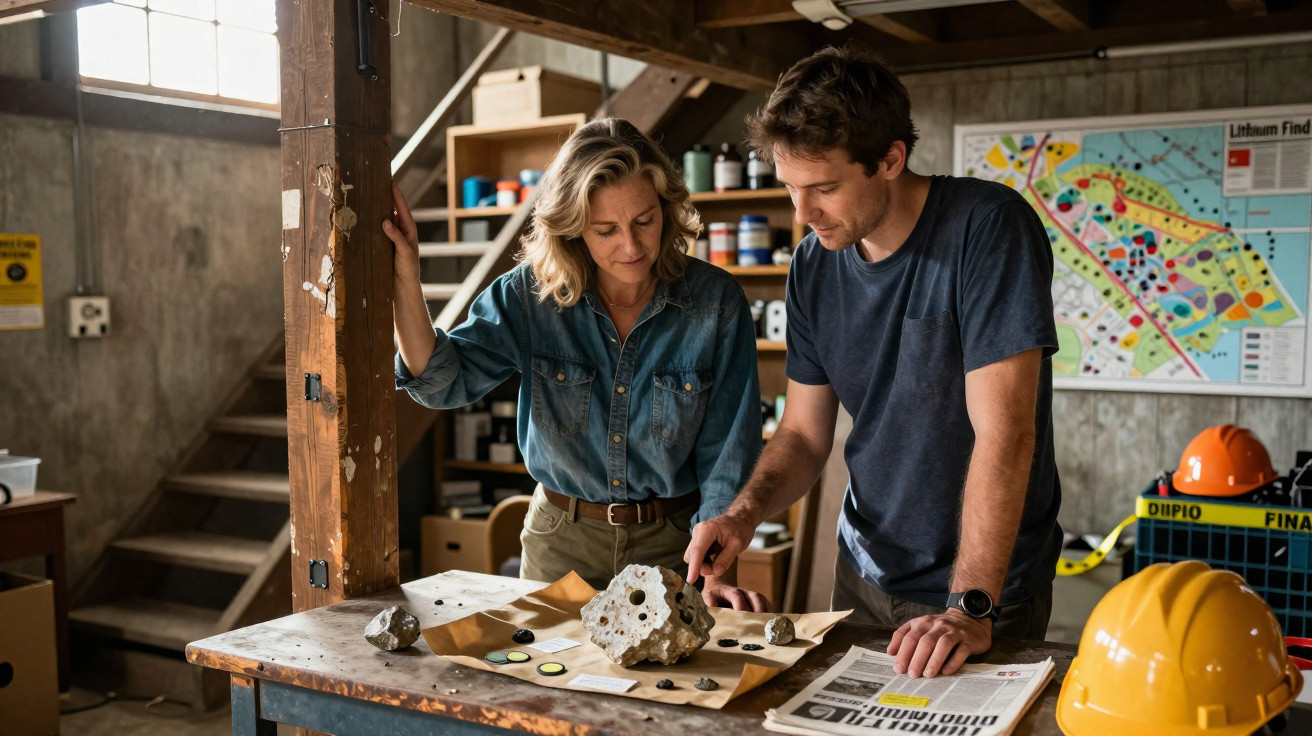
The metal shutter had been down for years, layered with peeling posters and rain marks. In this former shop, wedged between a chemist and a garage, nobody had paid much attention to the basement for a long time. That changed when a team of geologists arrived to take several core samples for an owner planning refurbishment work. Within hours, safety tape had sealed off the street and a prefectural order had prohibited access to the building. The word “lithium” spread rapidly from one phone to another, before neighbours had even understood what might lie beneath their feet. The case described here should be understood as a plausible field scenario: without an identified location or official order, it would be unwise to present the discovery as an established local fact. The concern, however, is very real. What lies beneath an old shop can alter the future of an entire neighbourhood.
An ordinary basement suddenly becomes a sensitive site
At first, there is nothing outwardly dramatic about such a find. Geologists usually work amid the muted noise of a drilling rig, labelled sample bags and yellowed cadastral maps. Beneath the former shop, they may have identified weathered rocks showing signs consistent with lithium mineralisation-a metal that has become strategic for batteries, electric vehicles and energy storage. An immediate closure does not mean a chemical hazard is escaping from the ground. More often, it reflects a precautionary approach: preventing unauthorised entry, protecting the samples and avoiding careless building work before checks are complete. In a busy shopping street, such a decision is bound to make an impression.
Consider a 600-square-metre plot with a sealed cellar and a former loading bay at the rear. An initial survey might collect around ten cores from several metres below ground, but that is still far from proving the existence of a mine, or even a commercially viable deposit. Laboratory work must establish the ore concentration, its continuity and the precise nature of the rocks encountered. Depending on the thresholds and methods used, an encouraging result may ultimately have no industrial value. Years of work often separate a geological trace from an exploitable resource. That gap fuels both speculation and hope.
The prefecture may step in on grounds of public safety, regulatory control of installations or protection of a study site. An old cellar can also conceal other issues: forgotten tunnels, unstable made ground, buried tanks or materials contaminated by previous activity. Lithium does not explode in the way some social-media videos suggest; its extraction and certain industrial processes require particular care, but finding an indication of it in rock does not automatically create an immediate risk for local residents. The sensible course is to secure the site, carry out the analysis and then provide information-not draw conclusions amid a swirl of rumours.
What local residents can do without panicking
When barriers and official vehicles appear, the first instinct is often to look for answers beyond the fencing. It is better not to do so. A closed area may contain a fall hazard, weakened ground or active drilling operations, and the urge to “just have a look” can complicate the teams’ work. Residents can record the reference number on the displayed order, contact the town hall or prefecture, and request documents that can be disclosed: the safety perimeter, length of the closure, official reasons and any diversions. Written information is more reliable than a post rapidly shared through a neighbourhood group.
Nearby traders have a more immediate concern: will customers still be able to get through, make deliveries or park? These practical questions should be raised promptly. An administrative closure may apply only to a premises, a courtyard or part of the pavement, yet its economic effects can be felt straightaway. Let us be honest: hardly anyone reads a prefectural order every day. Requesting an information meeting, a named contact and a temporary access plan is not unreasonable. It is, in fact, the calmest way to regain some control when uncertainty takes hold.
A common mistake is to treat the discovery of lithium, an approved mining project and the beginning of extraction as though they were the same thing. These three stages have neither the same timetable nor the same authorisations, and each is subject to separate checks.
“A geological anomaly is a signal to investigate, not a promise of wealth or an automatic health warning,” notes a principle shared by many subsurface-resource specialists.
- Check the source of the information with the prefecture or town hall.
- Observe the closed perimeter, even if it appears empty or temporary.
- Keep photographs of the official notices and the restriction times.
- Report a crack, unusual smell or ground subsidence without entering the site.
Lithium: a new industrial promise and an old local issue
Lithium captures attention because it represents an entire era: phones in our pockets, cars charging overnight and batteries expected to support a less stable electricity grid. When it appears beneath a former shop, the situation can seem almost absurd, as though the energy transition had arrived beneath worn floor tiles. Yet geology does not follow commercial maps. Some mineral formations run beneath towns, gardens and light-industrial areas long before any buildings are erected. The subsurface recognises no neighbourhood boundaries. It preserves a far longer memory of the landscape.
Any possible extraction would quickly raise less romantic questions: lorry traffic, dust, water use, noise, property values, jobs created and how the benefits would be shared. A discovery alone never answers them all. Environmental assessments, public inquiries, permits and accessible data would all be needed. Residents sometimes feel that a decision has already been made as soon as technical terminology appears in the press. In reality, a serious process can be lengthy and contested, which is normal. A project affecting the ground beneath a town must withstand scrutiny from the people living directly above it.
The story also highlights a simple truth: places thought to be abandoned are never entirely empty. Beneath a shuttered shop, there may be a cellar, records, an old water network, contamination requiring treatment or, more rarely, a mineral resource that needs to be understood. Neither excitement nor automatic fear is the right response. What is needed is demanding curiosity: the kind that asks for maps, analysis and clear answers. The next notice placed on an empty shopfront may deserve a different look. Not because there is treasure on every street corner, but because our towns stand above a discreet, complex and living world.
| Key point | Detail | Benefit for the reader |
|---|---|---|
| Prefectural closure | It may be intended to protect safety, enable analysis or safeguard site stability. | Understand that a closure does not prove there is an immediate danger. |
| Lithium indication | A detected presence does not guarantee an exploitable deposit. | Avoid hasty conclusions and rumours. |
| Local response | Residents can request the order and practical information. | Take practical action without disrupting operations. |
FAQ:
- Is finding lithium beneath a building dangerous? Not necessarily. Lithium in rock does not mean a hazardous substance is spreading through the air or water. Any potential risks depend on the condition of the site, the materials present and the work being carried out.
- Why can the prefecture close access so quickly? It may impose a precautionary measure where there is uncertainty about a building’s safety, ground stability or the proper conduct of technical assessments. The order should normally set out its perimeter and reasons.
- Can a deposit identified by geologists be worked immediately? No. The analyses must be confirmed, volumes measured, profitability assessed, impacts studied and the required permissions obtained. This stage may take several years.
- Are neighbours entitled to request information? Yes. The town hall, prefecture and relevant departments can provide information about access restrictions, public orders and, where applicable, planned consultation stages.
- What should you do if a rumour circulates on social media? Compare the message with an official source, an identifiable scientific publication or a news outlet that cites its documents. A photograph of a barrier alone can never reveal the precise nature of a discovery.






Comments
No comments yet. Be the first to comment!
Leave a Comment