
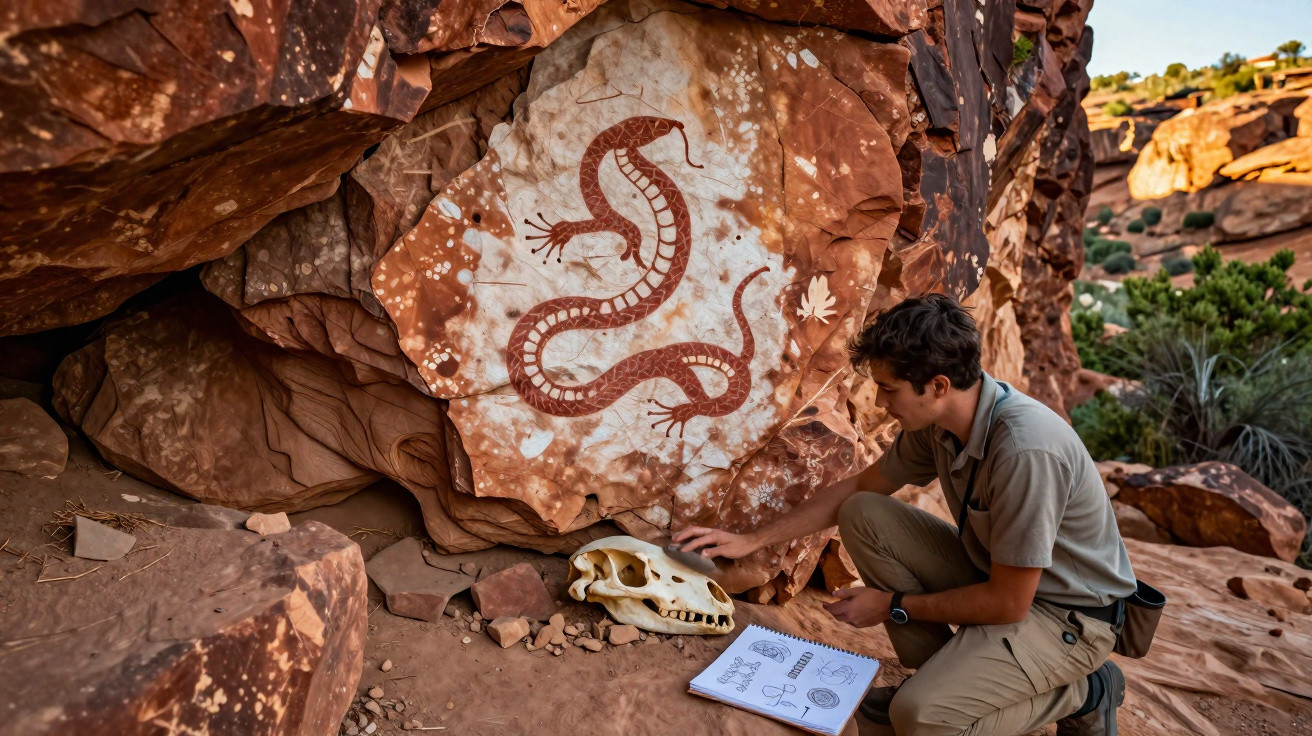
Indigenous communities in southern Africa may have painted animals that had been extinct for 260 million years before Western archaeologists had formally described their fossils.
In a provocative new study, evolutionary biologist Julien Benoit proposes that the rock art at La Belle France, in South Africa’s Free State Province, represents a neglected example of Indigenous palaeontology.
The image of a tusked creature, painted almost two centuries ago, is unlikely to portray an imaginary animal, Benoit suggests. Instead, it may recreate a species that lived in the area more than 260 million years ago.
The Horned Serpent and dicynodont fossils
The animal in the artwork is elongated and narrow, leading to the rock panel being known as the Horned Serpent.
Benoit, of the University of the Witwatersrand in South Africa, interprets it differently. In his view, the figure resembles a dicynodont: a four-legged, toothless, tusked predecessor of modern mammals. Dicynodont fossils are both plentiful and highly visible across the Karoo Basin.
Some have called this basin a “palaeontological wonderland”. It extends across much of present-day South Africa, although the fossils laid down there date from before the breakup of the Gondwana supercontinent.
Benoit contends that the toothed animal painted on the rock face by the ǀXam-ka ǃʼē people may represent a geomyth: an oral or written tradition that explains geological events and features, including fossils and landscape formations.
The arch in the animal’s back recalls the ‘death pose’ frequently seen in fossilised dicynodont remains.
"The painting was made in 1835 at the latest, which means this dicynodont was depicted at least ten years before the western scientific discovery and naming of the first dicynodont by Richard Owen in 1845," says Benoit.
"This work supports that the first inhabitants of southern Africa… discovered fossils, interpreted them and integrated them in their rock art and belief system."
Indigenous palaeontology in southern Africa
As reported by The New York Times, Benoit initially spotted the similarity between the Horned Serpent and a dicynodont in a book published during the 1930s. On visiting the original painting, he also identified several exposed dicynodont fossils nearby.
The Indigenous peoples of southern Africa are collectively known as San. Colonial accounts describe a local San myth concerning huge animals, larger than hippopotamuses or elephants, that once inhabited the region.
Archaeological findings now indicate that San ancestors collected fossils of this kind and carried them over long distances.
In a 2019 paper, Benoit, palaeontologist Charles Helm and other collaborators wrote that there was a "rich, underappreciated body of evidence for Indigenous awareness of fossils and geological phenomena."
They anticipated that a "diverse non-western, Indigenous palaeontological and geomythological heritage will probably become evident in southern Africa."
For Benoit, the Karoo painting of the tusked animal is the first fully developed example of that possibility. The ǀXam-ka ǃʼē people may have viewed dicynodont skulls as the remains of living animals and incorporated those creatures into both their art and worldview.
Details supporting the dicynodont interpretation
The downward-curving tusks in the Horned Serpent panel point in the same direction as dicynodont tusks, unlike those of elephants or warthogs. Indeed, no living African animal has tusks arranged this way.
"The skin of the tusked animal is dotted," writes Benoit, "which is not unusual in San rock art, but is also consistent with the warty mummified skin preserved in some dicynodont fossils in the area."
Benoit’s interpretation is likely to provoke substantial discussion about whether ancient societies could have reconstructed complete animals from fossils. For instance, the proposal that protoceratop fossils inspired griffin myths has recently been challenged by researchers who say the evidence supporting it is insufficient.
The scene might instead show a seal consuming a fish, or a land animal eating a snake. Benoit argues, however, that its U-shape is too short for either reading. Snakes and fish in San rock art generally display more recognisable features, while the lines are too thick to represent whiskers or blood.
"Even if one considers that the Horned Serpent panel has a purely spiritual meaning, it does not invalidate the hypothesis that the tusked animal itself may have been imagined based on a dicynodont fossil," argues Benoit.
"The spiritual and paleontological interpretation of this painting are not mutually exclusive."
The study appeared in PLOS ONE.




Comments
No comments yet. Be the first to comment!
Leave a Comment