
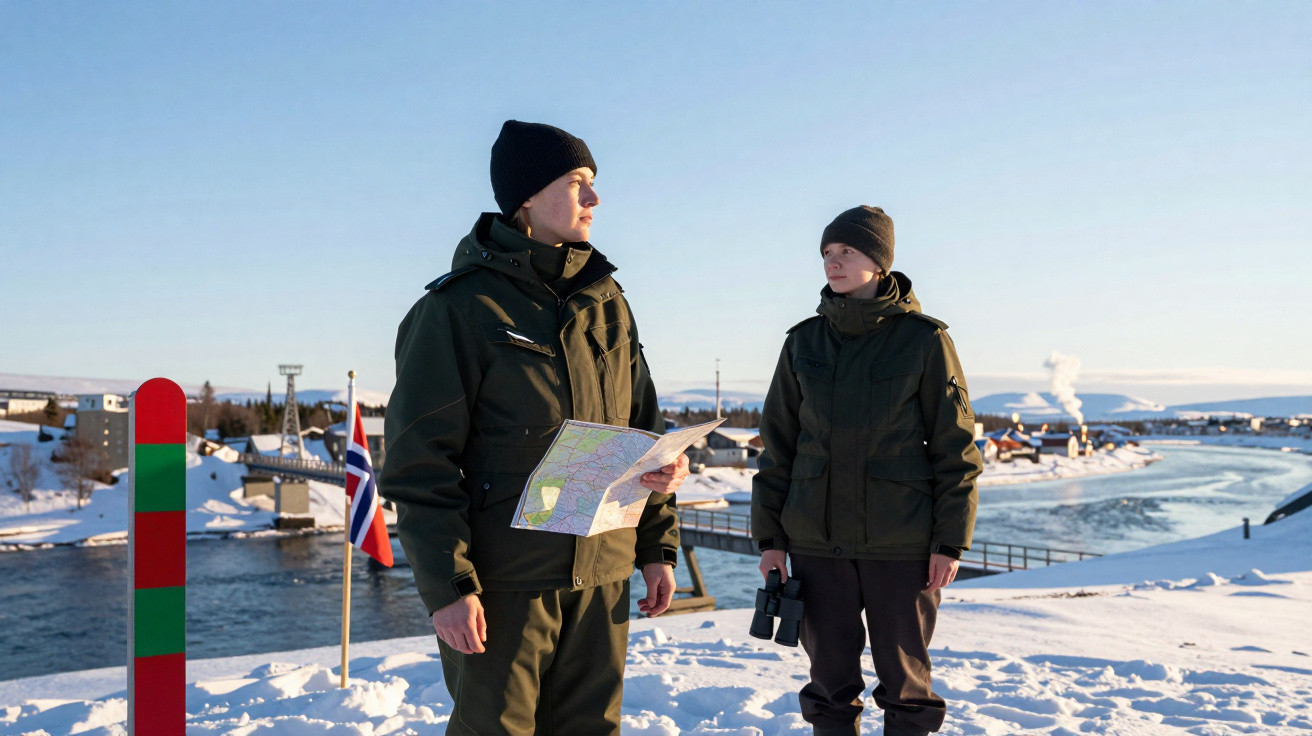
In Kirkenes, in Norway’s far north, winter seems to swallow every sound. Cars move slowly over compacted snow, windows stay lit deep into the night, and the Russian border lies only a few kilometres away. For a long time, that proximity mainly fostered cautious exchanges, local habits and, at times, a sense of routine. Today, the scenery is unchanged, but attitudes have shifted. Journalist Jean-Mathieu Pernin portrays a region that now listens to every Kremlin statement with renewed attention. Here, Vladimir Putin’s threats are no longer seen as distant noise from Moscow. They shape conversations, political decisions and residents’ everyday lives. The border is short, but its significance is immense.
In Kirkenes, Russia Is Never Truly Far Away
When Jean-Mathieu Pernin speaks about Norway’s High North, he is not referring to an abstract line on a map. He describes roads that end almost at the Storskog border crossing, families accustomed to Russian number plates passing by, and Kirkenes, a town that long lived alongside this awkward but familiar neighbour.
Norway shares around 198 kilometres of land border with Russia in Finnmark county. That may seem limited compared with the thousands of kilometres between Moscow and Paris, yet this strip of land places Norway directly beside a nuclear power involved in the war in Ukraine since February 2022.
What stands out in the journalist’s account is not panic, but a changed instinct. Residents and elected representatives are not trying to live in fear, but they recognise that a quiet border can become strategically important within hours. In the High North, silence never means complacency.
Norway Prepares Without Giving Way to Alarm
Norway’s approach is built around a straightforward principle: anticipate, organise and train. Oslo has increased its military focus in the north, expanded its co-operation with NATO, and stressed that Finnmark’s defence is not solely the concern of soldiers. It also depends on roads, telecommunications, hospitals and isolated municipalities.
For residents, this involves very practical steps: following local guidance, knowing useful routes and keeping a sensible supply for several days. We all know the feeling that an alert is too remote to justify changing our habits; in this region, that feeling has faded sooner than elsewhere.
The mistake would be to confuse preparedness with obsession. Let us be honest: nobody truly does this every day. Instead, Norwegian authorities aim to embed a culture of resilience, without turning every home into a bunker or allowing rumours to take hold.
What Jean-Mathieu Pernin’s Account Reveals About Europe
The report also captures a wider European turning point. For years, many countries believed geography kept them safe: Russia appeared distant, borders seemed stable and crises looked contained. The war in Ukraine has sharply demonstrated that security rests on everyday, often discreet choices, rather than on a simple sense of calm.
Norway is not facing this reality alone. Finland, which joined NATO in 2023, shares a long border with Russia, while Sweden joined the Alliance in 2024. Across the north, military maps, civilian infrastructure and local residents’ concerns now overlap far more closely.
“The Russian border is not a theoretical subject for people living just a few kilometres from it: it is part of the landscape, and therefore part of their concerns.”
- Vigilance does not mean living in permanent fear.
- Civil preparedness complements the military presence.
- The High North has become central to European security.
A Border That Demands a Different Perspective
Jean-Mathieu Pernin’s description extends well beyond Norway’s particular case. In Kirkenes, people are not living in a spy film: they work, take their children to school, check the weather and worry about the cost of groceries. Yet a sentence spoken in Moscow can now echo through this ordinary life.
The power of this reality may lie in its simplicity. Security is never guaranteed, even in the most stable countries. It is built through clear-sightedness, strong alliances and citizens who understand that peace sometimes requires facing danger directly, without allowing it to occupy every part of life.
Norway therefore offers a less spectacular but more useful image of how to respond to Russian threats: neither denial nor agitation. It is a calm, almost cold vigilance, much like the Finnmark landscapes where the horizon appears endless even though the border remains close by.
| Key point | Detail | Value for the reader |
|---|---|---|
| A sensitive border | Norway shares 198 kilometres of land border with Russia. | Understand why international tensions are experienced in practical terms in Finnmark. |
| Pragmatic preparedness | Oslo is strengthening defence, co-operation with NATO and civil resilience. | See how a country prepares without fuelling panic. |
| A European issue | The High North has become strategic for Norway, Finland, Sweden and the Atlantic Alliance. | Appreciate that northern security now concerns the whole of Europe. |





Comments
No comments yet. Be the first to comment!
Leave a Comment