
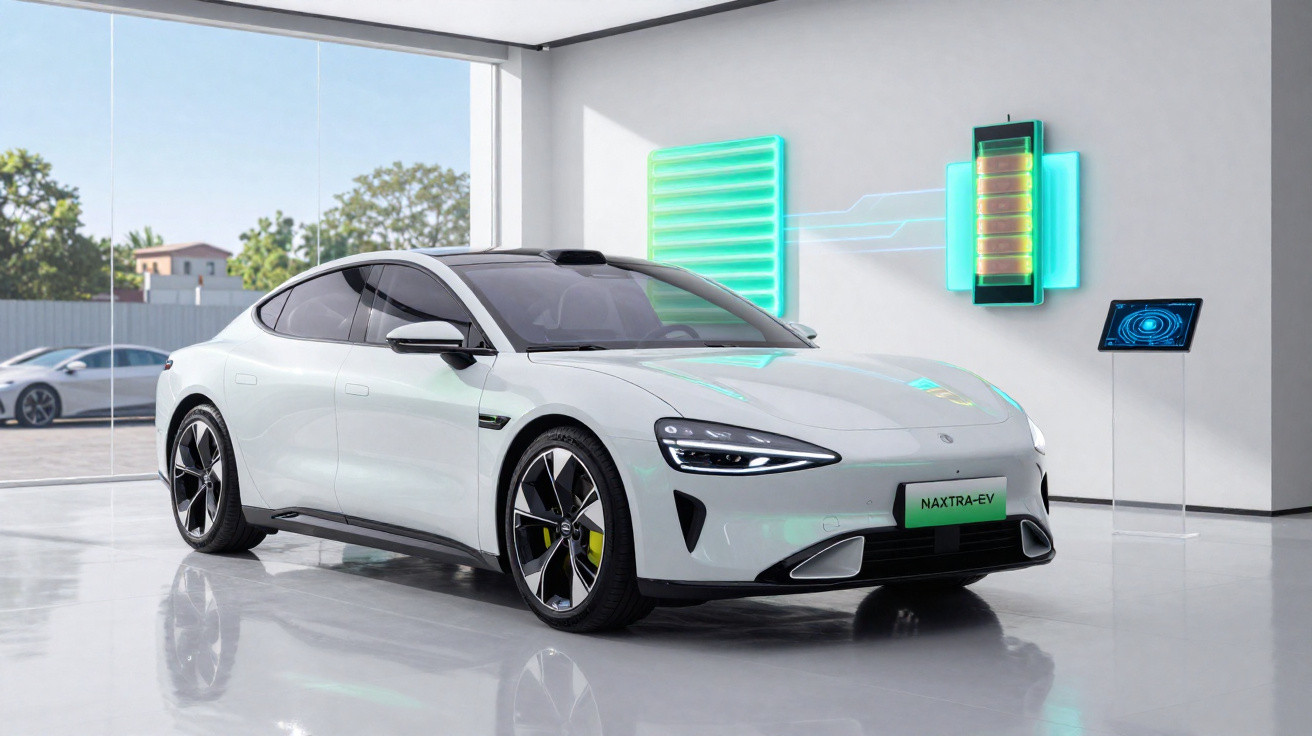
For years, sodium-ion batteries were regarded as having only limited potential to replace conventional lithium-ion units. CATL, the Chinese battery giant, has now changed that outlook.
At the start of 2025, the company unveiled Naxtra, the second generation of its sodium battery, which is already in mass production. CATL is now planning to introduce the technology into passenger vehicles in China.
CATL Naxtra batteries in passenger cars
According to Car News China, the first model expected to use them is the Changan Oshan 520, a three-box saloon. Unveiled in 2024, it was Changan’s first model to support battery swapping at dedicated stations instead of conventional charging, using CATL’s Choco-SEB technology. The new sodium-ion batteries will also be included in this battery-swapping standardisation project, making the Oshan 520 one of the most likely candidates to receive them.
Chinese website CLS reported that the company is already preparing winter trials with passenger vehicles. “The models taking part in this test include the Changan Oshan, and GAC and JAC passenger vehicles are also expected to join the programme afterwards,” said a source close to the matter.
The initiative builds on CATL’s recent progress in the commercial-vehicle sector. The company recently launched a 45 kWh sodium battery developed specifically for small vans. Its next objective is to bring the technology to passenger vehicles as well.
What are the advantages?
Unlike conventional lithium-ion batteries, sodium batteries use an element that is one thousand times more abundant: sodium. Both elements are found in the same salt flats, yet lithium accounts for only 4% of the material extracted.
That abundance partly explains the stated price: just 10 dollars per kWh, equivalent to €8.4 at the current exchange rate. This is considerably lower than the roughly 75 dollars (€63) per kWh for LFP lithium-ion batteries - the technology favoured by China’s automotive industry - or the approximately 100 dollars (€84) per kWh for Tesla’s NMC 4680 cylindrical batteries (Source: Bloomberg NEF).
A further factor lowering costs is the lack of a conventional anode. Instead, the anode is created only during the first charging cycle, removing the need for controlled-environment rooms in production and simplifying the manufacturing line.
There are further reasons behind such a low price, with the potential to reduce electric-vehicle production costs below those of combustion-powered models, as can be seen or heard in this episode of Auto Talks featuring Dr Helena Braga, a researcher at the Faculty of Engineering of the University of Porto.
Better performance and greater safety
One of the major advances CATL claims for its Naxtra battery is an energy density comparable with that of the best LFP batteries, at around 175 Wh/kg. According to CATL, this sodium-ion battery also offers a lifespan of up to 10,000 charging cycles. It is more tolerant of low temperatures too, operating down to -40°C, while safety is another key feature: “Even when punctured, they do not catch fire or explode,” says Gao Huan, CATL’s technology director.
Over the next three years, the Chinese company aims for sodium batteries to partly replace LFP batteries in specific applications. These include not only passenger and goods vehicles, but also the battery-swapping and energy-storage markets.






Comments
No comments yet. Be the first to comment!
Leave a Comment