
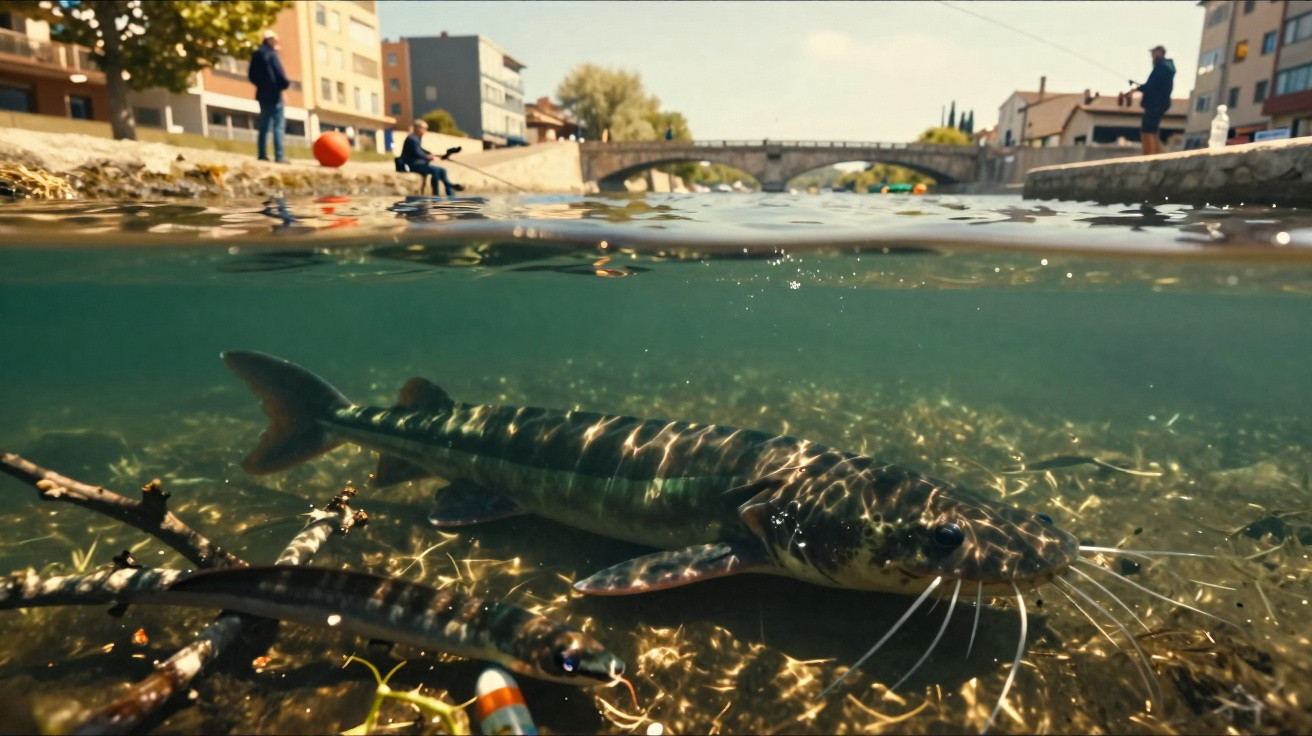
In Montpellier, the Lez may look peaceful, but beneath its surface lives a giant fish introduced by humans and a formidable hunter.
The banks of the Lez draw joggers, families, anglers and walkers who come to watch the ducks. Yet beneath this sometimes murky water, a far less familiar resident has also made its home. The Wels catfish, a freshwater fish with an average length of almost 1.5 metres, inhabits several French waterways. Its presence in Montpellier’s river shows how an introduction, even one made long ago, can permanently alter an urban ecosystem.
A giant concealed beneath the waters of the Lez
The size of the Wels catfish can be striking. Adult fish commonly measure between one and two metres, while the largest specimens grow far beyond that. The French record is close to 2.75 metres, and some European examples have reached almost 2.85 metres.
“A walker can follow the Lez without seeing anything, even though a predator more than one and a half metres long may sometimes be just a few metres from the bank.”
When it rises close to the surface, the fish has a distinctive appearance. Its head is broad and flattened, while its exceptionally large mouth is framed by long barbels. These whisker-like appendages allow it to sense vibrations and locate prey in dark water. Its back ranges from greenish-brown to black, with a lighter-coloured underside.
Its skin has no scales. Instead, it appears smooth and slimy, making the animal seem even more unusual when it is spotted by an angler or filmed near a quay. Despite its considerable size, it is generally discreet. It often spends the day in deep areas, beneath submerged obstacles or alongside cluttered banks.
A species established through human introductions
The Wels catfish was not historically found in French rivers. It originates from eastern Europe and central Asia. It had disappeared from the country for a very long time before returning during the 1970s, initially in the Saône basin.
Its reappearance was not a natural process. Releases and transfers encouraged its establishment across several river systems. Once it is present in a river, it can spread into new areas by travelling through connected waterways. This expansion explains why it is now found across much of mainland France.
The Lez catchment has not escaped this development. Assessments of local aquatic environments report the species within the river network. For residents, the thought of a very large fish in central Montpellier may seem surprising. However, it is now a recognised reality for anglers and river-management bodies.
Why the Wels catfish adapts so effectively
The Wels catfish tolerates a broad range of conditions. It can survive in slow-moving, murky, warm or organic-matter-rich water. Urban stretches can sometimes provide it with shelter, engineered depths and plentiful food.
- It mainly hunts at dusk or overnight.
- Its barbels detect movement around it.
- An adult has few natural predators in French rivers.
- It can live for a long time and reach a considerable weight.
- It benefits from a highly varied diet.
A predator able to eat almost anything
The Wels catfish does not feed solely on small fish. Its diet depends on what is available nearby. It eats fish, crustaceans, crayfish and amphibians, as well as small mammals that fall into the water on occasion. Instances of predation on waterbirds have also been documented in south-west France.
At certain locations, Wels catfish have been seen partly launching themselves out of the water to catch pigeons or birds resting at the water’s edge. This behaviour is spectacular rather than an everyday occurrence, but it demonstrates the species’ adaptability.
“The risk does not concern walkers: it mainly affects the fragile balance of the fish, amphibians and birds that use the banks.”
Contrary to fears sometimes expressed when large fish are seen, the Wels catfish does not usually pose a danger to people. It does not hunt swimmers, and incidents involving humans remain exceptional. Nevertheless, a few simple precautions are appropriate: do not try to feed it, do not handle a caught fish without experience, and keep pets supervised near the water.
The European eel among the most vulnerable species
The presence of a large predator is chiefly a concern for species that are already under pressure. The European eel is among the most closely monitored. Its life cycle is remarkable: it is born at sea, enters European fresh waters to grow, then returns offshore to breed after several years.
This journey is already made difficult by dams, pollution, the loss of wetlands and climate change. When a large opportunistic fish becomes established in the same habitats, it can add further pressure to existing challenges.
| Species affected | Potential risk | Aggravating factor |
|---|---|---|
| European eel | Predation during movements | Obstacles in waterways |
| Migratory fish | Competition and predation | Altered flow and reduced habitats |
| Amphibians | Capture in calm areas | Decline of ponds and natural banks |
Complex monitoring in an urban river
Determining the exact number of Wels catfish in the Lez takes time. The fish move around, hide, and may occupy areas that are difficult to reach. Angling federations, catchment organisations and aquatic-environment services rely on monitoring catches, field observations and reports from anglers.
Removing every Wels catfish from a river where the species is established is extremely difficult. A female can produce a large number of eggs, and once adults become large, they escape many natural pressures. Management therefore often focuses on gaining a better understanding of populations and giving priority protection to the most threatened species.
What residents and anglers can do
Releasing a fish, a turtle or any other animal into the wild is never a harmless act. A species moved outside its natural environment may compete with animals already there, spread diseases or disrupt the food chain. An animal that can no longer be cared for should be entrusted to a suitable organisation, rather than left in a canal or river.
Anglers also have a useful role to play. An unusual sighting, an exceptionally large fish or strange behaviour can be reported to the relevant local bodies. Such information helps track changes in the fauna of the Lez without turning every encounter into a spectacle.
The Wels catfish is a reminder that Montpellier’s river is not simply a pleasant setting for a walk. Beneath its bridges and along its vegetated banks, the Lez supports a living, changing environment in which the arrival of just one large predator can have lasting effects on many species.




Comments
No comments yet. Be the first to comment!
Leave a Comment