
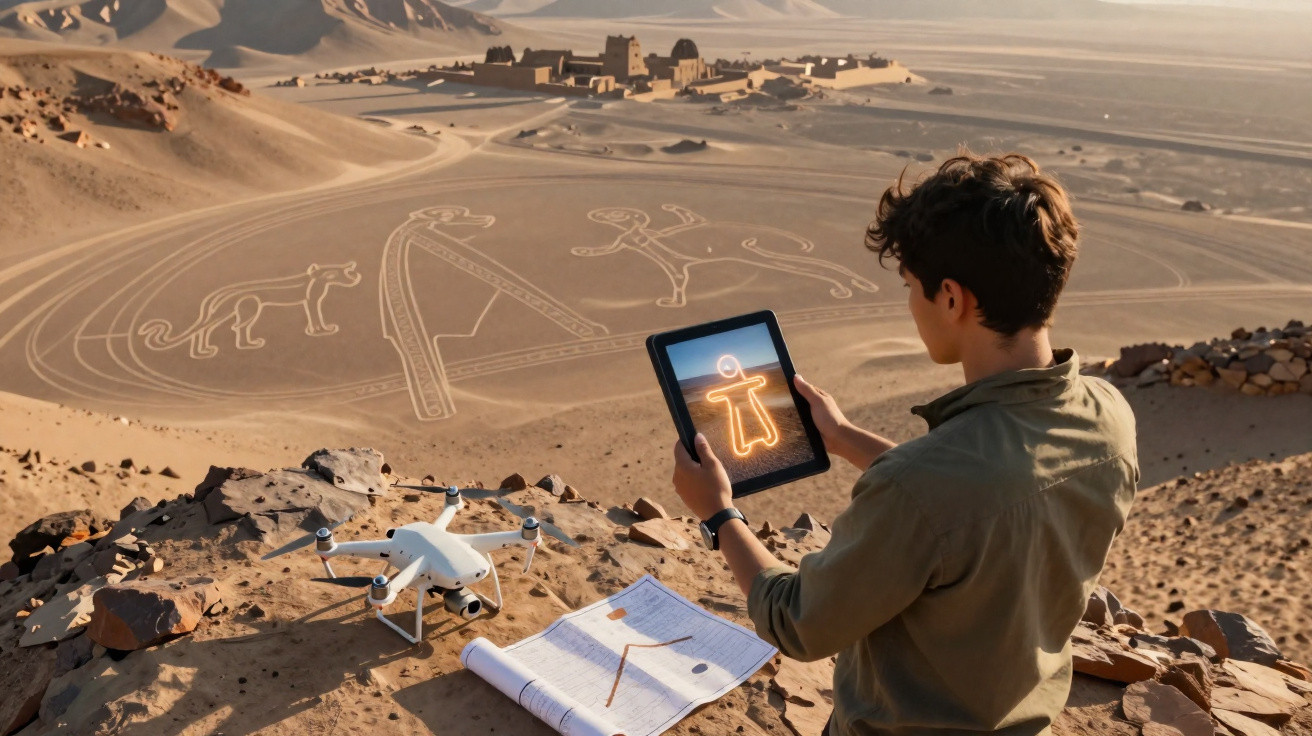
A long-running mystery is unfolding in the desert of southern Peru.
Centuries ago, communities living in the area etched enormous lines into the earth, forming images and symbols that can only be properly viewed from above. Known as the Nazca glyphs, these enigmatic designs have puzzled archaeologists since they were first identified.
Since their discovery in the 1940s, roughly 430 glyphs have been recorded on the dry plateau called the Nazca Pampa.
Drones and AI reveal 303 new Nazca glyphs
A team headed by Masato Sakai, an archaeologist and anthropologist at Japan’s Yamagata University, has now found an astonishing 303 additional examples in only six months by using drones and AI. The discovery almost doubles the previously known total.
It also offers fresh clues about the role of these mysterious symbols.
"The reason why the purpose of the geoglyphs' creation remained unknown for so long is that previous researchers lacked basic information about the distribution and types of geoglyphs," Sakai told ScienceAlert.
"However, in this paper, thanks to field surveys utilizing AI and remote sensing, the distribution of the geoglyphs has been clarified. As a result, we were able to shed light on the purpose behind their creation."
The researchers think that purpose was sacred. They suggest the glyphs formed part of a pilgrimage to Cahuachi, the Nazca culture’s ceremonial centre, which can be seen overlooking some of the glyphs from elevated positions on top of mounds.
Why the Nazca Pampa has been difficult to survey
Several factors have made the glyphs challenging to find. They were initially cut into the plateau between 500 BCE and 500 CE, and centuries of weathering have made them far less visible.
The vast scale of the Nazca Pampa also makes ground-based work impractical. The task is simply too large.
"Because the Nazca Pampa is so vast, at 400 square kilometers (154 square miles), it takes a long time to conduct research using conventional archaeological methods," Sakai explained.
Sakai has used remote sensing to investigate the Nazca Pampa since 2004. Before this latest study, he and his colleagues had identified 318 of the 430 glyphs already known, over a number of years.
People are evidently adept at recognising the characteristic traces of the faded and weathered symbols. However, the team believed AI could detect Nazca features that earlier observations had overlooked.
To test this, Sakai and his colleagues partnered with the IBM Thomas J. Watson Research Center to create an algorithm capable of finding faint glyphs among the debris of the Nazca Pampa in drone imagery.
Of the 303 newly identified glyphs, 178 - more than half - were put forward by the AI. The result demonstrates the tool’s ability to support research led by humans.
Relief-type geoglyphs and the route to Cahuachi
The newly found examples are classified as relief-type geoglyphs. Smaller and more difficult to recognise than the larger line-type geoglyphs, they make this new collection particularly compelling. Among the 430 glyphs known previously, 380 were relief-type glyphs and 50 were line-type glyphs.
The two forms portray different subjects. Relief-type geoglyphs chiefly show people and domesticated animals, whereas line-type geoglyphs predominantly feature wild animals. According to the researchers, their scale, location and spread also indicate how they may have been used.
"In the case of relief-type geoglyphs, you can see them if you walk along the trails. Therefore, I believe that the trails were created so that people could see the relief-type geoglyphs while walking along them," Sakai explained.
"On the other hand, in the case of line-type geoglyphs, they are concentrated around the starting and ending points of the network of linear geoglyphs. This network is connected to ceremonial centers Cahuachi and sacred places, so I believe that people walked along the network."
Cahuachi is known as a destination for human pilgrimages. People travelled to its adobe architectural complex, perhaps for ceremonies and gatherings, although precisely how the site was used and what made it significant remain poorly understood.
Yet the geoglyphs may provide answers. With more than 700 now revealed, researchers may be able to establish firmer explanations. This is the major question Sakai intends to investigate next.
"In the ancient Andean civilization, socially important information was sometimes conveyed through combinations and arrangements of pictures. I believe that information was inscribed on the Nazca Pampa through the arrangement and combination of geoglyphs," Sakai told ScienceAlert.
"I want to decipher the information embedded in the geoglyphs."
The research was published in Proceedings of the National Academy of Sciences.





Comments
No comments yet. Be the first to comment!
Leave a Comment