
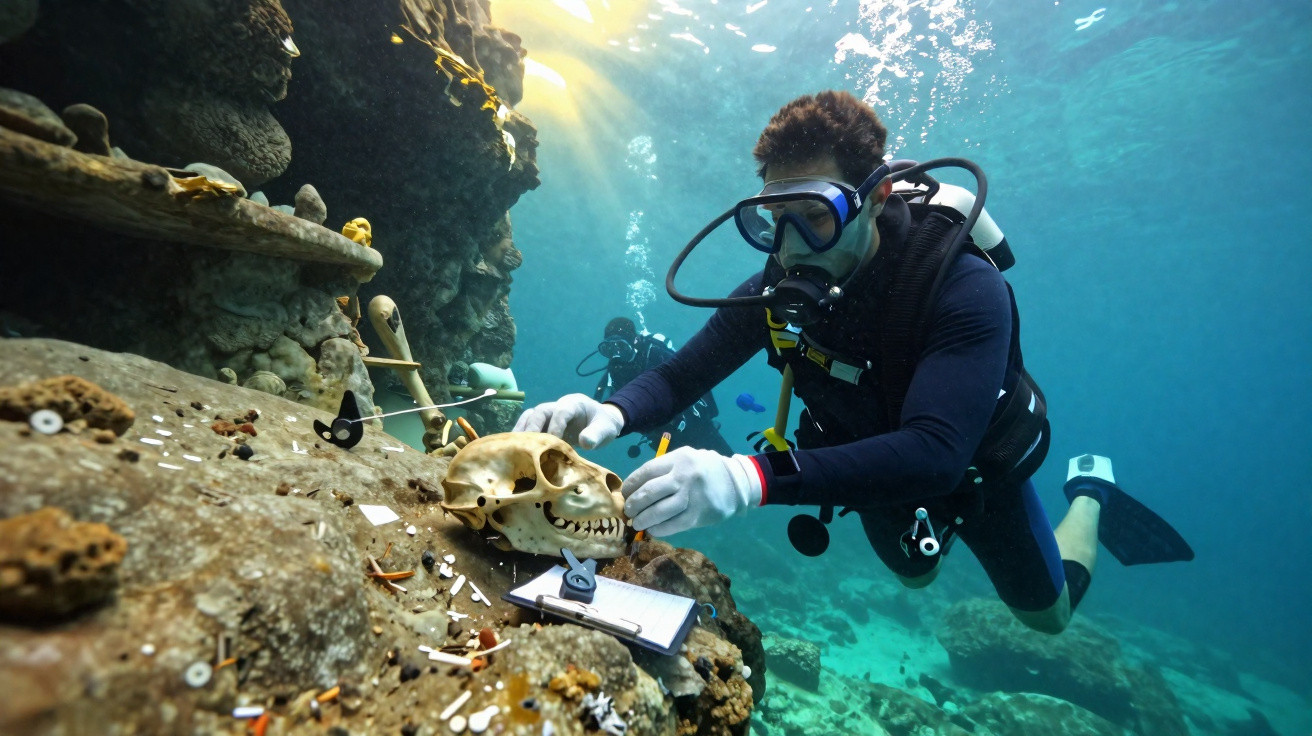
A group of cave divers and scientists has discovered a fresh collection of extinct monkey fossils far beneath the flooded tunnels of a Caribbean cave.
Four decades ago, Hispaniola and Jamaica had yielded only a handful of well-preserved New World monkey remains. Even so, those finds pointed to a gap in the evolutionary record of primates.
Among the fossil species was the Hispaniola monkey (Antillothrix bernensis), which had initially been identified from just an ankle bone and several fragments of jaw.
Hispaniola monkey fossils in flooded caves
Since 2009, advances in cave-diving technology and safety have enabled researchers to venture further into the islands’ submerged cave networks. The first A. bernensis skull was recovered in 2011. Important to the indigenous Taíno people, these underwater caverns contain “remarkably well-preserved” fossils that have remained undisturbed for millennia, sheltered from waves and animals.
The newest discoveries come from the Cueva Macho cave system in the Dominican Republic portion of Hispaniola, providing further insight into the extinct species.
“The number and quality of the Antillothrix crania outlined in this paper allow us to describe the skull completely and understand variation between individuals,” says Johns Hopkins University paleobiologist Siobhán Cooke. “This can tell us about the diet and social systems of these animals.”
Researchers recovered four additional skulls and three new mandibles from the cave. Together with these Cueva Macho specimens and an adult mandible found in the comparable Padre Nuestro cave, Antillothrix bernensis is now represented by seven near-complete crania, two maxillae fragments, an occipital fragment, five complete mandibles, and dozens of other non-skull bones.
Although that may seem a limited amount of material, the collection-particularly the skulls-reveals much about the monkeys’ body size, diet, differences between the sexes and even social behaviour. It provides more information than is available for any other Caribbean monkey.
“These new specimens, in combination with those previously described, will allow for a detailed study of population- and species-level variation, an exceedingly rare opportunity for any fossil primate,” the authors write in their paper.
What the Antillothrix bernensis remains reveal
After examining the fossils, the team estimates that males and females were similarly sized, reaching up to 3.4 kilograms (around 7 pounds). This indicates that mating may not have involved intense competition and that the monkeys might have lived in small, monogamous family groups, with offspring reliant on their parents.
Their rounded teeth and small canines appear suited to a fruit-based diet, much like that of modern South American titi monkeys, which share similar physical traits. The animals also seem to have lacked wisdom teeth, an uncommon feature among primates.
How the monkeys may have entered the cave
How the monkeys ended up in the caves so long ago remains unknown, though damage to the jaw fossils leads Cooke to think they did not enter voluntarily.
“It could be possible that a now extinct owl, which would have been quite large, caught these monkeys and brought them into the cave where it was living --rather than the monkeys falling in at random,” she says. “Owl feeding deposits are not uncommon in Hispaniolan caves.”
The Hispaniola monkey disappeared within the past 10,000 years, although the precise cause of its extinction is uncertain.
“These fossils help us to better understand the anatomy of Antillothrix, which can help us identify ecological factors that might have predisposed it to extinction… [and] ultimately guide policy for preserving the remaining mammalian diversity on the Caribbean islands and elsewhere ” says Cooke.
The research was published in the Journal of Human Evolution.






Comments
No comments yet. Be the first to comment!
Leave a Comment