
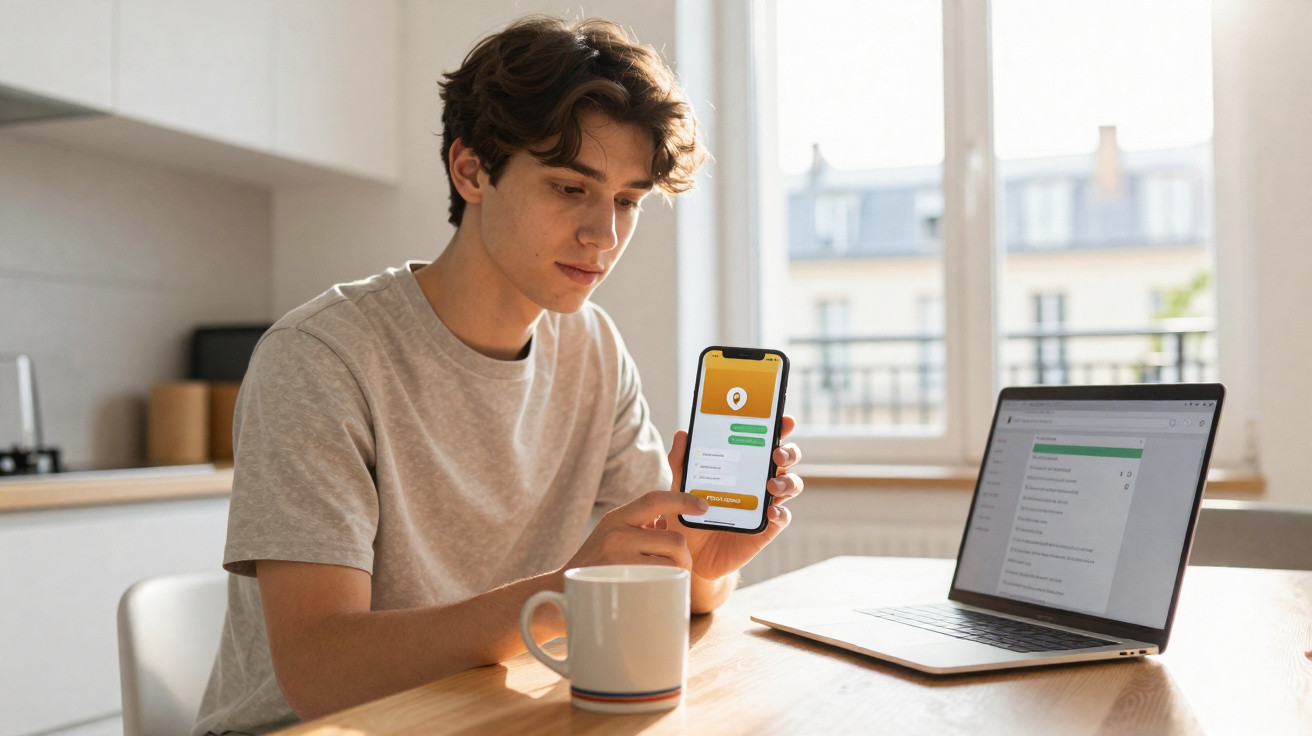
In France and elsewhere, WhatsApp is preparing to change the penalties it applies to practices deemed abusive on its messaging service.
Published on 15 June 2025, the source page provided, an online news article, reports that WhatsApp is developing a temporary account restriction. The measure would notably target repeated unsolicited messages, automated activity and certain commercial approaches.
A temporary penalty before an account closure
WhatsApp, Meta’s messaging app, may soon change how it deals with breaches of its terms of use. Until now, behaviour considered spam, including mass messaging or the use of automated tools, could result in an immediate, long-lasting suspension.
According to WABetaInfo, the specialist website cited by the source page, a new option known as “account restriction” is currently under development. It would act as a warning before a more severe penalty is imposed.
The temporary restriction would not completely remove access to WhatsApp: the user could still receive messages and reply in conversations that are already open.
The distinction is significant. For the duration of the restriction, an account would no longer be able to start new interactions. Contacting someone new or opening a new chat would therefore be impossible, although existing conversations and groups would remain available.
This approach amounts to a second chance. It would give users an opportunity to correct behaviour deemed problematic before they risk permanent removal from the platform.
Messages likely to draw WhatsApp’s attention
The planned measure does not concern a single message mistakenly sent to a relative. It is primarily aimed at activity resembling cold outreach, a scam campaign or automated distribution.
WhatsApp’s terms of use already prohibit several practices. The forthcoming temporary restriction could provide a graduated response to such breaches.
- Sending unsolicited messages to people who have not saved your number in their contacts;
- sending large numbers of identical or very similar messages;
- using software, bots or automated systems to contact users;
- promoting products or services without the recipient’s explicit consent;
- behaviour that may resemble an attempt at fraud or deception.
One isolated message does not necessarily constitute a breach. The risk rises when messages are repeatedly sent, when several recipients report the account, or when activity suggests automated use.
Spam and scams in WhatsApp’s sights
Messaging services have become a favoured channel for fraudsters. The scenarios are familiar: a fake delivery notice, a supposedly urgent job offer, an unexpected prize, or a message from an alleged relative asking for a money transfer.
The source page notes that messaging fraud is increasing and refers in particular to cybermalveillance.gouv.fr, the French platform for prevention and support in relation to digital malicious acts. Such messages often seek to trigger a quick response: clicking a link, calling back a number, providing a code received by SMS, or sharing bank details.
An unexpected request for money, a code or personal information should be checked through another means of contact.
For everyday users, it is also important to avoid being mistaken for an unwanted account. Repeatedly sending an advert to strangers, adding people to groups without knowing them, or relying on a mass-messaging tool can put an account at risk.
A WhatsApp feature still under development
The account restriction mentioned by the source was not presented as a feature already rolled out when the article was published on 15 June 2025. WhatsApp was expected to include it in a future update.
It should therefore not be assumed that a new uniform system already applies to every user in France. WhatsApp updates can be introduced progressively, depending on the app versions and devices in use.
The change forms part of Meta’s wider strategy to curb misuse of its messaging service. The stated aim is to keep it usable for communication while ensuring that legitimate accounts are not immediately excluded after the first detected breach.
What is already available in France
In France, WhatsApp users already have several settings to limit unwanted contact. The app allows them, in particular, to block a suspicious contact and report certain conversations.
There is also an option to silence calls from unknown numbers. This can reduce disruptions caused by malicious calls or cold calling. The phone will not ring for those calls, while a record of them remains in the call list.
Managing linked devices also deserves particular attention. When a WhatsApp account is used on a shared computer, tablet or browser, active sessions should be checked regularly and devices that are no longer being used should be signed out.
Simple steps to protect your account
- Never share a verification code received by SMS or in the app.
- Block numbers that unexpectedly request money or personal information.
- Confirm a relative’s identity by phone or through another channel before making any payment.
- Avoid sending the same promotional message to large numbers of strangers.
- Check the devices linked to your account, especially after using a public or shared computer.
The temporary restriction announced by WhatsApp could therefore have a dual effect: limiting accounts used to distribute spam while warning users whose activity appears suspicious. To avoid problems, commercial or bulk messages are best reserved for people who have clearly agreed to receive them.
A messaging account may also be targeted by impersonation attempts. If a contact claims to be a relative but suddenly uses a different number, asks for money or requests a code, caution remains the best response. Calling the person concerned directly can often remove any doubt.






Comments
No comments yet. Be the first to comment!
Leave a Comment