
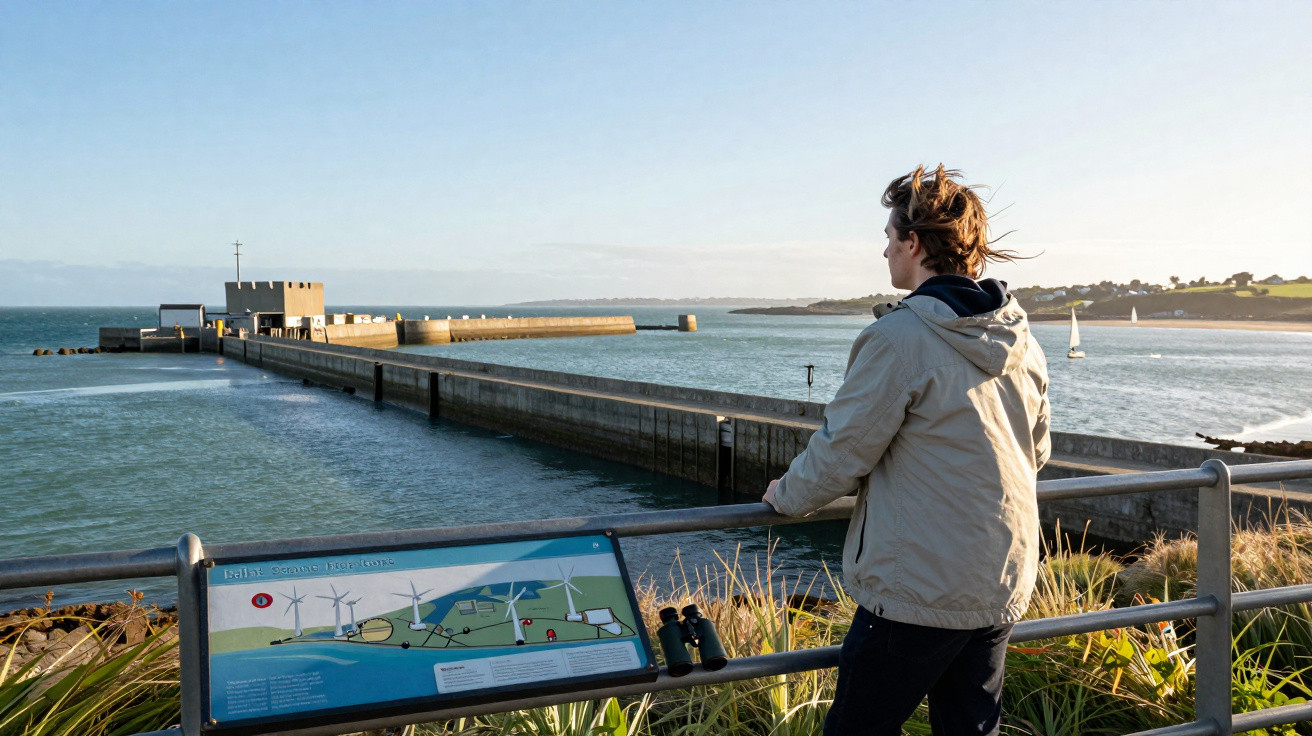
At daybreak, when the bay of Saint-Malo drains at an almost disconcerting pace, the road linking the town to Dinard appears to sit within a changing landscape. On one side, mudflats emerge, birds pick their way across them and boats lean over in the harbour; on the other, a vast structure contains and channels a force whose arrival is never entirely visible. Motorists frequently cross without a second thought, focused on an appointment or summer traffic jams. Yet 24 turbines have been working beneath their wheels in time with the sea since 1966. It is an understated spectacle, but one that tells a remarkable industrial story. With every tide, water is turned into electricity.
At the Rance, the sea is never truly off duty
Situated between Saint-Malo and Dinard, the Rance tidal barrage stretches for 750 metres, cutting across the estuary as a very tangible line between two banks. From the road, it may not match the romantic image often associated with Brittany: there is concrete, steel, sluice gates and a steady stream of cars passing without slowing.
Beneath this structure, the tidal power station’s 24 bulb turbine units provide an installed capacity of 240 megawatts. Every turbine can operate in either direction, whether the tide is coming in or going out; this technical feature makes use of the difference in water level between the sea and the Rance basin.
On paper, the idea seems almost simple: hold back the water at the right moment, then allow it to flow through the turbines. In practice, it depends on highly precise calculations involving tide times, water levels and the protection of the estuary. The sea sets the timetable, and the teams adjust accordingly.
A 1966 giant still generating almost 500 GWh a year
When it opened in 1966, the Rance tidal power station was a world first and an almost futuristic source of fascination. At the time, generating electricity from the tides seemed to offer enormous promise: renewable, predictable energy directly tied to one of the world’s most regular natural phenomena.
The station generates an average of around 500 GWh of electricity each year, depending on tidal conditions and how the site is operated. That is roughly equivalent to the annual electricity use of 225,000 people, excluding heating-a figure that gives fresh scale to the large metal gates visible from the banks.
Output is not continuous, as the tide does not follow human routines or evening demand peaks. It nevertheless offers an unusual advantage: tide times, and the energy that may be available, can be known well in advance. Here, the weather matters less than the lunar calendar.
The barrage has done more than reshape the view; it has also altered life in the estuary. Over the decades, currents, sediment deposits and natural balances have changed, while species have adapted to this new environment. This coexistence continues to be monitored closely, because renewable energy never removes the need to consider what it changes around it.
We all know the moment of plugging in a phone without wondering where the electricity comes from. At the Rance, that question suddenly becomes highly visible: power is created by water that rises, pauses briefly, then returns to the sea with quiet force.
How to see the Rance tidal barrage without missing what matters
To make sense of the site, the best approach is to pick a day with a high tidal coefficient and visit twice: first at high tide, then again a few hours later. The contrast is striking, particularly from the banks of the Rance or around Saint-Suliac, where the changing water level explains what is happening in the estuary better than any signboard could.
Many visitors simply drive across the barrage and come away remembering little more than a road and several technical installations. That is a shame, but understandable: with the satnav, children in the back and the wish to reach Saint-Malo quickly, it is easy to forget to look up. Let us be honest: nobody really does that every day.
Even a stop of a few minutes makes it possible to spot the features that make this barrage distinctive: the locks, sluice gates, passing vessels and sometimes spectacular water movements. To avoid a disappointing visit, it is best to check tide times before setting off and to bear a few straightforward points in mind:
“The Rance tidal power station uses tidal energy to generate renewable and predictable electricity,” EDF notes in its presentation of the site.
- Choose high tidal coefficients to see the differences in water level.
- Plan to stop on foot rather than merely driving across.
- Watch the boats and the lock, especially during the tourist season.
- Respect the technical areas, as this remains an operational industrial site.
Another common misconception is that the turbines run continuously, as they might in a conventional power station. They follow specific cycles and can either pump water or generate power according to requirements and tidal conditions. That less visible mechanism is precisely what makes the place so compelling: the Rance generates to the ocean’s timetable, not to the rhythm of our watches.
The site also shows that innovation does not always look like something new, gleaming and silent. This power station is nearly sixty years old, requires regular maintenance work, and its equipment has had to be upgraded over time. Clean energy is never magical: it must be maintained, monitored and debated.
A Breton landmark still challenging the way we generate electricity
The Rance tidal barrage is neither a mere local curiosity nor a postcard backdrop between Dinard and Saint-Malo. It remains one of the few tidal power stations of this scale in the world, built at a time when people imagined coastlines could supply a much larger share of Europe’s electricity.
Since 1966, other renewable technologies-especially wind and solar power-have gained considerable ground. Tidal power remains more difficult to develop because it requires very particular geographical sites and raises sensitive environmental questions. Yet it has one invaluable quality: few energy sources can claim tides’ reliability for punctuality.
Standing before the barrage, it becomes clear that the energy transition is not made up solely of panels installed on rooftops or wind turbines in the distance. It also involves earlier decisions, altered landscapes and sometimes uncomfortable compromises. The electricity lighting a home may have begun its journey in a Breton inlet, between a sea wall, a turbine and the slow retreat of the tide.
This place encourages a different view of the infrastructure encountered every day. Behind a bridge, a lock or a power line, there is often a story of labour, invention and place. At the Rance, that story continues twice daily, without grand speeches, in the sea’s relentless return.
| Key point | Detail | Added value for the reader |
|---|---|---|
| A unique barrage | 750 metres between Saint-Malo and Dinard, in operation since 1966 | Understand why this site is a Breton industrial landmark |
| 24 tidal turbines | Installed capacity of 240 MW, operating in line with the tides | See how water is transformed into electricity |
| Annual generation | About 500 GWh, depending on the year | Assess the barrage’s energy impact in practical terms |




Comments
No comments yet. Be the first to comment!
Leave a Comment