
Why add us? Get the latest news from Military Zone in your Google feed.
Join our official WhatsApp channel and receive news as it happens.
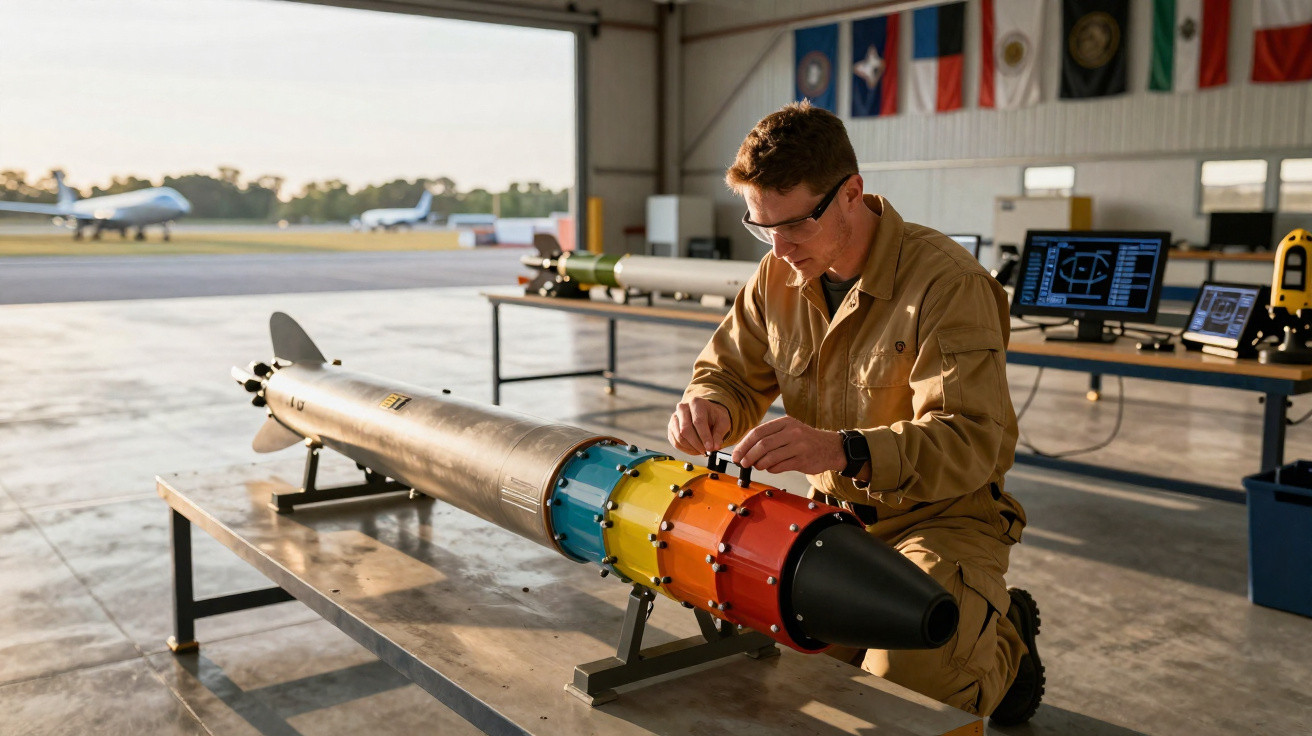
Through the Coalition Heterogeneous Affordable Offensive Strike (CHAOS) programme, the US Navy is advancing the development of a new generation of modular, “low-cost” cruise missiles. The initiative is intended to deliver affordable precision-strike weapons for US forces, allies and partners. From the outset, the programme also includes capabilities designed to support exports and integration by other users.
👉 Read more: Spanish Air and Space Force secures its strategic ISR capability with a new support contract for its MQ-9A Predator B aircraft
US Navy awards new CHAOS contracts
The Navy’s Precision Strike Weapons office (PMX-201) has awarded two contracts to move CHAOS forward. The second agreement went to Kongsberg-owned Zone 5 Technologies to manufacture the low-cost Rusty Dagger cruise missile. The first contract was awarded to CoAspire for the development of the Rapidly Adaptable Affordable Cruise Missile-Extended Range (RAACM-ER).
The programme is using Other Transaction Authority (OTA) to speed up prototype development and cut administrative costs. The Navy says that this mechanism enables development to be adapted to operational requirements. Van Hendrey, the official responsible for Munitions Acquisition, stated that the contracts mark another step towards an affordable maritime strike capability for security partners.
📌 You may be interested in:
- More than 2,600 US Navy personnel are already operating in the Middle East aboard USS Boxer
- With Airfox drones and eight countries involved, the Spanish Navy deploys the offshore patrol vessel BAM Meteoro to the Gulf of Guinea
According to information released by Zone 5 and Naval News, Rusty Dagger provides the programme with a solution already in production for Ukraine. Within the United States, the missile carries the AGM-188A designation and is part of efforts to expand the availability of long-range strike weapons. Its inclusion in CHAOS would make it possible to draw on a platform with previous production and operational experience.
CHAOS development is also connected to the evolution of the Extended Range Attack Munition (ERAM) missile. In March, the United States Air Force (USAF) conducted tests intended to accelerate the weapon’s integration onto F-16s operated by Ukraine. The trials covered procedures for loading the missile onto the aircraft, followed by further stages to validate its operation.
A modular architecture designed for allies
CHAOS has adopted an international partner-focused approach from the beginning. Sarah Abbott, who leads PMX-201, explained that area-denial systems developed by adversaries make it harder to sustain modern and affordable anti-ship capabilities. According to Abbott, CHAOS is intended to address that gap with an adaptable, exportable maritime solution.
The system architecture employs the Modular Open Systems Approach (MOSA) and the Weapons Open Systems Architecture (WOSA). This framework allows software and hardware components to be upgraded more quickly. It also leaves scope for joint assembly and local integration in partner countries.
The initial capability planned is an expeditionary ground-launched version. The Navy expects this system to enter production in 2028, before expanding its use to naval launch platforms. The programme also envisages aircraft-launched configurations, depending on the operational requirements defined by its users.
Ray Owens, director of the Navy’s International Programmes Office, said that the priority is to develop capabilities integrated with allies and partners. Zone 5, meanwhile, stated that it aims to provide capabilities to the US Navy and its allies through Rusty Dagger production. Through Foreign Military Sales (FMS), PMX-201 is also inviting partner nations to help define future CHAOS requirements.
Cover image courtesy of Zone 5 Technologies.





Comments
No comments yet. Be the first to comment!
Leave a Comment