
Add ZONA MILITAR on Google
Why add us? Receive the latest updates from Zona Militar in your Google feed.
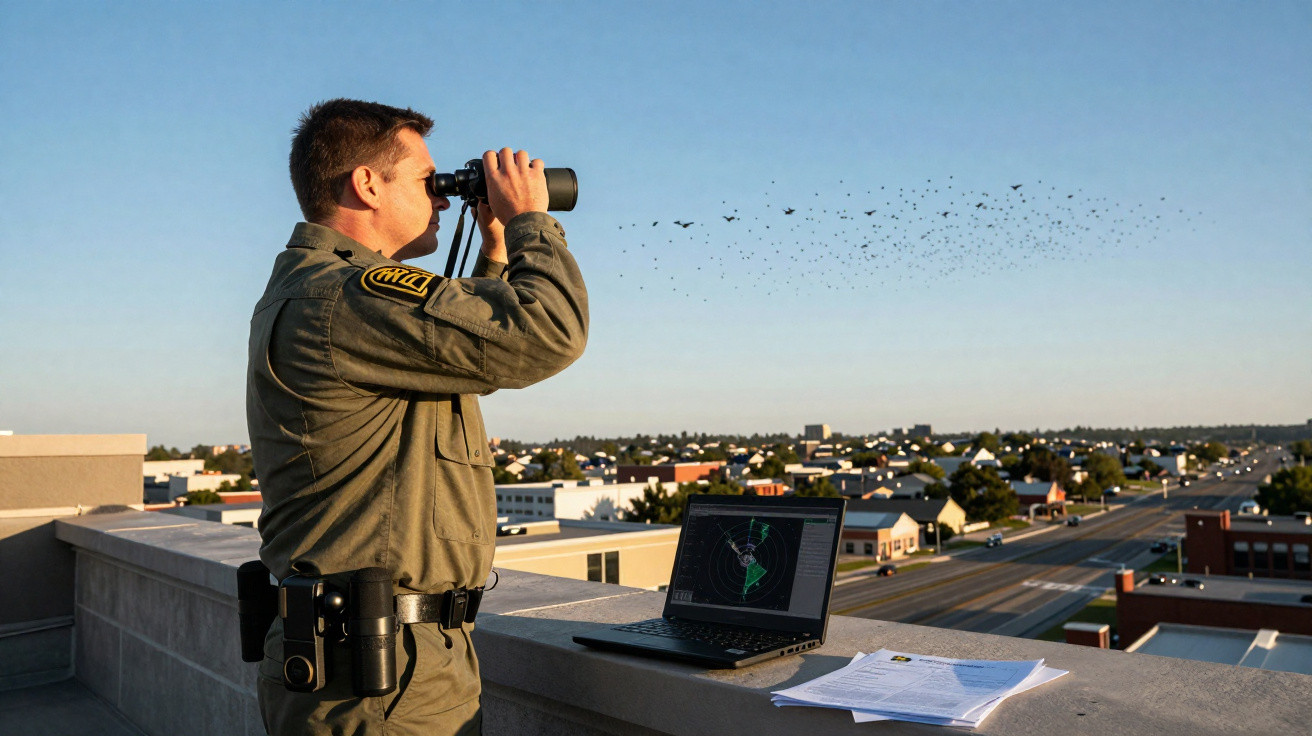
It is unusual for a senior US military officer to respond so candidly. During the Space and Missile Defense Symposium (SMD) in Huntsville, Alabama, Major General Joseph Jarrard, deputy commander of US Northern Command (NORTHCOM) and the second-most senior officer in NORAD’s US component, was asked whether the United States could defend its own territory against a drone swarm attack. His answer was unequivocal: no.
👉 Read more: US Air Force Declares Initial Operational Capability for New MH-139A Grey Wolf Helicopter to Strengthen Nuclear Arsenal
What followed explains why his remarks amount to more than a headline-grabbing statement. Jarrard conceded that the issue is not merely a shortage of a particular weapon or counter-drone capability, but a structural gap in sensor coverage. In certain parts of the country, the United States may be unable even to detect an approaching drone swarm, much less engage it after detection.
The shadow of Operation Spiderweb
Jarrard did not identify the precise scenarios that worry him most. Yet, since June 2025, any debate on homeland air defence has been inevitably influenced by Operation Spiderweb. In that Ukrainian operation, drones hidden in lorries were launched from sites deep within Russian territory, showing how comparatively cheap unmanned systems could endanger strategic aviation well away from a conventional front line. It has subsequently become a key reference in debates about homeland defence and the vulnerabilities posed by so-called “close-in” threats: attacks initiated inside, or close to, a nation’s own borders.
📌 You may also like
- British Army expands use of drones and electronic warfare to boost infantry battalion lethality
- The US Air Force deploys B-52H bombers to Australia to reinforce the Indo-Pacific
A more recent, less publicised event has added a further element to these concerns. Earlier this year, an FPV drone operated by an Iranian-backed militia struck a Black Hawk helicopter parked at a US base in Iraq. It provided an indication of how comparable methods might be reproduced against military infrastructure in other locations, including within US territory.
Why the problem is structural, not just financial
Jarrard’s assessment is especially important because it identifies a basic mismatch in design, rather than simply insufficient money or equipment. NORAD was created during the Cold War to watch for a relatively limited range of threats, above all Soviet bombers and ballistic missiles approaching North America along foreseeable routes, particularly through the Arctic. The threat landscape has since broadened considerably. As military officials increasingly put it, the challenge now runs “from the seabed to space.” It encompasses hypersonic weapons, cyberattacks, cruise missiles and unmanned systems launched from a lorry in a suburb, rather than an airfield or hostile military facility.
NORTHCOM has already begun fielding a partial answer in the form of rapidly deployable counter-drone *“fly-away kits,”* which can be dispatched to sites facing an emerging threat to assist in detecting and neutralising small unmanned aircraft.
An unseen rule
Jarrard also pointed to a hurdle that is bureaucratic rather than technological: the authorities and rules governing the employment of counter-drone systems are not always unambiguous or properly adapted to the speed at which the threat is changing. To tackle this issue, the command is applying lessons from Operation Noble Eagle, the homeland air-defence mission established after the 11 September 2001 terrorist attacks. That operation put in place a structure for continuing air patrols, interception procedures and coordination between military and civilian bodies.
The current aim is to apply that model of coordination and clearly assigned authorities to the drone threat, while bringing local and federal law-enforcement agencies into the process. A substantial share of the critical infrastructure that may need protection, in addition to military bases, lies beyond the sole jurisdiction of the US armed forces.
A vulnerability that extends beyond the United States
The United States is by no means the only country confronting this problem. Jarrard’s assessment mirrors a wider challenge faced by almost every modern military. Conventional air-defence systems were mainly built to identify and intercept aircraft and missiles with larger radar signatures. They may struggle greatly to spot small, slow-moving, low-observable drones; even where engagement is possible, doing so affordably creates a separate difficulty. The same saturation principle has become increasingly apparent in Ukraine, where Russia combines high volumes of relatively inexpensive drones with more advanced missiles. Cheap targets can saturate sensors and interceptor systems, compelling defenders to use costly munitions against threats whose production cost is only a small fraction of theirs.
For any military now reviewing its point-defence capabilities, whether for an air base, port, military installation or critical infrastructure, the NORAD case offers an uncomfortable lesson. Even the nation with the world’s largest defence budget now openly admits that it has not yet resolved one of the most fundamental challenges created by this new generation of threats: seeing them before they arrive.

Comments
No comments yet. Be the first to comment!
Leave a Comment