
Add Military Zone on Google
Why add us? Get Military Zone news on your Google.
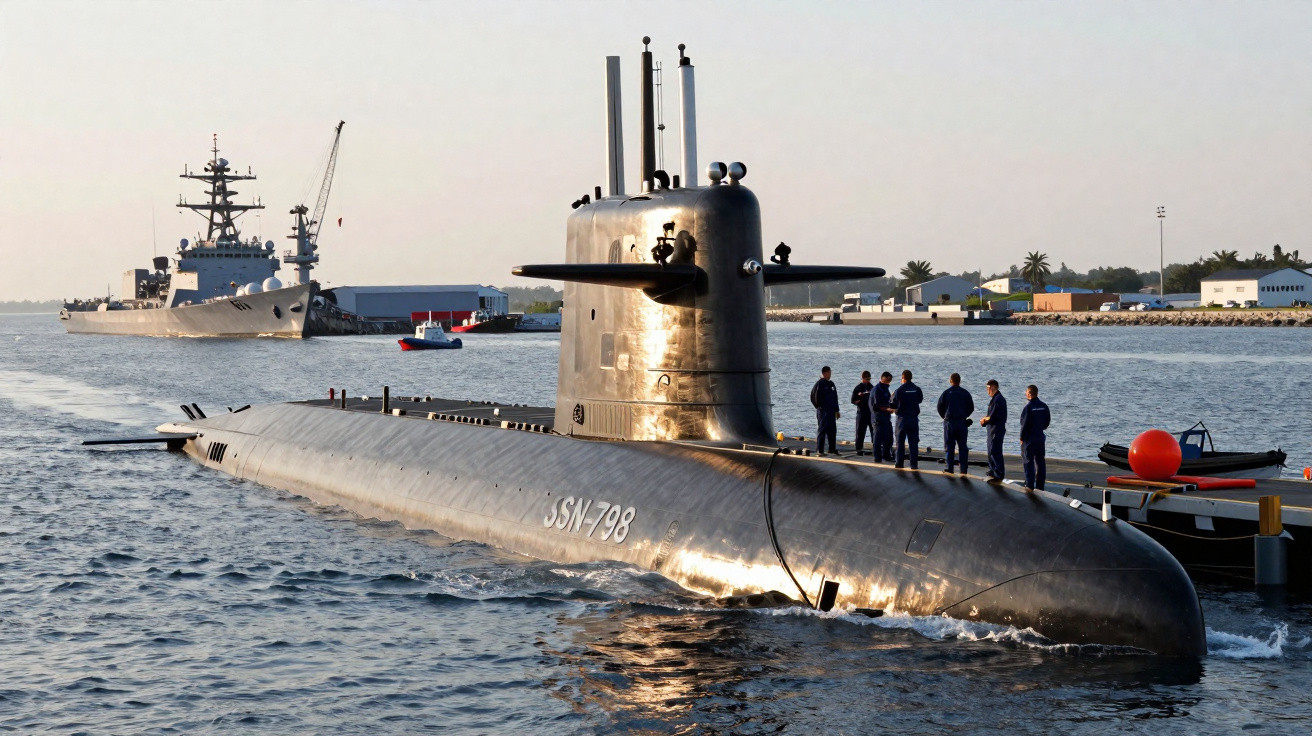
Just months after joining the fleet, the Virginia-class nuclear-powered attack submarine USS Massachusetts (SSN-798) of the United States Navy has been cleared to begin operations after completing its sea-trial programme. The Navy opted to waive the customary post-trial availability period, allowing the vessel to move straight into operational service following its formal commissioning in Boston on 28 March.
👉 Read more: US Air Force declares Initial Operational Capability for the new MH-139A Grey Wolf helicopter to strengthen the nuclear arsenal
Chief of Naval Operations Admiral Daryl Caudle said that Massachusetts is already combat-ready and should therefore remain available to its crew and the fleet. According to the officer, removing this additional unavailable period reflects the submarine’s sound material condition and makes it possible to deliver operational capability more quickly. It also releases shipyard staff and resources for the construction of the next generation of submarines required by the US Navy.
USS Massachusetts is the 25th Virginia-class unit and the seventh Block IV submarine, built through the industrial partnership between General Dynamics Electric Boat and HII Newport News Shipbuilding. During 2025, the boat completed its initial navigation trials before commissioning, when its diving control, communications systems, sensors, propulsion and overall platform performance were assessed.
📌 You may also be interested in:
- South Korean Navy: KSS-III Dosan Ahn Chang-ho submarine completes historic Pacific mission
- US Air Force deploys B-52H bombers to Australia to reinforce the Indo-Pacific
Virginia-class attack submarines and the renewal of the US submarine force
The Virginia class is gradually taking over the roles carried out for decades by the Los Angeles-class nuclear-powered attack submarines, which were among the principal pillars of US submarine capability during the final years of the Cold War. As these older boats leave service, the Navy is also pursuing modernisation and service-life extension programmes for selected submarines, seeking to preserve its deterrent capacity while new platforms continue to enter the fleet.
One example is USS Cheyenne (SSN-773), the last Los Angeles-class submarine to be built and commissioned, in 1996. Having undergone a modernisation process, the vessel is expected to remain in service as part of the measures designed to sustain force capacity during the transition to newer platforms.
Virginia-class capabilities and production blocks
The first Virginia-class submarine, USS Virginia (SSN-774), entered service in 2004. The class can employ Mk 48 heavyweight torpedoes, as well as several types of payload. From USS North Dakota (SSN-784) onwards, the submarines have incorporated two 87-inch Virginia Payload Tubes (VPTs), each able to launch six Tomahawk cruise missiles.
The programme was arranged into successive production blocks, enabling each new phase to introduce structural changes and improvements to sensors, combat systems and weapons-carrying capacity.
USS Massachusetts availability and future submarine changes
The early release of USS Massachusetts is also part of the United States Navy’s effort to make new combat capabilities available to the fleet more rapidly. Vice Admiral Rick Seif, commander of Submarine Forces, said the decision will immediately raise readiness and combat-capability levels, helping to maintain US superiority in the undersea domain.
This process is taking place alongside other planned changes to the Virginia-class submarine force. The Navy recently announced the reclassification of 19 units fitted with the Virginia Payload Module (VPM) as guided-missile submarines (SSGNs). These vessels are expected to take on part of the capabilities currently provided by the Ohio-class SSGNs, expanding long-range strike potential and the ability to conduct specialised missions as the older submarines approach retirement.

Comments
No comments yet. Be the first to comment!
Leave a Comment