
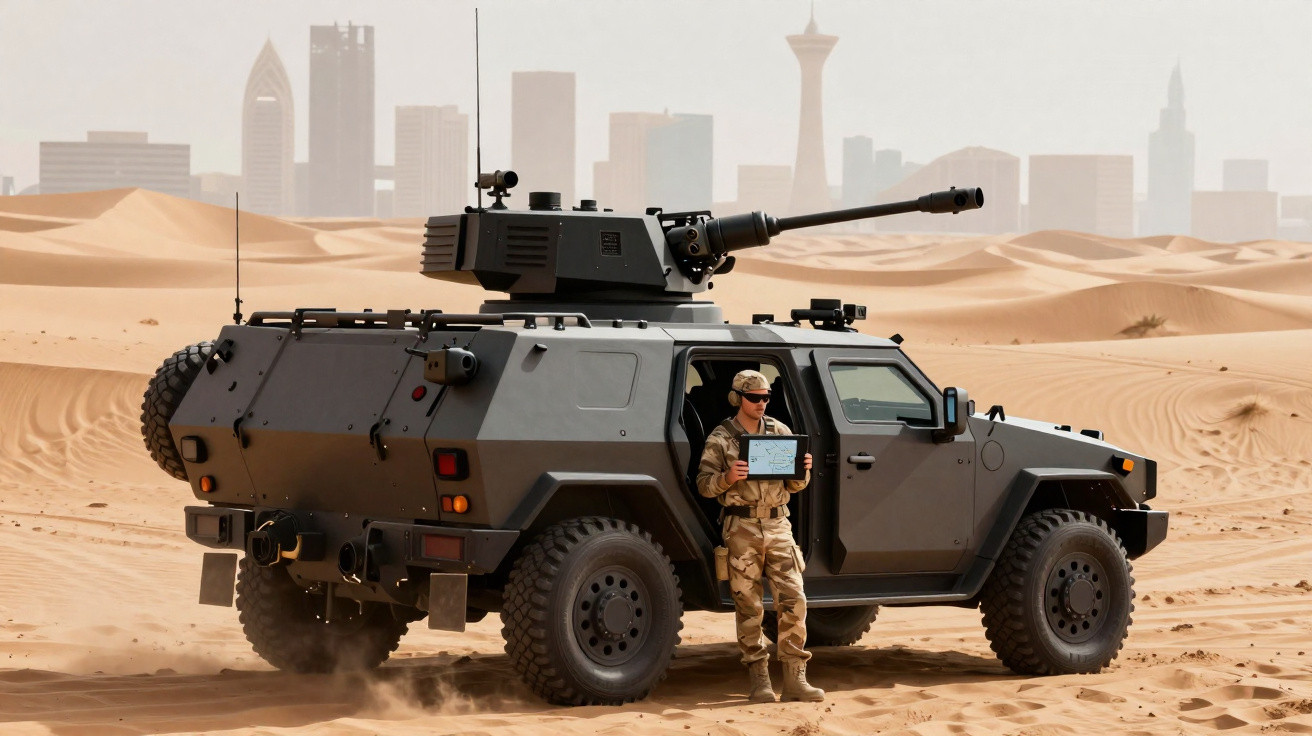
On a sandy proving track outside Riyadh, a compact French 4×4 repeatedly makes its circuit while its remotely controlled cannon silently follows threats that are not there.
The sight is ordinary, even rather unremarkable. Behind this new armoured vehicle, however, is a pointed industrial warning: fit the gun afterwards and its consequences will cost you for the next 30 years.
A 19-tonne 4×4 that will not be “just a truck”
At the World Defense Show 2026 in Riyadh, attention normally settles on enormous 8×8 platforms and main battle tanks. This year, though, a smaller vehicle from ARQUUS and Belgium’s John Cockerill Defense discreetly claimed some of that attention.
Known as MAV’RX, the concept is a 19-tonne armoured 4×4. It is able to carry a complete infantry team and, importantly, take part in combat. Its roof-mounted remotely operated turret carries either a 20 mm or 30 mm automatic cannon.
This pairing addresses an uncomfortable capability gap that many militaries have encountered again in Ukraine, the Sahel and the Middle East: a need for vehicles tougher than soft-skinned patrol platforms, yet lighter, less costly and easier to deploy than heavy 8×8 infantry fighting vehicles.
The French-Belgian MAV’RX is built around its turret from day one, turning a troop carrier into a combat tool instead of a rolling target.
In practice, the vehicle is intended to transport a full section, protect it against the most frequent battlefield hazards, and provide meaningful fire support as soon as troops dismount. This changes it from a “taxi” into a “partner in the fight”.
A market returning to the “missing middle”
Land forces have conventionally arranged fleets into clear categories: light 4×4s for logistics and patrol work, alongside heavy 8×8 or tracked vehicles for frontline operations. The space between these groups has frequently been filled through makeshift solutions.
Usually, that means taking a standard armoured personnel carrier and fitting a more powerful gun and sensors after soldiers begin suffering losses. The outcome is commonly underwhelming. Weight gradually rises, vehicle balance deteriorates, and the electronics compartment becomes a spaghetti bowl of incompatible systems.
Why retrofitted turrets are so expensive
Among industry engineers, “just add a turret” is almost a meme. Each additional kilogram on the roof alters the vehicle’s centre of gravity. This requires suspension modifications, braking revisions and new roll-over trials. Meanwhile, stabilised cannons, thermal cameras and sophisticated sights soon demand more power than the original alternator and cooling system can reliably deliver.
Once a vehicle is already in service, dealing with these problems is awkward and time-consuming. Units have vehicles removed for lengthy upgrades, maintenance teams must manage multiple sub-variants, and spare-parts holdings multiply.
Designing the turret in from the start avoids a vicious cycle: every “simple” upgrade triggers hidden costs in stability, power, cooling and software.
With MAV’RX, ARQUUS and John Cockerill intend to settle such decisions early. From the beginning, the chassis, hull, powerpack and digital backbone have been dimensioned and configured around the CLWS remote weapon station and its sensors. That is the project’s crucial “detail” - precisely the area where armies often lose budget when conflict reveals earlier compromises.
Mobility first: designed for deserts rather than brochures
The Riyadh exhibition offers little forgiveness to vehicles that merely appear impressive beneath air-conditioned lights. Customers from the Gulf and elsewhere require equipment capable of enduring years of heat, dust and abrasive sand.
MAV’RX is presented as a full-sized armoured 4×4, measuring roughly 6.98 metres long, 2.55 metres wide and 2.73 metres high. Its 19-tonne combat weight places it towards the top of the 4×4 class, while it remains air-transportable and road-legal in many states.
Its propulsion follows a conventional formula: a 6-cylinder, 8-litre diesel producing approximately 400 horsepower, coupled to an automatic gearbox. There is no exotic hybrid system or experimental powertrain. The decision is aimed at buyers who value predictable fuel use, straightforward servicing and parts availability over the long term.
Independent suspension and large 14.00 R20 tyres underpin its mobility claim. Its published performance figures suit demanding off-road operations: 60% gradients, 30% side slopes, a 0.5 m vertical step, a 1 m trench and 1.2 m of fording depth.
- Top weight: 19 tonnes
- Engine: 8-litre diesel, ~400 hp
- Crew and passengers: up to 10 personnel
- Mobility: 4×4, independent suspension, large tactical tyres
- Armament: remote-controlled 20–30 mm cannon (CLWS turret)
The objective is straightforward: a vehicle able to leave surfaced roads, accompany convoys across long distances, and redeploy rapidly without requiring specialist recovery assistance whenever conditions become difficult.
Protection: surviving the most probable threats
MAV’RX also occupies a practical middle ground on protection. It is not intended to exchange fire with tanks. Instead, it uses NATO’s STANAG 4569 standard for ballistic and mine protection, which sets resistance levels against small-arms fire, shell fragments and blasts beneath the hull or wheels.
The designers combine this armour package with survivability measures suited to severe climates: reinforced air conditioning, central tyre inflation, run-flat inserts and a rear-view camera that preserves situational awareness when reversing in confined urban areas or desert compounds.
Armour plates keep rounds out, but climate control, tyres and cameras keep the crew alive, alert and moving long enough to fight.
Beyond steel and Kevlar, the options list indicates the direction of land warfare. Buyers may specify CBRN filtration, laser-warning receivers, acoustic or optical shot detection, and a digital network architecture combining radios, GPS, intercoms and tactical battle management in one interface.
Such a “Battlenet” system makes the vehicle a network node rather than simply a protective shell. If a laser designator locks on, the crew is alerted. When a nearby unit identifies an ambush or drone swarm, its location automatically appears on the map. For forces accustomed to analogue radios and shouted reports, this development may matter almost as much as extra centimetres of armour.
A remote-controlled cannon at the heart of the concept
From troop carrier to fighting vehicle
John Cockerill Defense’s CLWS turret is fundamental to the concept. It can carry a 20 mm or 30 mm automatic cannon, together with day-and-night sensors and a laser rangefinder.
As the station is entirely remotely operated from inside the vehicle, the gunner remains protected by armour. This is increasingly important against snipers, artillery fragments and small attack drones aimed at exposed crew.
On a chassis engineered around it, the turret is not merely an additional weapon. It is the central reason for the vehicle’s existence. Its cannon can fix enemy infantry in place, disable technicals, suppress firing positions in urban alleyways, and rapidly establish a curtain of fire when a convoy is ambushed.
In battlespaces saturated with drones, the sighting system also serves as an intelligence resource. Thermal imagers and stabilised optics can observe far beyond a soldier’s unaided vision, returning threat information to section or company level.
Ten seats that reshape unit operations
Capacity is another revealing figure: up to ten personnel, including crew. This points to a vehicle intended for full sections or reinforced squads rather than only small reconnaissance teams.
Accommodating so many personnel alongside a turret and worthwhile protection demands difficult design decisions. Space for body armour, weapons, rucksacks and electronics must be created without making the vehicle excessively tall or reducing legroom to an exhausting level.
If the arrangement succeeds, its benefits are considerable. A battlegroup can undertake more tasks with one vehicle family: convoy escort, rapid reaction, checkpoint protection, route-clearance support and rapid reinforcement of endangered positions.
A well-designed “one chassis, many roles” fleet can be a greater advantage than adding yet another specialised vehicle type to the motor pool.
That simplification matters to logisticians. Fewer platform types require smaller stocks of unique parts, less fragmented mechanic training and provide a clearer long-term view of fleet condition.
Why Riyadh matters to this French-Belgian MAV’RX proposition
The World Defense Show has quickly become more than a showy exhibition. It provides a reality check for vehicles seeking entry into Gulf inventories and, consequently, other hot, sandy operational theatres.
For MAV’RX, this entails demonstrating that it can maintain lengthy desert patrols, withstand sudden sandstorms and preserve its electronics as temperatures rise. Buyers have learned through experience that systems proven in temperate Europe will not necessarily endure Arabian sunshine or Sahelian dust.
| Date / period | Event | Capability impact |
|---|---|---|
| 8–12 February 2026 | World Defense Show, Riyadh | Desert proving ground and benchmark against global competitors |
| 8–12 February 2026 | Public debut of MAV’RX with CLWS turret | Signals a firm “transport + fire support” positioning from day one |
The industrial partnership also supports the sales case. Rather than buying a vehicle from one supplier and a turret from another, leaving the customer to resolve integration problems, ARQUUS and John Cockerill offer a combined package. This could make negotiations, warranties and long-term support easier - an area in which many armed forces have had costly experiences.
Anti-drone, ambush and grey-zone roles
The conflicts influencing procurement today are not conventional tank-on-tank engagements. They comprise protracted patrol campaigns, roadside bombs, loitering munitions and rapid attacks by small, agile hostile groups. Drones observe convoys, identify them for artillery or attack them directly. Ambushes emerge from villages, wadis or tree lines beside apparently quiet routes.
MAV’RX is designed for this “grey zone”. It is not intended to replace large infantry fighting vehicles during frontal attacks. Rather, it enables logistics convoys and light units to respond rapidly and accurately when combat reaches them.
Its remote turret can engage low-flying drones at short range, penetrate unarmoured vehicles deployed as suicide bombs, and deliver suppressive fire without requiring a person to stand behind an exposed pintle-mounted gun. With an effective sensor suite and sound training, a section equipped with MAV’RX vehicles can establish overlapping zones of observation and fire along vulnerable routes.
What “integrating the turret from the start” actually involves
The key argument for this vehicle concerns a recurring theme in defence procurement: architecture. When engineers refer to “turret integration”, they mean far more than creating an opening in the roof.
A contemporary remote weapon station consumes electricity like a small house. It requires clean, stable power for servos, gyros, computers and cooling. Its cables need protected routing and shielding against electromagnetic interference. Software must communicate effectively with navigation units, radios and any higher-level battle-management system.
Where these factors are considered in the initial design, every additional sensor or weapon option can connect to a known and tested digital backbone. Where they are not, every upgrade becomes a small development programme involving custom brackets, bespoke wiring looms and unpredictable effects on reliability.
Across a service life of 20 to 30 years, the difference in cost, downtime and operational availability between these approaches can be enormous. That is the price difference the French-Belgian team hopes commanders and finance ministries will recognise once they look beyond brochure imagery.
Practical scenarios and trade-offs on tomorrow’s battlefield
Consider a mixed convoy in the Sahel: fuel tankers, supply lorries and several armoured escorts. A drone detects the column and passes its location to an insurgent group equipped with technicals and mortars. Without built-in fire support, the escorts can protect crews but cannot readily reach out to neutralise firing points quickly.
Replace them with vehicles such as MAV’RX and the situation changes. Vehicles at the front and rear can use turret sensors to observe ahead, identify potential ambush positions and plan alternative routes away from the road. Should contact occur, they can return stabilised fire while moving, buying the commander valuable minutes to move the rest of the convoy beyond the kill zone.
None of these capabilities is without cost. A 19-tonne 4×4 carrying a 30 mm cannon is more complicated and expensive than a simpler mine-resistant vehicle with a machine-gun ring. Gunners, drivers and maintainers all face additional training requirements. Spare barrels, specialist equipment and ammunition supply also burden the support chain.
For many states, the decisive question will be how to balance that added complexity against the increasing cost of being outgunned by agile opponents using drones, rockets and inexpensive technicals. The French-Belgian proposition is that integrating the turret and its brain from the first day makes that balance easier to sustain in the long term, rather than attempting to assemble it under fire ten years later.


Comments
No comments yet. Be the first to comment!
Leave a Comment