
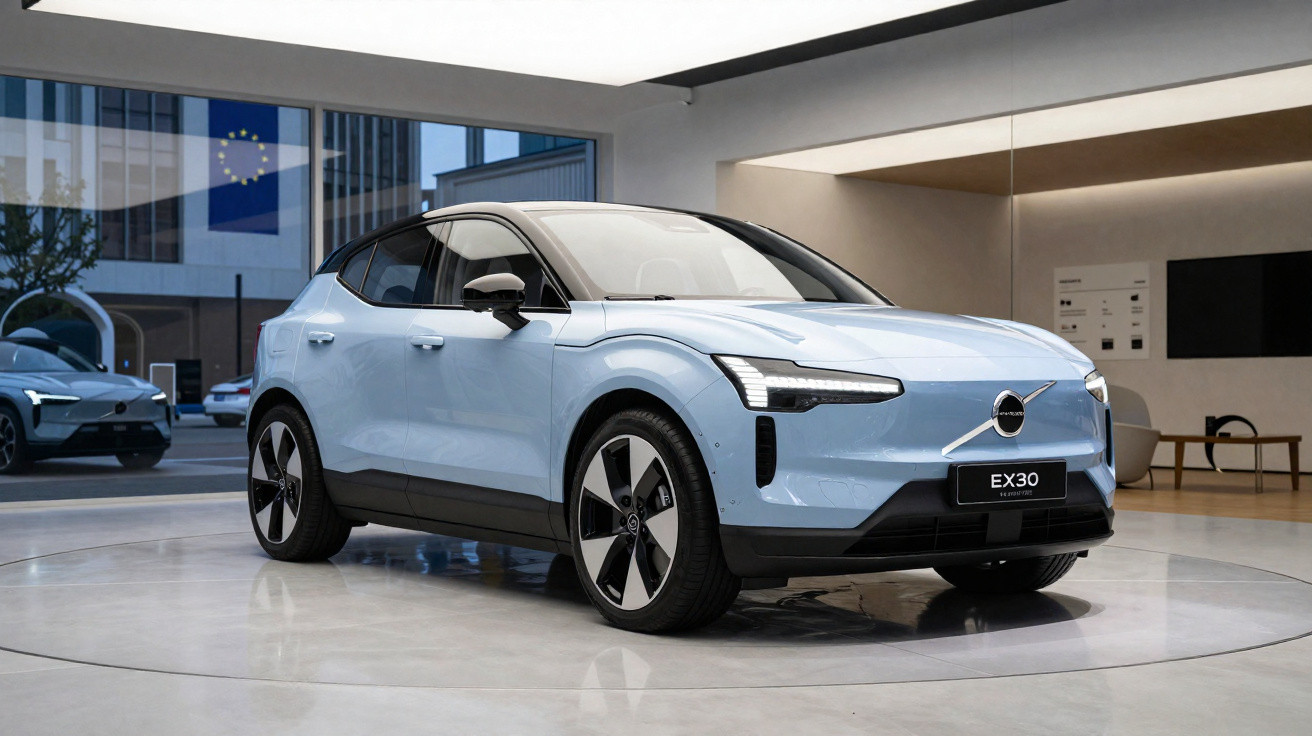
Volvo Cars has voiced concern about the European Union’s (EU) provisional import tariffs on electric cars made in China.
Jim Rowan addressed the additional EU import duties and their potential effect on the manufacturer during the question-and-answer session accompanying its second-quarter results.
The issue is particularly significant because the new EX30 - the model chiefly responsible for Volvo’s growth this year and already Europe’s third best-selling electric model - is the brand’s only vehicle built in China and sold in Europe.
It is therefore important to understand how the additional import tariffs - an extra 19.9% in Volvo’s case - may affect both the EX30 and Volvo’s overall financial performance.
Volvo Cars chief executive Jim Rowan said that, considering the “turbulent environment”, the company’s results had been very satisfactory, “which is already a good starting point”.
Nevertheless, he stressed that, even though operations are currently progressing well, a possible increase in import duties on China-built electric cars could create a short-term issue.
The Swedish car maker has already confirmed that EX30 production will move to Europe, specifically Ghent in Belgium, at the end of the first half of 2025.
“Until we are able to start producing the EX30 in Belgium, we will try to understand what impact the tariffs will have in the second half of this year.”
Jim Rowan, CEO of Volvo Cars
Uncertainty over EU tariffs and the Volvo EX30
Volvo Cars chief financial officer Johan Ekdahl reiterated this uncertainty. He said that, while “it is not possible to precisely quantify the exact impact of these tariffs, it is clear that they will have some influence”.
“We do not know the exact outcome of these tariffs, because discussions with the European Commission are still ongoing.”
Johan Ekdahl, CFO of Volvo Cars
Despite strong demand and the EX30 delivering very positive gross margins (20%), the chief executive said that “we are looking at all available options”, without ruling out a price change for the electric SUV. In Portugal, Volvo EX30 prices start at €39,554.
Other concerns
Discussing import tariffs further, Rowan also raised concerns that the United Kingdom - Europe’s second-largest market - has yet to decide whether it will introduce the same tariffs provisionally imposed by the EU.
Alongside tariffs, the Volvo Cars CEO answered questions about the Chinese market and the price war that continues there. Rowan said the market “is very turbulent and has much more competition than it had in the past.”
However, he explained that the brand’s strategy, especially for electric models, is not to compete in the mass market, but instead in the premium segment.
“We remain in the premium segment, which allows us to survive the turbulence, which should last between 18 months and two years”.
Jim Rowan, CEO of Volvo Cars
Volvo Cars’ chief executive also highlighted other geopolitical concerns, including the US presidential election. He also pointed to the increase in US import tariffs on batteries, from 7% to 25%.
Even so, Rowan emphasised that, regardless of these concerns, “the important thing is to make sure that you have a resilient supply chain.”
“It is not possible to predict turbulence in the automotive industry, or where it will occur, so rather than trying to guess, we need to ensure that we have a more resilient supply chain than we had before.
Jim Rowan, CEO of Volvo Cars




Comments
No comments yet. Be the first to comment!
Leave a Comment