
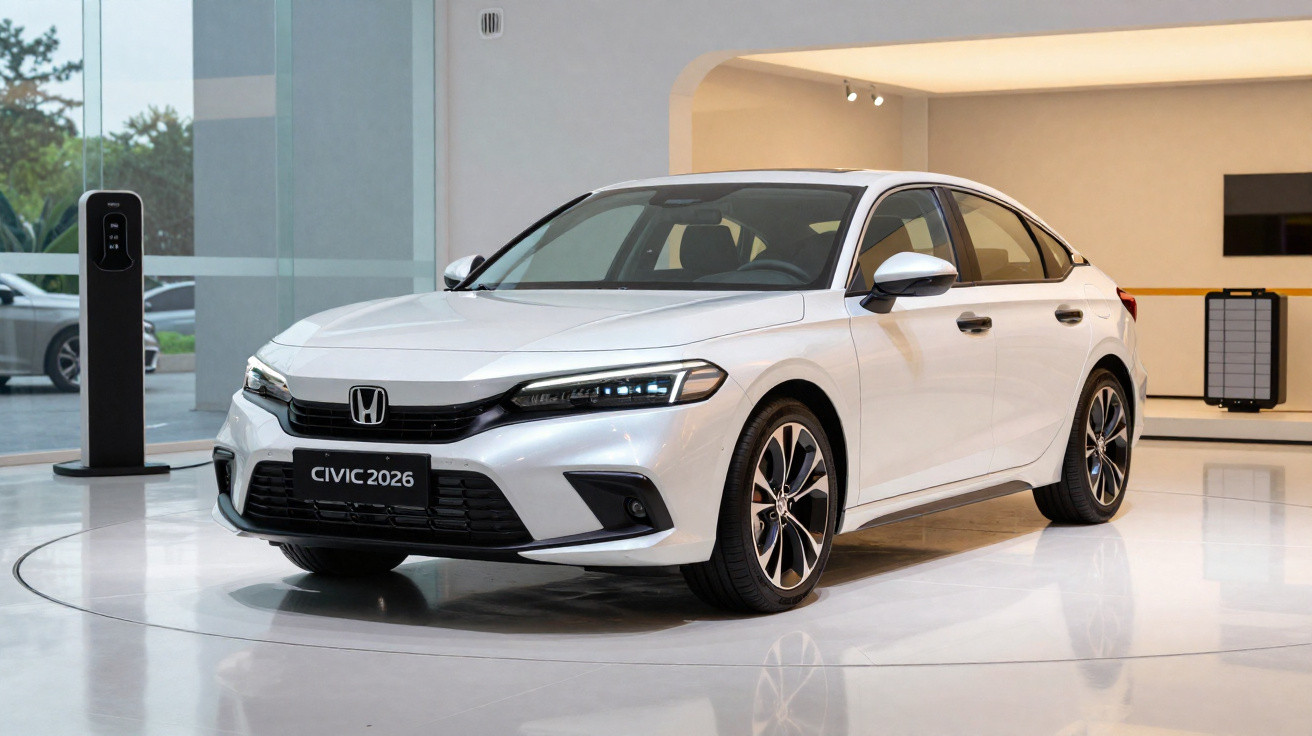
Honda is discreetly preparing a new Civic intended to be lighter, cleaner and more engaging to drive, while remaining a practical everyday car. Underpinning that ambition is an all-new modular platform created from the outset for electrified powertrains – and Honda believes it can remove 90 kg, improve real-world performance and cut fuel consumption simultaneously.
A new platform designed for electrified power
Following years of gradual revisions, Honda is essentially taking a fresh approach with the twelfth-generation Civic, scheduled for 2026. Its most important development sits beneath the bodywork: a new architecture built to accommodate hybrid, plug-in hybrid and, eventually, fully electric power.
Rather than modifying an existing petrol-car chassis, Honda’s engineers have redesigned the structure around a floor-mounted battery pack, a wider track and neater suspension mounting locations. This should alter both the Civic’s cornering character and the amount of cabin space it can provide.
Honda targets about 90 kg of weight reduction on the new hybrid Civic versus today’s equivalent, without stripping equipment.
Known internally as the “Global Small Modular” platform, the architecture is planned for several body styles and international markets. This points to a five-door hatchback for Europe, a likely saloon for Asia and North America, plus the possibility of a more sporting derivative at a later date.
Weight reduction without cutting equipment
Taking 90 kg out of a modern family hatchback is a substantial challenge when customers still want large displays, safety systems and extensive sound insulation. Honda’s strategy covers several areas:
- Increased use of high-strength steel in important chassis sections
- Re-engineered hybrid components, including more compact motors and inverters
- Simplified wiring looms and electronics to eliminate duplication
- Lighter seats with thinner but more rigid seat frames
The engineering team is also focusing on weight distribution. Making the centrally positioned battery pack a structural component, while reducing mass at the front, should create a more neutral balance. In turn, this ought to mean crisper initial turn-in and more composed responses in emergency manoeuvres.
Civic hybrid powertrain: greater efficiency and response
The current e:HEV arrangement, which combines a naturally aspirated 2.0-litre petrol engine and an electric motor, is already known for its economical real-world performance. For the 2026 Civic, Honda is expected to develop this system rather than replace it.
The petrol engine should receive a higher compression ratio and lower internal friction. Alongside a more efficient cooling system and updated control software, Honda is aiming for under 4.5 l/100 km on the WLTP combined cycle – an ambitious result for a family-sized hatchback without plug-in capability.
The next Civic hybrid aims to use less fuel than many city cars, while offering motorway performance closer to a traditional 1.5‑litre turbo.
On the electric side, the principal drive motor is expected to become smaller while providing stronger short bursts of torque through improved power electronics and a slightly enhanced battery. The noticeable benefit should be smoother acceleration away from junctions and more assured overtaking, particularly from 40–80 km/h.
Plug-in hybrid and full EV plans
Honda is not yet confirming comprehensive details, but the platform has been prepared for a plug-in hybrid Civic with a larger battery and the ability to charge at home. This version could deliver 60–80 km of electric-only driving range, covering many everyday commutes without consuming fuel.
A battery-electric Civic is also being considered for a later stage. It would probably share technology with the Honda e:Ny1 SUV, packaged in a lower and more aerodynamically efficient body. The emphasis is likely to be on a practical range target rather than attention-grabbing figures, using efficiency instead of an excessively large battery to manage weight and cost.
| Version | Powertrain | Main focus |
|---|---|---|
| Civic hybrid | 2.0 petrol + electric motor | Low consumption, everyday usability |
| Civic plug‑in hybrid | Petrol + larger battery, charging port | Electric commuting, long-range flexibility |
| Civic electric | Battery-only, no engine | Zero tailpipe emissions, city-friendly running |
Driving character: retaining the Civic’s dynamic DNA
For established Civic followers, the larger concern is how the drive for improved efficiency will influence handling. Honda is keen to underline that steering response and body control remain fundamental to the programme, alongside weight saving.
Positioning the battery lower in the vehicle should reduce the centre of gravity compared with an equivalent petrol-only model. Together with the wider tracks, revised suspension geometry and firmer mounting points, this should limit body roll in corners and allow quicker reactions to steering inputs.
The goal is a compact hybrid that still feels eager and precise on a twisty road, not just tidy in the official tests.
Honda’s engineers are additionally adjusting how the hybrid system reacts to throttle inputs. Many hybrid cars can seem disconnected, with the engine holding a constant droning speed as the vehicle gradually accelerates. Honda wants engine speed, road speed and the driver’s right-foot inputs to correspond more closely, giving the Civic a feel closer to that of a conventional automatic while retaining lower fuel costs.
Interior technology and improved space
The new platform also offers packaging advantages. By placing the battery below the floor and moving hybrid hardware nearer to the engine bay, Honda can create more rear legroom and a more evenly shaped boot, despite revising the rear suspension to accommodate a wider track.
The cabin is expected to gain a fully digital instrument display, a larger central touchscreen and more sophisticated voice control. Over-the-air software updates are planned, enabling Honda to revise energy management, driver-assistance systems and infotainment functions without requiring a workshop appointment.
Even with this increase in technology, the brand is expected to retain physical controls for regularly used features, including temperature and volume. This is a response to drivers who are tired of navigating touchscreen menus while driving.
Why 90 kg less transforms the hybrid experience
A 90 kg reduction in a compact hybrid may appear theoretical, yet it influences several aspects of daily driving. With less weight to shift, the electric motor need not work as hard when pulling away, extending the period in which the engine can remain off in traffic and at lower speeds.
At motorway cruising speeds, reduced weight lowers the power required to sustain 70 mph, especially on mild gradients. This cuts fuel use and allows the hybrid system to call on electric assistance more regularly, rather than starting the engine for each small incline or overtaking manoeuvre.
Tyres and brakes benefit as well. Lower mass reduces tyre wear under heavy braking and limits heat peaks in the brake discs, potentially permitting slightly smaller and lighter components without reducing safety margins.
Everyday driving scenarios
Take a 30‑mile mixed commute involving suburban traffic, a ring road and a brief motorway section. In the present Civic hybrid, the engine already starts and stops to maintain battery charge and keep progress smooth. The lighter body and new platform should allow longer electric-only sections through town on the same route, with less sudden engine involvement on the ring road.
Across a year, even an improvement of 0.5 l/100 km could save several full tanks of fuel. For company-car drivers subject to strict CO2 thresholds, that reduction could also enable eligibility for a more advantageous tax band in some markets.
Important hybrid terms explained
Honda’s discussion of the new Civic includes a range of electrification terms that can become unclear in normal conversation. Several definitions help explain what the 2026 model is intended to offer.
A “full hybrid”, such as the Civic e:HEV, can travel short distances using electric power alone but cannot be plugged in. Its battery is charged mainly by the engine and recovered braking energy. A “plug-in hybrid” has a larger battery and a charging socket, providing useful electric-only range and home charging, though it also adds weight and complexity.
Modular platforms, including Honda’s new Civic architecture, are effectively adaptable vehicle skeletons. They enable manufacturers to produce different types of car around shared mounting points for engines, batteries and suspension. This distributes development costs and reduces the time needed to bring specialist versions – such as a sporting hybrid or a pure EV – to market.
For motorists, the mix of a lighter structure, more efficient hybrid technology and a choice of plug-in hybrid or electric variants offers greater flexibility without changing brand. In a class full of crossovers and competitively priced Chinese new arrivals, that range could prove vital to Honda’s next phase.






Comments
No comments yet. Be the first to comment!
Leave a Comment