
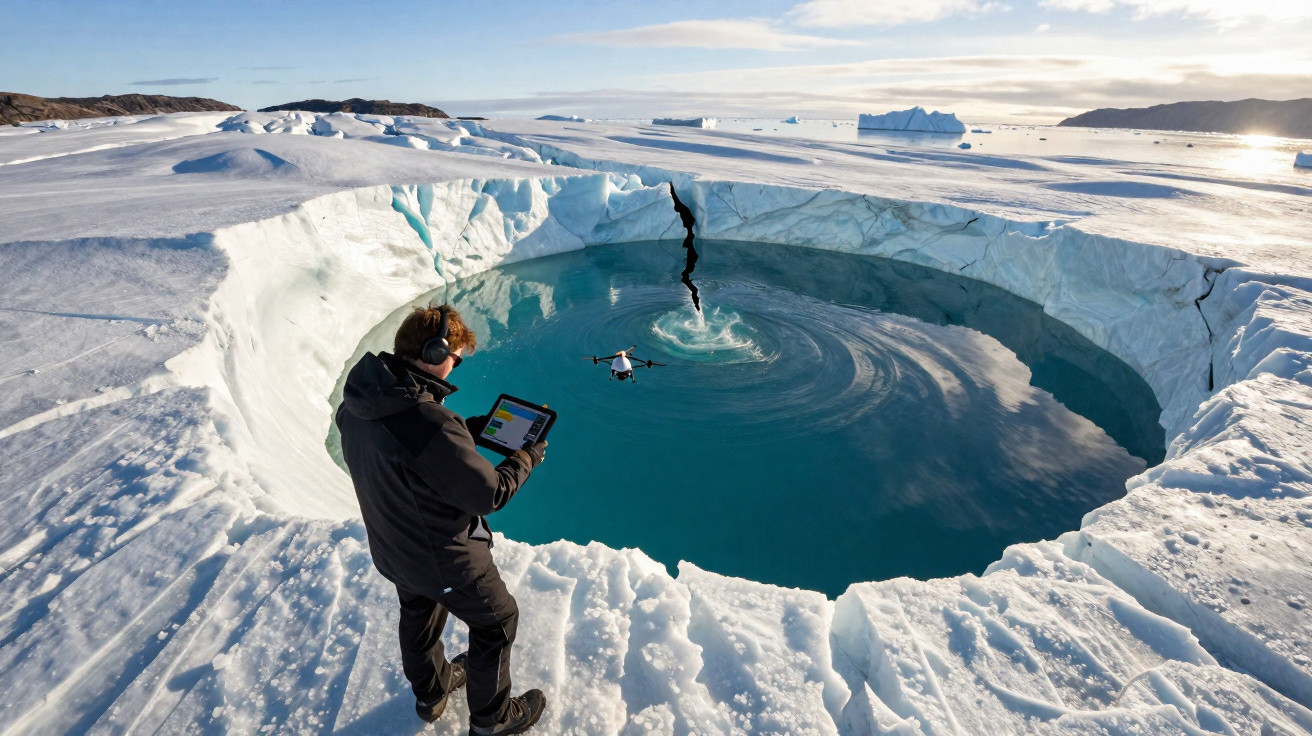
High over the Arctic Ocean, a floating glacier tongue is bending, fracturing and rising as meltwater races through it, providing an unusual real-time glimpse of how a warming climate can swiftly destabilise ice previously regarded as fairly stable.
A glacier tongue under pressure
On Greenland’s isolated north-east coast, the Nioghalvfjerdsbræ ice tongue – more commonly called the 79°N Glacier – has turned into a natural field laboratory for climate researchers. It is among just three large floating glacier tongues still remaining in Greenland, making it significant for projections of future sea-level rise.
The area has warmed markedly since the mid-1990s. Warmer seawater is eroding the glacier from underneath, while higher air temperatures have transformed parts of the surface into a seasonal network of ponds and streams.
Satellite imagery first showed a new feature in 1995: a substantial meltwater lake sitting directly on the glacier tongue. Covering roughly 21 square kilometres, this lake has become the subject of an in-depth investigation led by scientists at Germany’s Alfred Wegener Institute (AWI).
The lake does not simply freeze and refreeze. It repeatedly drains in sudden, violent events that reshape the glacier itself.
The researchers have recorded seven significant drainage events from this one lake, including four during the past five years alone. During each event, vast quantities of freshwater surge through cracks and vertical shafts in the ice, reaching the glacier bed before flowing towards the ocean.
A giant lake that disappears overnight
Seven drainages, becoming faster and more unusual
When drainage occurs, the lake empties rapidly – within hours or days. Satellite pictures captured before and afterwards show the bright blue water surface abruptly becoming dull and broken. The previously still lake is replaced by an intricate web of fractures.
From 2019, AWI researchers identified a notable new shape within these fracture fields: broad triangular structures spreading outwards from the drained lake basin. Such formations differ from the more rounded, sinkhole-like patterns generally observed after surface lakes drain on other glaciers.
The triangular fracture fields act like giant funnels, channelling water into openings in the ice tens of metres across.
Known as moulins, these openings are vertical shafts that serve as drains in the glacier surface, directing meltwater straight to the bed, at times more than a kilometre beneath. Once the lake passes a critical threshold, the moulins transfer enormous volumes of water in a very short period.
Aircraft and satellite observations indicate that water keeps moving through the moulins for a while even after a major drainage event. Rather than being flushed by one isolated outburst, the glacier therefore receives successive pulses of meltwater.
The unusual behaviour of “living” ice
The research also demonstrates that ice can behave in less intuitive ways. Across years and decades, glacier ice moves like an exceptionally thick liquid, but over shorter periods it can bend and rebound as an elastic material does.
This twofold behaviour helps account for the triangular fracture system’s persistence. Surface fractures remain apparent and largely unaltered for years, whereas radar data reveal that channels inside the glacier change, narrow and partly close as the ice creeps and refreezes, without disappearing altogether.
Consequently, every summer melt season does not begin anew. Existing weak points can be reactivated by incoming meltwater, potentially explaining why the lake has drained more often in recent years.
- Viscous behaviour: ice gradually flows downhill under its own weight.
- Elastic behaviour: when rapidly stressed, ice can flex, fracture and rebound.
- Result: fracture systems persist for long periods and may reopen as water pressure increases.
When water lifts an entire glacier
A concealed blister beneath the ice
Among the AWI study’s most striking results comes from faint shadows in aerial images and returns from ice-penetrating radar.
Along certain fracture lines, each side of the crack sits at a different elevation. The slight rise on one side indicates that ice has been forced upwards from below, with the greatest uplift located directly under the former lake basin.
Large volumes of draining water appear to have pooled beneath the glacier, forming a pressurised subglacial lake that physically lifts the ice tongue above it.
Radar sections reveal what appears to be a water blister confined beneath the glacier. The added pressure pushes the ice upwards and distorts the surface by several metres. Notably, surface fractures linked to this uplift remain visible more than 15 years after the first major drainage.
This uplift alters more than the glacier’s form. Increasing water pressure at the bed reduces friction between the ice and the rock or sediment below, potentially allowing the glacier to slide seaward more quickly, particularly during or soon after drainage events.
Is the 79°N Glacier entering a new state?
Using satellite images, airborne radar and computer modelling together, the team reconstructed the lake’s filling and drainage, the spread of fractures, and the opening and closing of internal channels.
They applied viscoelastic models – mathematical methods that represent ice as both flowing and spring-like – to assess whether the drainage routes can close entirely again or whether every event leaves the system somewhat better prepared for the next.
The key question now is whether repeated drainages have pushed the glacier into a different, less stable mode of behaviour.
Across approximately a decade, the lake has moved from occasional outbursts to a more consistent pattern of rapid, recurring drainage. Every event drives an extreme meltwater pulse into the underside of the glacier, altering conditions at the bed over periods of hours to days.
Scientists are now asking whether the glacier can still revert to a calmer winter state annually, or whether it has passed a threshold at which cracks and channels become semi-permanent, ready to reactivate as soon as melting returns.
Why one lake matters for global sea level
Cracks spreading higher up the glacier
The specifics of one lake on one glacier may appear highly local. For ice-sheet modellers, however, this system supplies rare evidence of the connection between surface melting and the deep, concealed plumbing within major ice bodies.
As the atmosphere warms, the area in which melt ponds can develop is advancing farther inland and to higher elevations on the slope of the 79°N Glacier. Compared with the 1990s, new lakes and fractures now affect a wider portion of the ice tongue.
This is not confined to north-east Greenland. Thousands of seasonal lakes emerge every summer across the ice sheet. While some merely refreeze, others drain catastrophically, breaking through hundreds of metres of ice. Models have so far struggled to capture these events realistically.
| Process | Effect on glacier |
|---|---|
| Surface melt and lake formation | Increases weight and water pressure at the ice surface |
| Lake drainage through moulins | Quickly transports water to the glacier bed |
| Basal water pressure increase | Lowers friction and may accelerate ice flow |
| Repeated drainage cycles | Keeps fractures and channels active, altering glacier behaviour |
The AWI research provides measured fracture shapes, drainage timing and evidence for durable internal structures that can now be incorporated into numerical models of the Greenland Ice Sheet. Improved modelling can in turn refine projections of how rapidly ice will enter the ocean as the planet warms.
Key terms and what they really mean
Some of the technical terms used in this research describe straightforward ideas:
- Moulin: A nearly vertical shaft through ice that carries surface water to a glacier’s base. It can be thought of as a huge drainpipe cut by running water.
- Subglacial lake: A body of liquid water held beneath ice. These lakes range from small pools to extensive basins spanning kilometres.
- Viscoelastic modelling: A method for simulating materials that both flow and spring back. Applied to glaciers, it helps forecast how ice bends, fractures and creeps.
- Glacier tongue: A long, narrow extension of ice floating on the sea while remaining connected to the principal ice sheet on land.
Understanding these mechanisms also makes the potential risk clearer. Fractures can leave a glacier tongue more prone to breaking apart when it faces storms, ocean warming or additional meltwater. If large sections detach, they remove a natural barrier that slows ice flowing from inland valleys into the sea.
One developing concern is the combined influence of surface melt and ocean heat. Warm seawater can thin the floating tongue from below while lakes and fractures weaken it from above. This double pressure could reduce the lifespan of features such as the 79°N Glacier tongue, allowing more ice to discharge into the open ocean earlier than anticipated.
Researchers are already modelling future conditions in which melt seasons last longer and lakes develop earlier in the year. In these simulations, drainage happens more frequently, basal water systems remain active for longer, and the glacier tongue reacts through faster flow and increased flexing. Although exact figures differ among models, their message is consistent: this “cracking and draining” behaviour is likely to become more intense as the Arctic warms.






Comments
No comments yet. Be the first to comment!
Leave a Comment