
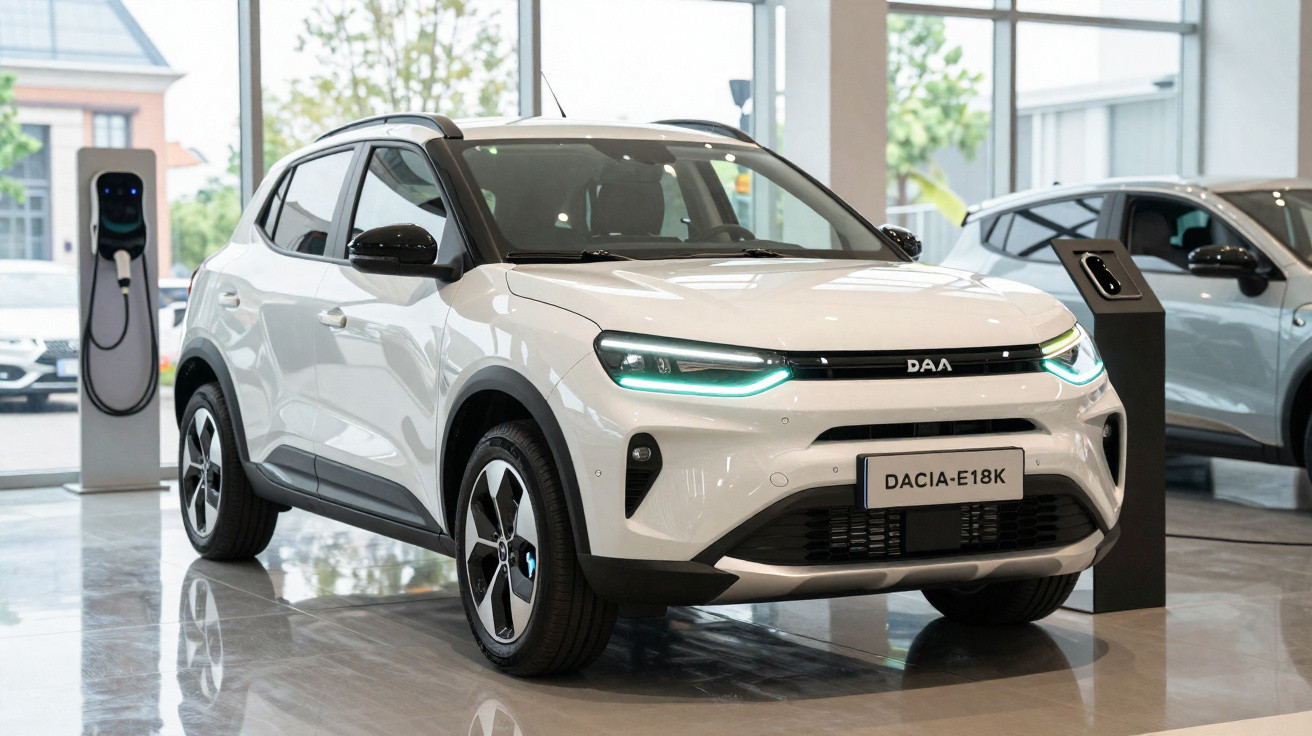
Dacia, long dismissed as a “budget brand”, is refining its approach for the electric era. The Renault Group manufacturer intends to launch four new electric cars, with one clear objective: making electric mobility accessible to people whose main consideration has so far been price. At the heart of the strategy is a new family of small electric cars, starting at well below €18,000.
Dacia goes electric without abandoning its price-focused DNA
Until now, Dacia’s electric offering has effectively centred on a single vehicle: the Spring city car. It is inexpensive, uncomplicated to drive and designed chiefly to provide the cheapest possible electric transport from A to B. The brand is now taking the next step, increasing its electric range from one to four models by 2030.
The group is aiming for around two thirds of all Dacia models sold to have an electric powertrain by 2030.
This deliberately places the marque in the gap between costly premium EVs and basic combustion-engined cars. While many rivals are pushing prices upwards, Dacia wants to uphold its established promise of delivering as much car as possible for as little money as possible.
New Dacia small electric car family targeting under €18,000
The first car in the next generation of EVs will use the next-generation Renault Twingo as its technical basis. In appearance and overall concept, however, it is expected to be unmistakably Dacia: tough, straightforward and free from costly fripperies.
The crucial issue is price. Dacia has announced an entry point below €18,000. For a proper small electric car built in Europe, that represents a direct challenge to Volkswagen, Stellantis and their rivals.
European production should make government incentives available, potentially bringing the actual purchase price down towards €15,000 in some countries.
For many buyers on tight budgets, this could be the first opportunity to buy a new electric car without taking on debt for years or opting for a spartan Chinese import.
Why Dacia is moving production to Europe
The existing Spring EV is shipped to Europe from Chinese factories. Although this keeps manufacturing costs down, it creates a tangible drawback in certain markets: it does not qualify for national purchase incentives because it is not built in Europe.
Dacia is taking a different route with the new Twingo-derived model. Production is planned at European plants, offering several benefits:
- better prospects of qualifying for national environmental incentives
- shorter transport routes and reduced logistics costs
- less political exposure in the debate over cheap Chinese imports
- a marketing advantage among buyers who value European manufacturing
This gives the manufacturer some room to manoeuvre: it can set a tightly calculated list price while incentives further reduce the effective final price.
Four electric models by 2030: what is already emerging
Dacia has not yet revealed every detail, but the broad direction is becoming clear. What is certain is that four fully electric cars are due to be in the line-up by 2030. At present, the Spring is the only officially available model, while the Twingo-based car will mark the beginning of the next wave.
The volume models that follow could prove particularly interesting. Attention is focused above all on the Sandero range, which is a genuine sales success in many countries.
Electric Sandero considered highly likely
An all-electric Sandero is regarded internally as very likely. It would serve the conventional compact-car segment, providing enough room for a family, shopping and holidays while remaining sufficiently compact for urban use.
According to industry sources, the engineers are planning to use LFP batteries, or lithium iron phosphate batteries, to control costs. These batteries store slightly less energy per kilogram, but they are considerably cheaper and are regarded as robust.
That approach is particularly well suited to Dacia. Setting range records is not the priority; what matters is everyday usability, a sensible operating range and a price that does not place too much strain on household budgets.
Duster remains with petrol and hybrid power for now
The Duster, the brand’s successful SUV, raises another interesting question. Dacia is currently keeping its plans under wraps here, and an all-electric Duster is not officially planned. Versions with hybrid or mild-hybrid technology are more likely.
There are sound reasons for this. A large SUV needs substantially more battery capacity to offer a practical everyday range, and those battery costs would undermine the brand’s value promise. Dacia is therefore initially concentrating its fully electric models on smaller, lighter vehicles.
How Dacia is carrying its budget strategy into the electric age
At its core, Dacia is staying true to itself. Its development teams use existing Renault Group technology, remove expensive extras and keep the choice of variants limited. This cuts supplier costs, inventory requirements and manufacturing complexity.
Dacia wants to deliver “the most competitive solution in terms of price, costs and customer benefit” – in other words, no luxury, but dependable technology at an entry-level price.
In practice, this means uncomplicated interiors, durable plastics and modest infotainment systems. Rather than fitting huge screens into designer dashboards, Dacia is more likely to rely on smartphone integration and functional controls.
This also reduces the likelihood of expensive repairs. For many owners who keep their cars for a long time and are not overly concerned by minor scratches, that is precisely the appeal.
What the Dacia plan means for German-speaking customers
For the German-speaking market, the new electric-car roadmap creates genuine lower-priced alternatives. Until now, many small electric cars have started well above €20,000 even after incentives were deducted.
With a list price below €18,000 and possible incentives, the new Dacia EVs would enter a price bracket currently dominated by petrol and LPG models. Commuters, city residents and young families in particular may take notice.
| Model / plan | Status | Planned starting price | Production location | Key point |
|---|---|---|---|---|
| Twingo-based small electric car | announced | under €18,000 | Europe | expected to qualify for incentives |
| Dacia Spring | already on sale | currently variable | China | not eligible for incentives in some countries |
| Electric Sandero | in planning | not yet confirmed | not yet confirmed | LFP battery highly likely |
Opportunities and risks of budget electric cars
Competitively priced EVs do not offer advantages alone. Buyers should bear a few points in mind. Battery capacity is likely to be fairly modest in order to save money, so anyone regularly covering long motorway journeys will need to recharge more often and accept lower sustained speeds.
Affordable models also tend to offer sensible rather than record-breaking charging rates. That is sufficient for day-to-day use with charging at home or at work. Those who frequently depend on rapid chargers should examine the technical specifications carefully.
On the other hand, customers benefit from simpler technology. Less equipment also means fewer components that can fail. It is a practical approach that suits the brand’s customer base: people who see a car more as a useful everyday item than a status symbol.
What terms such as “bonus” and “LFP battery” mean
In many European countries, governments support electric-car purchases through grants or tax incentives. Eligibility is often tied to conditions such as a maximum list price or production in Europe. This is exactly where Dacia’s move in manufacturing comes into play: a low list price combined with such incentive schemes can significantly reduce the effective purchase cost.
The LFP batteries being discussed for future Dacia EVs use a different chemical composition from many current lithium-ion batteries. They are less sensitive to high temperatures, are considered highly durable and do not require expensive raw materials such as cobalt or nickel. This lowers the price, even if range per kilowatt-hour is slightly reduced.
For typical Dacia customers, that combination could be particularly appealing: practical everyday range, robust engineering and straightforward operation, alongside a price tag that signals good sense rather than premium status.


Comments
No comments yet. Be the first to comment!
Leave a Comment