
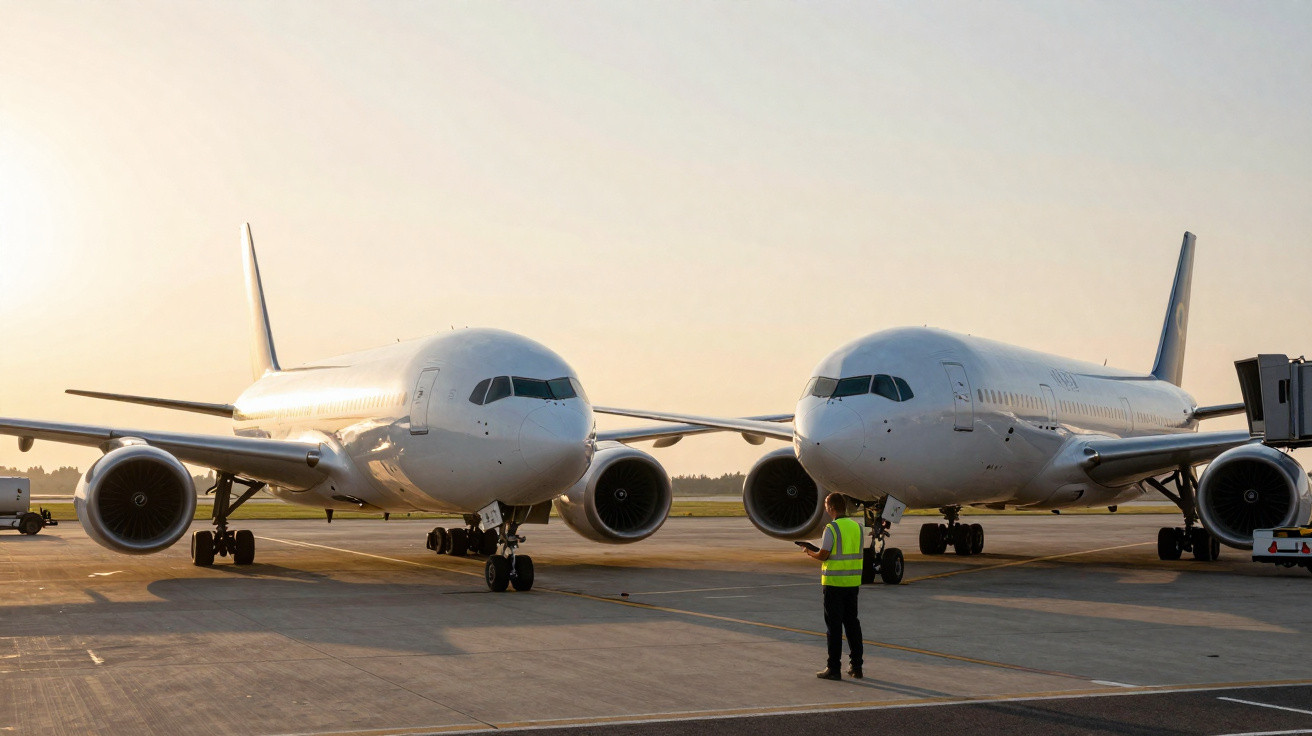
The Boeing 777-9, the newest development of the US manufacturer’s flagship wide-body aircraft, is moving nearer to entering service as the Airbus A350-1000 strengthens its foothold with leading airlines. The pair are poised for one of commercial aviation’s most evenly matched contests in decades, with billions of dollars of orders and fuel savings in play.
Two giants for ultra-long-haul operations
The Airbus A350-1000 and Boeing 777-9 occupy the upper tier of the twin-engine aircraft market. Each has been created for long-haul services that require airlines to combine substantial capacity with high efficiency.
The A350-1000 is already operated by airlines including Qatar Airways, Cathay Pacific and British Airways. In a three-class configuration, it generally accommodates about 350 to 410 passengers. Its largely carbon-fibre-reinforced plastic construction cuts weight and improves fuel economy.
Boeing’s response is the 777-9. Building on the established 777 family, it features an extended composite wing with folding wingtips, enabling it to fit standard airport gates despite its considerable wingspan. Depending on cabin configuration, airlines are planning layouts for approximately 380 to 425 passengers.
The 777-9 and A350-1000 sit in the same niche: high-capacity, efficient, twin-engine jets meant to replace aging 747s and A380s.
Both aircraft reflect a broader industry shift, with airlines replacing huge four-engine aircraft with more adaptable, fuel-efficient twin-engine jets that can be operated profitably across a wider range of routes.
Boeing’s 777-9: a new long-haul flagship under pressure
The path to service has been difficult for the 777-9. Certification has faced repeated delays amid scrutiny of Boeing’s engineering and quality processes. Every postponement has deferred deliveries and required certain airline customers to revise their fleet plans.
Even so, its technical potential continues to attract attention. The 777-9 is powered by General Electric GE9X engines, which rank among the largest and most advanced turbofans ever built for commercial aviation. Together with the redesigned wing and aerodynamic improvements, they are intended to reduce fuel burn per seat against earlier 777 generations.
Its folding wingtips are an especially distinctive feature. In flight, they allow the aircraft to gain the efficiency benefits of a long wing, while on the ground they retain compatibility with existing airport taxiways and gates.
The 777-9’s blend of range, capacity and side-by-side seating makes it a natural successor for carriers wanting to retire older 777-300ERs.
A number of Gulf airlines, among them Emirates and Qatar Airways, have placed major 777-9 orders, expecting the aircraft to form the backbone of their long-range networks during the 2030s.
Airbus A350-1000: the lighter, quieter competitor
As Boeing works towards bringing the 777-9 into commercial service, Airbus benefits from having an aircraft already flying. The A350-1000 continues its family’s focus on lower weight and passenger comfort. Its carbon-fibre fuselage and wings, combined with advanced Rolls-Royce Trent XWB-97 engines, are engineered to maximise efficiency on long-range missions.
Passengers frequently point to the A350’s comparatively quiet cabin, increased humidity and larger windows. For airlines, its appeal lies in its extensive range and its ability to operate both high-density routes and secondary city-pair services.
Certain operators market the A350-1000 as a premium aircraft, using fewer seats while increasing business class and premium economy capacity. Others choose denser seating to reduce unit costs on heavily travelled routes.
Key technical contrasts
| Feature | Airbus A350-1000 | Boeing 777-9 |
|---|---|---|
| Typical three-class seats | Approx. 350–410 | Approx. 380–425 |
| Main structure | Composite fuselage and wings | Aluminium-lithium fuselage, composite wing |
| Engines | Rolls-Royce Trent XWB-97 | GE Aviation GE9X |
| Notable feature | Very long range, low cabin noise | Folding wingtips, 10-abreast economy focus |
| Main competitors | 777-9, 777-8 (future), older 777-300ER | A350-1000, older 747 and A380 segments |
Airline strategies: capacity versus flexibility
For airlines, selecting between these aircraft is seldom a straightforward choice between one or the other. The decision usually depends on a combination of route networks, airport limitations, fleet heritage and financing conditions.
Airlines operating highly concentrated hubs, including those in the Gulf and parts of Asia, value the additional seating capacity available with the 777-9. Keeping those seats occupied helps contain per-passenger costs, particularly where demand remains dependable throughout the year.
Conversely, operators concentrating on point-to-point long-haul flights, such as some European and Asian airlines, commonly place greater importance on flexibility. The A350-1000, alongside the smaller A350-900 from the same family, can more readily be moved between routes when passenger demand varies.
For most airlines, the choice is less about national loyalty and more about which aircraft matches their specific network and risk appetite.
What passengers may notice on board
For travellers, distinctions between the two types may appear modest, but can still matter on a lengthy overnight journey. Individual airlines largely determine cabin design, although several patterns are becoming clear.
- Many 777-9 customers are likely to choose a 10-abreast economy cabin, which may feel comparatively restrictive around the shoulders.
- The A350-1000 generally uses a nine-abreast arrangement, providing standard economy passengers with a slightly wider seat.
- Both aircraft can be equipped with premium business class suites featuring doors, direct aisle access and fully flat beds.
- The A350’s higher cabin humidity and lower pressurisation altitude may leave some passengers feeling less affected by jet lag.
Onboard features such as mood lighting and quieter engines also influence the passenger experience. These less tangible details are increasingly part of how airlines distinguish their brands, even when they operate broadly comparable aircraft.
Environmental stakes in the Airbus–Boeing rivalry
The long-haul market faces pressure to reduce emissions, and both aircraft are promoted as more efficient alternatives to the types they replace. Replacing older four-engine jets with an A350-1000 or 777-9 can deliver significant fuel savings for every passenger carried.
The manufacturers also stress sustainable aviation fuel (SAF) compatibility. Both aircraft are certified to use SAF blends, while planned future developments seek to support higher blend ratios as supplies of the fuel expand.
The true emissions impact of these new jets depends not only on technology but on airline behaviour: how full they fly and which routes they serve.
A wider argument remains over whether efficiency improvements encourage airlines to introduce additional flights and seats, thereby partially cancelling out environmental gains. This issue applies to every new generation of long-haul aircraft, including these two competitors.
How the duel could reshape global routes
Over the coming decade, the entry of the 777-9 and the continuing expansion of the A350-1000 fleet are likely to alter long-haul networks. Airlines may restart exceptionally long services that were uneconomic with previous aircraft, or add frequencies on profitable city pairs.
For instance, an airline might operate the A350-1000 on a lower-demand ultra-long-haul route where range and fuel efficiency are most important, while assigning the 777-9 to high-demand trunk services such as Europe–Asia or US–Middle East corridors.
Travellers could gain more non-stop connections between secondary cities, avoiding traditional hubs. Smaller long-haul aircraft have already begun this trend, while these larger twin-engine types apply the same approach to routes with greater demand.
Reading the technical jargon
Conversations about long-haul aircraft contain numerous terms that can seem unclear. Several are particularly helpful when comparing the A350-1000 with the 777-9:
- Range: the furthest distance a fully loaded aircraft can travel without refuelling. Greater range makes non-stop operations possible on more city pairs.
- Fuel burn per seat: the amount of fuel consumed for each passenger transported. Lower values usually indicate stronger economics and reduced emissions.
- Wide-body: an aircraft with two cabin aisles. This configuration is suited to long journeys, higher passenger numbers and larger cargo holds.
- Composite materials: advanced carbon-fibre structures that weigh less than conventional aluminium and therefore help lower fuel use.
Knowing these expressions makes airline announcements easier to interpret and explains why carriers become enthusiastic about new aircraft years before passengers set foot on them.
Risks, opportunities and what comes next
Both manufacturers continue to face challenges. Boeing must secure certification for the 777-9 and reassure regulators and the public that it has fully incorporated the lessons of earlier crises. Any further delay might lead some customers to order more A350s instead.
Airbus, meanwhile, must balance robust demand for its A320neo and A350 programmes with supply-chain pressures. Engine manufacturers also face strain, including constrained maintenance capacity and demanding reliability expectations for long-haul operations.
For airlines, an order for either type is a long-term commitment. These aircraft commonly remain in service for 20 years or longer. Choices made now will influence fares, route maps and passenger comfort well into the 2040s.
Should fuel prices increase or environmental rules become stricter, the comparative strengths of these two aircraft may change once more. Airlines that have selected a more adaptable mix of A350-1000s, 777-9s and smaller long-haul aircraft may be better able to respond, moving capacity between routes and retiring less efficient models sooner.
The next stage of this Airbus–Boeing competition will develop gradually, flight by flight, as the 777-9 joins the A350-1000 on some of the busiest and longest routes worldwide. For passengers, its impact will be less evident in specification-sheet figures than in ticket prices and seat comfort midway through a 14-hour flight.






Comments
No comments yet. Be the first to comment!
Leave a Comment