
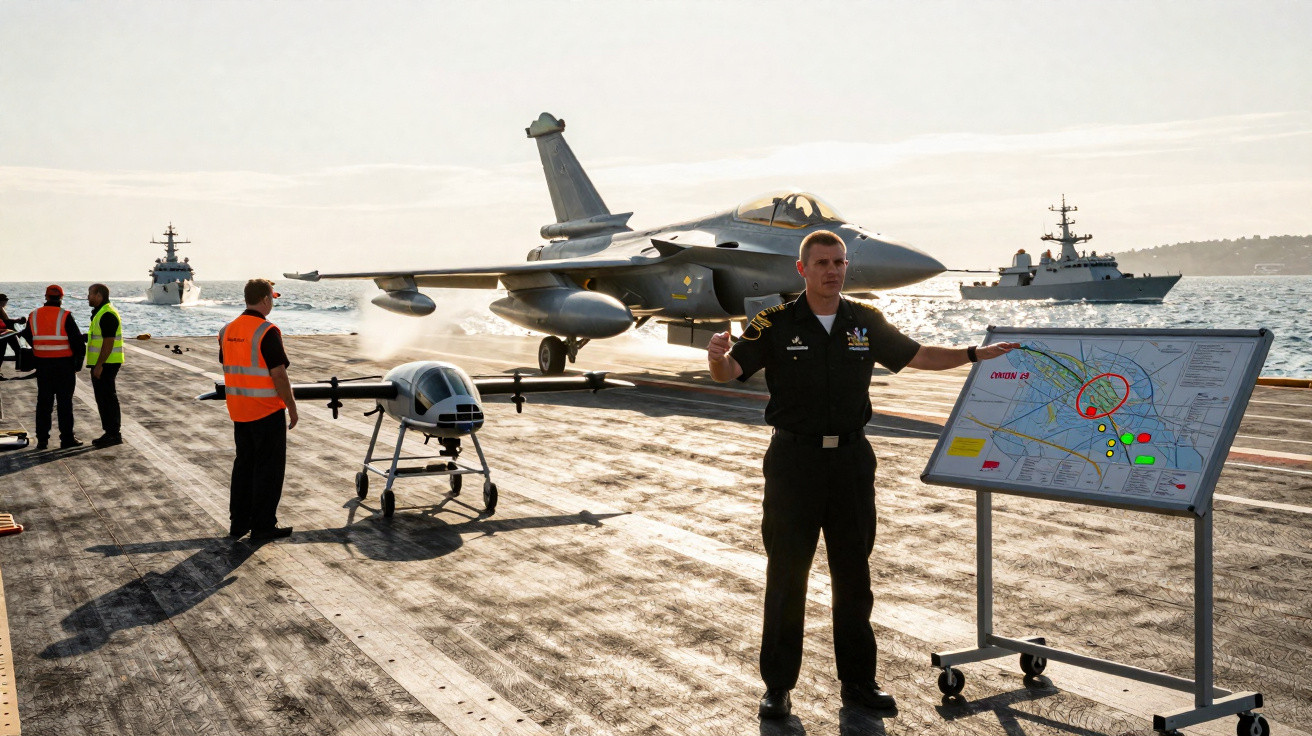
The French aircraft carrier Charles de Gaulle has moved beyond the relative comfort of routine patrols to become the focal point of the most ambitious French-led war game in recent years. This demanding rehearsal is not intended to produce impressive photographs, but to assess whether forces can sustain operations for weeks under pressure.
From the Mediterranean to the Atlantic: a strategically significant deployment
Moving a carrier strike group between seas is never merely a matter of navigation. It combines a military test with a political signal. By deploying Charles de Gaulle from Toulon to the Atlantic for the ORION 26 exercise, France is indicating where it believes future pressure may intensify: on the maritime routes carrying reinforcements, fuel and trade into Europe.
In this scenario, the Atlantic is far more than a setting. It is treated as a contested theatre in which allied convoys require protection, submarines must be pursued and air cover has to be sustained amid continual threats. The carrier is not operating by itself; it sits at the heart of a close formation of escorts, supply vessels and aircraft required to function as one integrated force.
France wants ORION 26 to answer a simple question: can its forces not just arrive first, but keep fighting for weeks without falling apart?
The French Navy confirmed the Atlantic deployment in early February 2026, shortly after the group departed Toulon. The timing is significant. ORION 26 will run for several months rather than a single extended weekend, with the purpose of examining endurance, logistics and command decisions over a prolonged period. In modern warfare, victory seldom belongs to the side that shoots first; it belongs to the side able to repair, resupply and regenerate combat power after the initial shocks.
ORION 26: high-intensity warfare grounded in realism
French officials call ORION 26 a “high-intensity” exercise, and in this case the term is intended to mean more than promotion. The drill links every phase of a contemporary campaign, including planning, deployment, escalation and large-scale activity on land, at sea and in the air.
Around two dozen countries are expected to participate, with roughly 10,000 personnel taking part at different stages. Such a multinational force brings genuine friction: differing languages, processes, political restrictions and technical systems that do not always fit together smoothly.
Instead of presenting a tidy, pre-planned scenario, organisers intend to introduce delays, unclear intelligence and unforeseen requests from allies. The challenge is whether the command chain can retain control when information is incomplete and demands accumulate more quickly than solutions.
- Can allied headquarters establish a shared understanding of the battle?
- Can logistics sustain a high operational tempo without exhausting stocks too rapidly?
- Can commanders absorb losses and revise plans within hours rather than days?
ORION 26 is less about flashy manoeuvres and more about “plumbing”: fuel lines, spare parts, data links and decision cycles that either hold or snap under pressure.
The carrier group as a catalyst rather than a trophy ship
Throughout ORION 26, Charles de Gaulle will serve as the central point in a compact yet dense network of capabilities. About 20 Rafale Marine fighter jets are expected to fly from its deck on air-defence, strike and reconnaissance missions. Air-defence frigates, destroyers and at least one fleet tanker will escort the carrier, protecting it while maintaining its supplies.
Together, these assets form a floating airbase intended to maintain a continuous sortie rate. This demands unceasing flight-deck activity, maintenance work below deck and planners managing missions in brief cycles. Each take-off, landing and refuelling operation must be synchronised with escort movements and with allied aircraft using the same airspace.
Genuine multi-domain operations: where air, sea, cyber and space converge
ORION 26 is described as “multi-domain” not simply because multiple services are involved, but because they are expected to operate as a single system. Air, land and maritime operations are interwoven with cyber activity and intelligence gathered from space.
A cyber incident that slows a planning tool may postpone a strike. Interference with satellite communications could isolate a carrier group from higher command at a critical moment. A weakness in radar or space surveillance might allow an enemy submarine or bomber to approach more closely.
The ORION 26 scenario reflects present European concerns: grey-zone pressure against a neighbour, political coercion and then a progression into open conflict. French and allied staffs must handle public messaging, escalation and intense combat simultaneously. That combination is precisely what can erode coalitions in real circumstances.
The real opponent in ORION 26 is not a fictional enemy state; it is decision fatigue, technical friction and the risk of allies drifting out of sync.
Logistics as the ultimate test
Lengthy exercises expose false assumptions. Jet and ship fuel, missiles, spare parts, food, laundry and medical support can all become factors limiting operational pace. A carrier group needs more than enough supplies for one powerful strike: it requires reliable, continuing flows that allow it to maintain pressure for weeks.
The fleet tanker is especially important in this respect. Replenishment at sea enables the group to remain on station rather than returning repeatedly to port, where its movements would become more predictable and easier to disrupt. The operation’s entire tempo depends on these refuelling periods, often conducted at night and in difficult weather.
Human endurance creates another vulnerable element. High-tempo carrier life is noisy, stressful and tiring. Flight-deck personnel operate near powerful engines, heavy equipment and live weapons. A brief lapse in attention can lead to fatal accidents. ORION 26 is intended to establish how far crews can be stretched before minor errors, small failures and maintenance shortcuts start to build up.
Charles de Gaulle: a unique asset under severe scrutiny
Charles de Gaulle remains a distinctive European capability: a nuclear-powered aircraft carrier fitted with catapults and arresting gear, designed to launch heavy fighter aircraft carrying full weapons loads. Its maximum speed of roughly 27 knots is not intended to outrun other vessels. Instead, it allows the ship to position itself into the wind quickly enough to recover and launch aircraft when required.
The vessel’s published specifications are striking on paper. In operational terms, however, they represent the boundaries within which its crew must work. During ORION 26, its true worth will be judged by what the carrier group can provide every day: air cover for land forces, security for shipping routes and credible strike choices for political leaders.
A carrier is less a symbol than a promise: that a country can bring its own runway, support it at sea and plug it into allied plans without becoming a burden.
France wants its partners to regard that promise as dependable. The exercise will also inform discussions about the future French carrier programme, PANG (porte-avions de nouvelle génération). Any vulnerabilities identified now could influence design decisions for decades, including deck arrangements, energy systems and crew numbers.
What France is seeking to demonstrate
ORION 26 places France in a leadership position within a wide coalition. Paris is doing more than supplying forces: it is seeking to demonstrate that it can coordinate, sustain and adapt a complex operation under pressure, from the North Atlantic to continental Europe.
Its political message has two strands. France aims to show potential adversaries that it can fight intensely and for a prolonged period alongside allies, rather than merely making statements. It also wants partners to see that French capabilities, particularly the carrier group, provide meaningful strength to collective defence planning.
| Aspect | What ORION 26 checks |
|---|---|
| Leadership | Can France run a complex coalition scenario without losing coherence? |
| Endurance | Do forces maintain tempo past the first week of heavy activity? |
| Interoperability | Do ships, aircraft and headquarters from different nations actually work together? |
| Logistics | Do fuel, munitions and spare parts arrive where and when they are needed? |
| Political control | Can civilian leaders steer escalation while operations are underway? |
Why these exercises matter beyond France
For anyone trying to understand another military-exercise acronym, several definitions are useful. A “carrier strike group” comprises the carrier, its escorts and its support vessels. “High intensity” describes operations in which losses, ammunition expenditure and operational tempo resemble what planners anticipate in a real war rather than a peacekeeping deployment.
In these circumstances, every additional day of sustained activity produces a cumulative effect. Systems become overstretched, literally as well as figuratively. Crews tire, supplies decline and commanders face increasingly difficult choices: which unit receives the last allocation of precision weapons, which ship takes priority for repairs and which allied request is dealt with first.
Exercises such as ORION 26 offer a comparatively safe environment in which to confront those unpleasant decisions before events impose them. They also reveal where national interests could conflict. An ally may withhold an asset for domestic reasons, or request protection that others regard as a distraction. Rehearsing such frictions early can make them easier to manage later and with less resentment.
There are also drawbacks. A long, demanding exercise is costly, consuming flying hours, fuel and spare parts that may be required elsewhere. It may additionally disclose weaknesses to close observers, including coverage gaps, slow decision-making and shortcomings in particular units.
France is wagering that its gains will exceed those costs. A carrier tested to its limits is easier to rely on during a crisis. A command structure that has already faltered in training and then adjusted is less likely to freeze or fragment when the consequences are real. With Charles de Gaulle at its core, ORION 26 is intended to test precisely these limits in full view.





Comments
No comments yet. Be the first to comment!
Leave a Comment